Saturday, January 15, 2022

Jennifer Bae plans 8th Subcircuit run

Jennifer Bae has announced plans to seek an 8th Subcircuit vacancy. That's a link to her campaign website in the preceding sentence; a link has been added to the site Sidebar as well.

Bae's campaign bio notes that she currently serves as "Director of Employee Discipline at the Cook County Sheriff’s Office," managing "a department charged with disciplining over 6,000 sworn officers and civil employees, [conducting] hearings and trainings, and [executing] all grievance processes, including arbitration against unions representing employees."

Licensed as an attorney in Illinois since 1997, according to ARDC, Bae has worked as a criminal defense attorney in private practice as well as, according to her campaign bio, a "staff attorney" for the City of Chicago and an Assistant Cook County State's Attorney. She was the first president of the Women’s Criminal Defense Bar Association. In 2010, Bae was appointed to the First Judicial District Committee on Character & Fitness by the Illinois Supreme Court, serving first as a member, then Vice-Chairman, and ultimately as Chairman.

Bae's campaign bio also notes that she "volunteers with many local organizations such as the Korean American Voter Organizing Initiative & Community Empowerment (KAVOICE), the Korean American Bar Association’s Legal Clinics, and Korean American Community Services (KACS)."

Bae previously filed for a 4th Subcircuit vacancy in 2008 and for 12th Subcircuit vacancies in both the 2012 and 2016 election cycles. She has only appeared once on the ballot, in the 2016 primary.

Suburban drug treatment courts get federal grant

A press release issued by the Office of the Chief Judge earlier this week:

A new federal grant will boost three existing suburban court programs that help drug users.

The Bureau of Justice Assistance has awarded $550,000 over four years to the Drug Treatment Courts in the Fourth Municipal District (Maywood), the Fifth Municipal District (Bridgeview) and Sixth Municipal District (Markham). The grant will pay for clinical case management for these three south suburban courts.

Drug Treatment Courts are part of the Circuit Court of Cook County’s network of “Problem-Solving Courts,” which also includes Veterans’ Treatment Courts and Mental Health Treatment Courts. These courts are in the Leighton Criminal Court Building as well as in all the suburban municipal district courts.

Also known as specialty or therapeutic courts, these courts seek to help high-risk/high-need individuals suffering from an underlying mental health, social or substance use disorder from becoming repeat offenders. Problem-solving courts achieve this goal by providing counseling, treatment, and intensive supervision.

Drug court participants typically are in the program for two years. Participants, who are charged with non-violent crimes, participate in the programs voluntarily.

Problem-Solving Courts Director Kelly Gallivan-Ilarraza noted that the Circuit Court of Cook County budget does not cover everything for problem-solving courts, so various grants are essential to their operation.

“We are extremely grateful for the Bureau of Justice Assistance grant,” Gallivan-Ilarraza said. “It will enable us to continue to help people get out of the cycle of substance use and criminal behavior and allow them to change their lives.”

“For nonviolent defendants who are driven by drug addiction, the drug treatment courts exercise compassion in the pursuit of justice. Treatment, not punishment, is the best option to pursue,” Chief Judge Timothy C. Evans said.

“Often, these individuals would rather receive a short-term jail sentence so that they can start using again upon release,” Judge Evans said. “Instead, we provide a long-term effective treatment plan that can help end their suffering and the suffering of their families and friends. This grant will help defendants find a future of sobriety.”

The suburban courts work with case managers from TASC Inc., who provide clinical assessments of all defendants entering the drug courts. The case managers determine the level of treatment needed and whether it will require out-patient or in-patient services.

The case managers are also trained to help defendants enroll in Medicaid and re-enroll as required every year. Medicaid coverage can pay for the drug court defendant’s treatment.

A total of 41 participants graduated from drug court programs last year. There are a total of 268 current participants.

The Bureau of Justice Assistance is a component of the Office of Justice Programs, a federal agency that provides federal leadership, grants, training, technical assistance and other resources to improve the nation’s capacity to prevent and reduce crime, assist victims and enhance the rule of law by strengthening the criminal and juvenile justice systems.

40th Ward Dems announce endorsements in Cook County judicial races... so far

The 40th Ward Democratic Organization has put up its endorsements on its website.

Here is a link to the complete list of the group's endorsements in all races. If you peruse the list carefully you will count endorsements in only seven of the nine countywide judicial races. Ald. Howard Brookins, Jr. is conspicuous by his absence, as is Thomas E. Nowinski. This is a list of the 40th Ward's judicial endorsements:

Countywide Vacancies
  • Mike Weaver,
  • Judge Rena Van Tine,
  • Judge Diana Lopez,
  • Judge Araceli De La Cruz,
  • Judge Ruth Gudino,
  • Yolanda Sayre, and
  • Tom Donnelly

6th Subcircuit vacancies (2)
  • Lori Roper and
  • To be determined

8th Subcircuit vacancies (2)
  • Brad Trowbridge and
  • To be determined

9th Subcircuit vacancy
  • Sanjay Tailor

A second 9th Subcircuit vacancy has opened since this list was posted, of course, and the "to be determined" language in connection with the second 6th and 8th vacancies suggests that the group will update this list at some point. And, of course, there may be additional endorsements in countywide races. But this is what has been made public so far.

Brad Trowbridge to seek 8th Subcircuit vacancy

Bradley R. Trowbridge has announced plans to seek the Gordon vacancy in the 8th Judicial Subcircuit. That's a link to his campaign website in the preceding sentence; a link has also been added to the Sidebar on this site.

This is Trowbridge's third attempt to obtain an 8th Subcircuit vacancy; he ran before in 2012 and 2020. Accoring to his new campaign website, Trowbridge has lined up some significant support for this latest venture. Here is the list of endorsements he includes on his website:

  • Tom Tunney, 44th Ward Alderperson/Committeeperson,

  • Harry Osterman, 48th Ward Alderperson/Committeeperson,

  • Pat Dowell, 3rd Ward Alderperson/Committeeperson,

  • Lucy Moog, 43rd Ward Democratic Committeeperson

  • Paul Rosenfeld, 47th Democratic Committeeperson,

  • Sean Tenner, 46th Ward Committeeperson,

  • Maggie O'Keefe, 40th Ward Committeeperson, and

  • John Daley, Cook County Commissioner/ 11th Ward Committeeperson.

Trowbridge operates the Law Offices of Bradley R. Trowbridge on North Sheffield Ave. He has been licensed to practice law in Illinois since 2000, according to ARDC. His website also notes that he has an M.A. in Human Development Counseling and 10 years' experience in counseling "vulnerable and at-risk populations."

A former president of the Chicago Metropolitan Battered Women's Network, according to his campaign website, Trowbridge has also taught law courses as an adjunct (at what used to be known as John Marshall Law School) and published on family law issues. His campaign website also notes volunteer work with Equality Illinois, the Illinois Safer Schools Alliance, First Defense Legal AID, PAWS, and The Coalition to Stop Gun Violence.

Friday, January 14, 2022

Deidre Baumann campaign website launched

A new campaign website has been established in support of the latest bid by Deidre Baumann for a seat on the Cook County Circuit Court. That's a link to the site in the preceding sentence; a link has also been added to the Sidebar on this site.

Licensed as an attorney since 1992, according to ARDC, Baumann practices with the firm of Baumann & Shuldiner. She began her legal career, according to her campaign bio, with as an Assistant Public Defender. After leaving that office, Baumann "began working at a small boutique firm specializing in First Amendment law." She set up her own practice in 1996. Between 2009 and 2011 Baumann represented many of the plaintiffs in the Burr Oak Cemetery scandal.

A countywide judicial candidate in 2016 and 2020, Baumann's campaign bio stresses her extensive bar association activity. According to her updated campaign bio, she currently chairs the General Practice and Small Firm Section Council of the Illinois State Bar Association, serves as secretary for the Federal Civil Practice Committee of the Illinois State Bar, and serves on the Board of Directors for the Lesbian and Gay Bar Association of Chicago and on the Board of the Decalogue Foundation. Baumann is a past-president of both the Decalogue Society of Lawyers and the North Suburban Bar Association. Also, according to her campaign bio, Baumann has served on the Executive Boards for the Women’s Bar Association of Illinois and the Chicago Bar Association, Alliance for Women. Also, Baumann has chaired the Suburban Bar Coalition for many years, according to her campaign bio.

Baumann attended the University of Illinois, from which she received both her undergraduate and law degrees. A Lane Tech graduate, Baumann is a long-time officer and board member of the Lane Tech Alumni Association, according to her campaign bio. Since 2004, the bio notes, Baumann has "served as President of the Chicago/Cook County 4-H Foundation, an organization dedicated to providing scholarships for deserving 4-H youth who are attending a college or university."

Thursday, January 13, 2022

Who's running for what....

This is the first day petitions can circulate for the June primary (and the weather is better than we'd dared hope -- especially after the ice storm last weekend). Stick around, though, it's going to get much, much worse.

Anyway, with petitions out, there's no longer any mystery surrounding the vacancy sought by each endorsed Cook County candidate.

Here are the vacancies, paired with the name of that person endorsed by the Cook County Democratic Party for each vacancy:

  • Brennan vacancy: Howard B. Brookins, Jr.

  • Canon vacancy: Diana López

  • Hyman vacancy: Thomas E. Nowinski

  • Ingram vacancy: Yolanda Harris Sayre

  • Leeming vacancy: Rena Marie Van Tine

  • Lynch vacancy: Michael Weaver

  • McGury vacancy: Ruth Isabel Gudino

  • O'Brien vacancy: Araceli Reyes De La Cruz

  • Sullivan vacancy: Thomas More Donnelly

These folks are linked together now, on a single petition.

Others vying for these positions are not limited in terms of the vacancies for which they can circulate. John Smith can circulate separate petitions for each and every one of these countywide vacancies, although he might get beaten up if he tries (you want me to sign how many sheets of paper?), but, even if he emerges unscathed, with nine sets of ready-to-file petitions, he can only actually file one.

Not like the old days, when John Smith could file for every vacancy and then had a little time, after sizing up the competition in each race, to withdraw from all but one. That's no longer permitted.

Even so, there's a certain amount of gamesmanship that is likely to be involved in the circulation of petitions. We'll watch together.

Campaign website found for Thomas E. Nowinski

Found on the Internet: This campaign website for countywide candidate Thomas E. Nowinski. That is a link to the campaign website in the preceding sentence; a link has also been added to the Sidebar on this site.

Nowinski was one of the nine persons slated by the Cook County Democratic Party this past December for what were then eight countywide openings (a ninth spot has since opened up).

(You might think that campaign websites would spring up overnight for those receiving the Party's nod -- but, at least this year, based on my search this morning, that does not seem to be the case. Websites have not been the exclusive means for campaigns to get their message out for a number of cycles now. Nowinski, for example, also has a campaign Facebook page. Perhaps campaign websites are becoming "old school"? I fully expect that some judicial candidate will announce a TikTok presence during this campaign cycle. But I digress.)

Nowinski currently serves as Chief of Staff to Iris Martinez, the Clerk of the Circuit Court. Licensed as an attorney in Illinois since 2004, accourding to ARDC, Nowinski's campaign bio states that he began his legal career as a Cook County Assistant State’s Attorney "where he tried hundreds of criminal and civil bench trials and jury trials in state and federal court." While assigned to the SAO's Civil Actions Bureau, Nowinski became the lead attorney representing Cook County offices in the Shakman litigation. He eventually became a Deputy Supervisor, overseeing a 14-attorney litigation unit.

His campaign bio also notes that Nowinski served as Deputy Director of Labor Relations for Cook County.

Nowinski was the Cook County Democratic Party's fifth alternate in the 2018 election cycle. He was the first alternate in 2020, but no new vacancy opened in time.

Free seminar next Thursday on how judicial candidates are evaluated

This seminar will be put on by the Chicago Bar Association next Thursday, January 20, from 4:00 to 5:00 p.m., and, yes, it is an opportunity for the CBA to identify and attract more people to serve on its Judicial Evaluation Committee. But it is also an opportunity for you, Dear Reader, to explore whether JEC service would be something you may want to do. For the good of your profession. Or to improve the quality of the judiciary. Or maybe to further your own judicial ambitions (a great many sitting judges served on JECs at some point along the way). Maybe even for all of these reasons.

Did I mention that this seminar is free?

You may not wish to serve on the CBA JEC. But every Alliance bar group has its own JEC, too. This seminar would be of value to persons interested in, or currently serving on, any JEC.

To register, click here.

Wednesday, January 12, 2022

Moving on... and some housekeeping announcements

If you've been visiting regularly these past several days (and, if you have, thank you) you must have noticed that I think there's a significant flaw in the language of the newly-passed Judicial Circuits Districting Act of 2022, a flaw which jeopardizes the candidacies of those slated by the Cook County Democratic Party for the nine countywide judicial vacancies (as well as the candidacies of anyone else interested in those vacancies).

I Tweeted about it, and got this response from Maya Dukmasova of Injustice Watch:

(If you're interested, here's a link to Dukmasova's story on the Judicial Circuits Districting Act of 2022, published this morning.)

Anyway, bottom line is that "insiders" are telling Dukmasova that the flaws in the new law will be fixed, presumably to allow the Cook County Democratic Party's nine slated candidates and any lucky alternates for whom a vacancy might open between now and March 14 to run countywide as planned.

Nobody's told me anything like that, by the way, but I will subside. Stand down. Move on.

(You know, the Illinois Democratic Party has had access to some real top-drawer legal talent over the years. Maybe now they'll consult with some of them. But, again, I've moved on. If I get wind of any amendment, I'll advise.)

Those of you reading on your phones will not have noticed this, but I have put up the Circuit Court Candidate list in the Sidebar of my main page. The list is shorter than I thought it would be, but, even though some names will drop off this list soon, the list itself will get longer, and quickly now, too, inasmuch as tomorrow is the first day candidate petitions can circulate. Here is the list so far:

I may also put up a separate list of Appellate Court candidates -- but not today.

Whilst fiddling with the Sidebar on this site, I did try and insert a widget with my Twitter feed embedded. All the cool sites have this. But, at least so far, mine has only partially succeeded. If you click on the link you will get to my Twitter feed -- but, at least on my equipment, it's not showing up in the Sidebar itself. I'll continue to work on this.

And one more thing... while I've chided the Supreme Court (in a very civil manner, I hope) about the manner in which judicial vacancies are posted on the Circuit Courts Vacancies page of the Court's website, it appears to be very much up to date, mainly because it corresponds down the line with the 2022 Judicial Vacancies report on the Illinois State Board of Elections website (.pdf document).

Before the Supreme Court updated its website last year, the ISBE vacancies page (which only appeared shortly before any given election) was the only authoritative list of vacancies around. (Unless one was one of those "insiders," of course.) For those non-insiders looking for late-breaking vacancies, the ISBE page is a vital resource.

Tuesday, January 11, 2022

Viviana Martínez to make 14th Subcircuit bid; campaign website launched

Viviana Martínez, a Special Assistant for Legal Affairs in the Office of the Chief Administrative Officer of Cook County, is running for a 14th Subcircuit vacancy in the upcoming June primary. That's a link to her campaign website in the preceding sentence; a link will be added to the Sidebar on this site when that is put up.

Licensed as an attorney since 2007, according to ARDC, Martínez's campaign bio details a number of different assignments over the course of her career, albeit not in chronological order.

The campaign also has an active Facebook page. That page touts a number of endorsements. This one, from 22nd Ward Committeeman Mike Rodriguez, is the most recent:

There are two vacancies in the 14th Subcircuit in this election cycle. This endorsement, at least, suggests that Martínez and Iris Y. Chavira are running together, or at least cooperatively.

This campaign represents Martínez's first attempt to obtain judicial office.

Iris Y. Chavira seeks 14th Subcircuit vacancy, launches campaign website

Iris Y. Chavira, a Division Chief and Senior Administrative Law Judge for the City of Chicago Department of Administrative Hearings, has announced her intention to seek one of the two available 14th Subcircuit vacancies in the 2022 Democratic Primary. That's a link to her campaign website in the preceding sentence; a link will be added to the site Sidebar when that is set up.

Chavira's campaign biography notes that she worked as an Assistant Corporation Counsel for the City of Chicago Department of Law before joining the Department Administrative Hearings, rising to supervisor of the Federal Civil Rights Litigation Division.

Before that, according to the campaign bio, Chavira was an Associate General Counsel with the Office of Illinois Governor Pat Quinn, managing "a portfolio of nine state agencies, focusing on public safety and education," managing "the Governor’s executive clemency process, assisting with the granting of thousands of clemency petitions, including the Governor’s first-ever pardon based on innocence."

Chavira began her legal career as an Assistant State’s Attorney in the Cook County State’s Attorney’s Office, handling both civil and criminal matters.

According to her campaign bio, Chavira serves on the Board of Advisors and Southwest Regional Advisory Board for Catholic Charities of Illinois, is a member of DePaul University College of Law Alumni Engagement Board, a is member of the Women’s Leadership Committee for the Latino Leadership Council. She has been an active member of the Hispanic Lawyers Association of Illinois, having served on the Executive Board and Board of Directors for over five years.

Licensed to practice law in Illinois since 2008, according to ARDC, this is Chavira's first attempt to obtain judicial office.

HB3138 is now law -- what will that mean for Cook County judicial hopefuls?

Let's start with what we know for sure:

The new subcircuit maps are now law: On Friday, January 7, Gov. J.B. Pritzker signed HB3138 into law. It is now P.A. 102-0693.

Because the bill has been signed into law, we also know that §2f(d-5) has now been added to the Circuit Courts Act. This provision states:

All vacancies in circuit judgeships in the Circuit of Cook County, which are not allotted to Judicial Subcircuits 1 through 15 pursuant to subsection (c) of this Section, existing on or occurring on or after June 1, 2022 shall be allotted in numerical order to Judicial Subcircuits 16, 17, 18, 19 and 20 until there are 11 resident judges to be elected from each of the those subcircuits (for a total of 55).

Let's move into what we think we know:

There are currently nine countywide judicial vacancies in Cook County. There may already be more, but that's what we know about now for sure.

Under the law as it existed prior to the enactment of P.A. 102-0693, these vacancies would have been filled in the forthcoming November election. The persons elected in November would take office on December 5, 2022.

Under the law as it existed prior to the enactment of P.A. 102-0693, any countywide judicial vacancies created (whether by death, retirement, or removal from office) on or before March 14, 2022 would also have been filled in the forthcoming November election. Filing for vacancies occurring on or before February 20 would have taken place between March 7 and 14; filing for vacancies occurring between February 21 and March 14 would have taken place between March 28 and April 4.

The Cook County Democratic Party slated nine persons for countywide vacancies this past December; it also anointed 11 hopefuls as alternates, ready-made, pre-slated candidates for any countywide vacancies that open up between now and March 14.

But the thing about vacancies existing now is that they will still be vacancies on June 1, 2022.

So will these vacancies, the ones that exist now, and any that come into existence between now and March 14, be filled by the 2022 election... or will they be divided up among the new subcircuits for the 2024 election? (Under P.A. 102-0693 no one will be elected from any of the new Cook County Judicial Subcircuits until 2024.)

I don't think for one millisecond that the drafters of the Judicial Circuits Districting Act of 2022 meant or intended to dump the nine persons that the Cook County Democratic Party had slated or to deny any of the 11 named alternates from seeking any later-opening countywide vacancy that might have opened up.

However, given the plain language of §2f(d-5) of the Circuit Courts Act as amended by the Judicial Circuits Districting Act of 2022, it would appear that this is exactly what happened.

Obviously, I must be wrong about this? Right?

It doesn't bear directly on the question posed above, but there have apparently been alarm bells sounded in official quarters about the unintended consequences of the hastily drawn up Judicial Circuits Districting Act of 2022. I produce herewith a screenshot from a Tweet from MarkMaxwellTV (and a link to the original Tweet that you will probably want to click on) in support of this contention:

I retweeted the above this morning, along with a plea for a peek at the memo referred to in Maxwell's story.

I won't hold my breath waiting to see it. I understand my position here. I'm not a political insider (obviously). I'm not seen as a professional journalist. I'm not even an election lawyer. I'm just an observer -- and a nobody nobody sent.

I certainly claim no particular inside information.

After reading my articles last week about HB3138 a retired Cook County judge wrote me to advise that I had miscounted the number of pre-1992 judges (elected City-only or Suburbs-only) still serving in Cook County. I'd said there were two; the judge pointed out three and, of course, the judge was correct. I checked.

In my defense, I've been following along on an ancient, badly faded photocopy of an order, purportedly signed by then-Supreme Court Chief Justice Benjamin K. Miller, setting out the order (determined by lot) in which subcircuit vacancies would be filled. It has been accurate since at least 2010 when (in order) "A" vacancies were filled in Subcircuits 9, 3, 14 and 1. Next up on the lottery list were Subcircuits 13, 8, and 4 -- and these had "A" vacancies assigned for the 2012 election. Next on the list were Subcircuits 10 and 11; these had "A" vacancies in 2014. In 2016, "A" vacancies were filled in Subcircuits 6 and 12, just as the list predicted. That left three vacancies for Subcircuits 2, 7, and 15, respectively. No "A" vacancies were added in 2018, but Judge Alexander White's 2018 retirement led to the filling of an "A" vacancy in the 2nd Subcircuit in the 2020 election. That left two (7 and 15) on my list.

Which is the source of my apparent error. Or did someone skip a line once some time ago that hasn't yet been rectified?

I'll probably never know.

The point is, on this beat, I'm as useful and as accurate as the information I can scrounge. And, maybe, and perhaps even understandably, as the guy peering through the knothole in the fence, sometimes I miss stuff.

But this is what I'm seeing so far: Through an accident of drafting, Cook County's existing countywide judicial vacancies appear not likely to be filled in the 2022 election. Maybe this will be fixed. Maybe I've got it wrong. If someone explains why I'm wrong to me, I'll try and explain it to you, too.

Friday, January 07, 2022

I'm not sure they thought this one all the way through: Looking more at how the 20 new subcircuits will be set up

The Judicial Circuits Districting Act of 2022 is 389 pages long... but most of of it---nearly all of it, really---consists of written descriptions of the many and various subcircuits set up in Cook County and in several other parts of the state.

So the 'meat' of the legislation, the part that isn't just a dense jumble of county, ward, township, precinct, tract, or block names or numbers (which is meant to be a written depiction of what is shown on the maps), doesn't begin until p. 354 of the statute, starting with §50. That's where all the terms and abbreviations are explained. Section 50(h) provides a means of figuring out what to do if the written descriptions of one subcircuit overlap the boundaries of another.

Section 52 of the Act amends §2A-1.1b of the Election Code (one of the recently enacted provisions setting up special rules for the forthcoming 2022 primary and general elections) but the changes made therein are of interest to those in Lake County and in far Downstate Madison and Bond Counties.

The stuff that's of primary interest to Cook County judicial wannabes, aspiring kingmakers (judgemakers?), and (dare I suggest?) voters, begins with §60 (at p. 362 if you're following along on a separate screen). This section amends several provisions of the Circuit Courts Act (705 ILCS 35/1 et seq.).

On initial reading, the amendments to §2 of the Circuit Courts Act might not seem to have any impact on Cook County. This is the provision that states that Cook County gets to elect 94 circuit judges. That has meant that the County of Cook gets 94 countywide judicial slots. But this changes dramatically as we work through the rest of the Act.

Section 2f of the Circuit Courts Act is amended by §60 of the Judicial Circuits Districting Act of 2022 to increase the number of Cook County subcircuits from 15 to 20, effective December 2, 2024. Meaning for certain sure that the forthcoming 2022 primary will be conducted under the old subcircuit map. In case you were worried. And there's a provision promising that we'll all do this again in 10 years. At least, that's the current plan.

Section 2f(b) refers to the 165 existing subcircuit judgeships created by the original subcircuit act. Actually, we never quite finished populating the original subcircuits; there are two sitting judges elected under the old (pre-1992) system whose vacancies, whenever they may occur, will be alloted to the 7th and 15th Subcircuits, respectively. The lottery procedure, by which the order of the allocation of subcircuit vacancies was determined, as new vacancies were created, was set out at §§2f(c)-(d) of the Circuit Courts Act. That procedure remains in place, under the new Act, until December 2, 2024.

Provision is made for the population of judgeships in the newly created Subcircuits 16-20 by adding §2f(d-5) to the Circuit Courts Act. This provision states:

All vacancies in circuit judgeships in the Circuit of Cook County, which are not allotted to Judicial Subcircuits 1 through 15 pursuant to subsection (c) of this Section [the vacancies that won't exist until the two remaining pre-1992 judges leave office], existing on or occurring on or after June 1, 2022 shall be allotted in numerical order to Judicial Subcircuits 16, 17, 18, 19 and 20 until there are 11 resident judges to be elected from each of the those subcircuits (for a total of 55).

I'm not sure this is what the drafters intended, but I am sure this is what the statute says: There will be no more countywide Cook County judicial vacancies, effective June 1, 2022, until each of the new subcircuits is brought up to a full complement of 11 judges each. Existing subcircuit judges can serve out as long as they are retained, but when a subcircuit judge leaves the bench his or her vacancy will be a vacancy in that subcircuit... which under the new map may be in an entirely different part of the county.

At the moment, we have nine countywide vacancies to be filled in the 2022. I think we may safely assume that the drafters of the statute meant or assumed that these vacancies would be filled under the current system.

But each of those vacancies will, obviously, be "existing on... June 1, 2022." They exist now. They would not cease existing, in the ordinary course, until the first Monday in December of this year, when new judges are sworn in. But... look at what the statute says: The candidates recently slated for these vacancies by the Cook County Democratic Party may be in for a tremendous shock.

But even if we assume that these nine candidates will be permitted to run for the vacancies they were slated for, there will surely be no more countywide vacancies to fill for many years to come. We have nine countywide vacancies now; historically, that's about average. Sometimes we have more -- a dozen maybe. But it will take a while to get to 55.

And the remaining countywide vacancies, when they can be filled again, a decade or more hence, will be just about as rare as Appellate Court seats.

And if the slated nine candidates are able to run for the vacancies for which they've been slated, it will nevertheless be bad luck for the judicial hopefuls that were willing to wait in line for a vacancy -- because there aren't going to be any for a long, long while.

The Cook County Democratic Party has long gotten a great deal of money from persons hoping to be slated for a judgeship. There's the assessment, of course -- $40,000 or so -- but there's also all the event tickets and donations that hopefuls make in the hopes that they (and their legal skills of course) will be noticed by the powers that be. With this new statute, that income stream dries up, and will stay dry for a long time to come.

Look, I'm no election lawyer. This article is not giving legal advice to anyone. But I will venture this prediction: We are either heading for a lawsuit or a face-saving technical corrections statute on this new statute very soon. Maybe an amendatory veto. But I think there's a drafting problem here. I really do.

Thursday, January 06, 2022

Continuing: The "evolution" of HB3138 -- or -- Subcircuit redistricting in an instant

In our last installment, we introduced you to HB3138, the bill that, last night, became a 389-page judicial redistricting bill.

As introduced, of course, the bill had nothing to do with judicial redistricting, in Cook County or anywhere else. But HB3138 had other virtues that recommended it highly to those looking to quickly enact a map, to wit, it had passed the House and was on the cusp of passing the Senate, too, prior to yesterday.

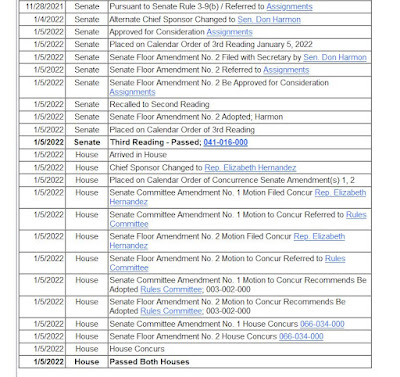
The almost leisurely pace of this bill, through the House and into the Senate, is reflected in the legislative history of the bill displayed on the General Assembly's website (click to enlarge or clarify):

As originally introduced, this bill was the model of bipartisanship; it passed the House 113-0.

It arrived in the Senate on April 23, 2001 and received its First Reading on April 28.

Then something happened. As HB3138 made its way through the Senate Committee structure, Senate President Don Harmon filed an amendment to the bill. This is the text of Senate Amendment 1 to HB3138, filed May 26, 2001:

1    AMENDMENT TO HOUSE BILL 3138

2    AMENDMENT NO. ___. Amend House Bill 3138 by replacing
3   everything after the enacting clause with the following:

4   "Section 5. The Supreme Court Act is amended by changing
5  Section 7 as follows:

6    (705 ILCS 5/7) (from Ch. 37, par. 12)
7    Sec. 7. The The supreme court shall be vested with all
8   power and authority necessary to carry into complete execution
9   all its judgments and determinations in all matters within its
10   jurisdiction, according to the rules and principles of the
11   common law and of the laws of this State.
12   (Source: P.A. 81-275.)"

Before this amendment, the statute was dull and lifeless. But then comes the amendment! As rewritten, the soaring language of that deathless prose sends little shivers up your spine, doesn't it?

Now I suppose, if any seasoned legislator or legislative staffer were to actually read this post, he or she might tell me to chill out. The experienced person might assure me that things like this have been done in Springpatch since before Abraham Lincoln jumped out of a window to try and avoid a quorum call.

And Abraham Lincoln did jump out a window once, for that very purpose. I looked it up. (See, David Herbert Donald's Lincoln, p. 77, Simon & Shuster, 1995.) And, as a lawyer, and therefore a sucker for precedent, I might be inclined to believe that the stockpiling of almost-passed bills has been in the General Assembly's toolbox since Vandalia was the state capital.

But -- even if that were true -- not the part about Lincoln -- that is true -- the part about almost-passed bills -- I really doubt that giant 389-page bills could have been swapped out for a single paragraph before the advent of modern word processing software.

But let us continue. After this thrilling amendment was introduced, it was quickly approved by committee and the bill, as now amended, received its Second Reading, and placed on the calendar for its Third (and final) Reading. And then it was placed on hold. On ice. In stasis.

Until it was needed. Here is the rest of the legislative history, taken from the GA website (click to enlarge or clarify):

Golly. Things sure happen fast when some folks make up their minds.

Now I know that I'm veering off topic here for a moment, but I'm afraid some readers might worry: What happened to the non-controversial, unanimously-passed amendment to §11 of the Supreme Court Act?

Well, it became law, right enough, this past July.

It seems that an identical piece of legislation was filed in the Senate as SB337. SB337 passed the Senate unanimously, too, and around the same time that HB3138 was adopted by the House. SB337 and HB3138 might have even passed by each other as they journeyed across the Capitol. Ultimately, it was the Senate version that passed the House on May 19, 2021 (becoming P.A. 102-94) and leaving HB3138 available to be hollowed out and put in storage until it was needed last night.

Which brings us to the Judicial Circuits Districting Act of 2022 itself.

A number of rumors are already swirling about the unintended consequences of this enactment -- for example, one rumor has it that this new law will hit the Cook County Democratic Party squarely in the pocketbook.

But -- unlike the stellar graduates of the Evelyn Wood Speed Reading Course who must predominate in the Legislature -- it will take me a little time to work through this lengthy bill. Bear with me a little while.

To be continued....

They put down the crayons alright: Cook County got a new subcircuit map last night

For the record, the new Cook County map, the one that got posted on the House Redistricting website just this past Monday, got joined by a few friends sometime yesterday afternoon or evening. Here's a screenshot:

All those links are active as of this morning.

But there still needed to be a vehicle, a vessel into which this carefully brewed cartographic data might be poured.

HB3138 was chosen for this task.

Until yesterday afternoon or evening (I'm not privy to the exact time), this was the text of HB3138:

1    AN ACT concerning courts.

2    Be it enacted by the People of the State of Illinois,
3  represented in the General Assembly:

4    Section 5. The Supreme Court Act is amended by changing
5  Section 11 as follows:

6     (705 ILCS 5/11) (from Ch. 37, par. 16)
7    Sec. 11. Marshals.
8    (a) The office of marshal for the Supreme Court is hereby
9   created, such marshals to be selected by the Supreme Court,
10  and the duties of such marshals shall be to attend upon its
11  sittings and to perform such other duties, under the order and
12  direction of the said court, as are usually performed by
13  sheriffs of courts. The salary of such marshals shall be fixed
14  by the judges of the Supreme Court, such salary to be payable
15  from the State treasury, upon bills of particulars, signed by
16  any one of the judges of the Supreme Court.
17    (b) Marshals are peace officers and have all the powers
18  possessed by police officers in cities and by sheriffs.
19  Marshals may exercise these powers throughout the State. No
20  marshal has peace officer status or may exercise police powers
21  unless: (i) he or she successfully completes the basic police
22  training course mandated and approved by the Illinois Law
23  Enforcement Training Standards Board; or (ii) the Illinois Law


    HB3138 Engrossed - 2 - LRB102 10630 LNS 15959 b

1  Enforcement Training Standards Board waives the training
2  requirement by reason of the marshal's prior law enforcement
3  experience or training or both.
4    (c) The office of marshal for the Supreme Court may also
5  employ court security officers to be responsible for
6  maintaining the security of any courthouse or courtroom
7  occupied by the Supreme or Appellate Court of this State. A
8  court security officer has the authority to arrest in the same
9  manner as authorized by similarly certified officers of a
10  county sheriff. However, the arrest powers of the court
11  security officer are limited to the performance of the
12  official duties of the court security officer. A court
13  security officer who is trained and qualified as permitted by
14  law may carry a weapon at his or her place of employment and to
15  and from his or her place of employment. No court security
16  officer authorized under this Section may exercise arrest
17  powers or carry a firearm unless: (i) he or she successfully
18  completes the basic court security officer training course
19  mandated and approved by the Illinois Law Enforcement Training
20  Standards Board; or (ii) the Illinois Law Enforcement Training
21  Standards Board waives the training requirement by reason of
22  the individual's prior experience or training or both.
23  (Source: P.A. 100-151, eff. 8-18-17.)

24    Section 99. Effective date. This Act takes effect upon
25  becoming law.

What, you may ask, does this have to do with judicial redistricting... in Cook County (or anywhere else)?

Absolutely nothing.

But... yesterday... things changed.

Wednesday, January 05, 2022

Ocasio appointed Acting Presiding Judge of the 4th Municipal District

Statement issued yesterday by the Office of Chief Judge Timothy C. Evans:

The Hon. Ramon Ocasio has been named acting presiding judge of the Fourth Municipal District in Maywood, said Chief Judge Timothy C. Evans.

“I am pleased to announce the appointment of Judge Ocasio to this new position of responsibility in our Fourth Municipal District, and I know he will strive for excellence, as he has done throughout his judicial career,” Judge Evans said.

Judge Ocasio was first elected in 2006, and has served in the Maywood branch for most of his judicial career. Currently a felony court judge, he has previously served in Central Bond Court (now the Pretrial Division) and in the First Municipal District.

A lifelong Chicago resident, Judge Ocasio received his bachelor’s degree from the University of Illinois at Urbana-Champaign and his law degree from Northeastern University School of Law in Boston. Before coming to the bench, he was a Cook County public defender and ran the Illinois attorney general’s regional consumer fraud office in Chicago. He also has served as president of the Puerto Rican Bar Association, and has served as the first president of the Illinois Latino Judges Association.

“I look forward to working with Chief Judge Evans to achieve our mutual goals of diversity, equity and justice in our courts and to understand and confront disparate outcomes,” Judge Ocasio said.

The appointment follows the announced retirement of the Hon. Cheryl D. Ingram, who had been the presiding judge of the Fourth Municipal District since 2010. She began her judicial career in 1992.

Judge Ingram's retirement, in turn, opens up that ninth countywide vacancy that the Cook County Democratic Party has already slated.

Judge Ingram was a recipient of the CBA's Dickerson Award in 2020.

Tuesday, January 04, 2022

A new draft of the 20-subcircuit map has been posted on the Ilinois Redistricting website

That's the Redistricting page of the Illinois House Dems website. Lest there be any confusion.

The link to the latest map can be found by clicking here. But here is a screenshot of the new map for general illustrative purposes:

At some point someone is going to have to put down the crayons and markers and actually draw up enabling legislation. I have not been informed of any proposed legislation at this time.

And, remember, new subcircuits are going to have to be drawn in several collar counties, too.

So stay tuned.

Stephen A. Swedlow to make 8th Subcircuit bid

Stephen A. Swedlow is planning to run for judge in the 8th Subcircuit, and he's already kicked in a half million dollars into his campaign warchest in a bid to overwhelm potential competition. (His Notification of Self-Funding was filed with the Illinois State Board of Elections on December 22. That disclosed that he had put $400,000 into his campaign. Another hundred thousand went in the following day, according to the ISBE website.)

The Co-Managing Partner of the Chicago office of Quinn Emmanuel Trial Lawyers, Swedlow made national news in August 2020 when, on behalf of his firm, he asked for an attorney fee award of $185 million "for representing a group of health insurers who will be paid about $3.7 billion from the U.S. government, reimbursing them for never-made payments promised under Obamacare." (While the fee request was almost entirely approved by Judge Kathryn C. Davis of the U.S. Court of Federal Claims on September 16, 2021, it is being challenged on appeal.)

Swedlow's campaign chair and treasurer is fellow Quinn Emmanuel partner Andrew H. Schapiro, the former U.S. Ambassador to the Czech Republic.

Licensed in Illinois since 1996, according to ARDC, Swedlow has not previously run for judge. He did, however, apply for associate judge in 2021.

Swedlow's campaign website, linked in the first sentence of this post, is still under construction as this is published. However, his firm biography notes that Swedlow "currently serves as court appointed lead counsel in multidistrict class action litigation against Facebook on behalf of all Facebook users for antitrust and privacy misrepresentations. He also serves as lead counsel in class actions against Amazon for privacy violations on behalf of children unlawfully recorded by Alexa." According to the firm biography Swedlow has represented both plaintiffs and defendants in over 100 class action cases in state and federal court across the country in technology, privacy, environmental and consumer protection cases. He has also served as a lecturer at Northwestern School of Law.

Wednesday, December 29, 2021

Office of the Chief Judge mandates COVID-19 vaccines for all employees

In announcing the employee mandate, the Office of Chief Judge Timothy C. Evans issued the following statement:

In recent weeks, the nation has seen a surge in coronavirus cases due, in large part, to the emergence of the highly contagious omicron variant. Because of this surge, and following discussions with public health experts and union representatives throughout the pandemic, the Office of the Chief Judge has determined that vaccination against COVID-19 will be mandated for all of its approximately 2,600 employees, with limited exceptions for those who receive accommodations for medical conditions or sincerely held religious beliefs.

“Public health experts have determined that unvaccinated individuals are more likely to contract and transmit the virus and to experience more serious symptoms of COVID-19 than those who are vaccinated,” said Chief Judge Timothy C. Evans. “This step is being taken to ensure the safest possible workplace for our employees, and to protect employees of our justice partners, court services patrons, residents of the Juvenile Temporary Detention Center, and the general public.”

Chief Judge Evans said he expects to distribute the full policy by the end of this week to all employees and judges, as well as to the unions representing the office’s employees, and anticipates discussions with those unions will commence shortly thereafter. Highlights of the policy include:

  • Unvaccinated employees must comply with the mandate within 21 days, meaning they must receive the first shot of either the Pfizer or Moderna vaccine, or one shot of the Johnson & Johnson vaccine. The second dose of the Pfizer or Moderna vaccine must be received as soon as practicable after receiving the first.

  • Employees may request exemptions from the requirement for medical or religious reasons. Anyone requesting an exemption must submit a medical or religious accommodation request form to Human Resources by January 17, 2022, to allow for evaluation and determination.

  • Failure to follow this policy may subject an employee to discipline, up to and including termination of employment.

Since I reported the Christmas Eve update on Covid cases among the judiciary and OCJ employees (only yesterday), the OCJ has announced that four more judges and 53 more OCJ employees have been diagnosed with COVID-19 (for a total, now, of 36 judges and 581 OCJ employees). That represents a significant increase in only five days, but it appears consistent with surging numbers reported among the general population locally and nationally.

Some OCJ employees have been diagnosed with Covid more than once, but are only counted once in the 581 total, according to statements issued by that office. Given that there are roughly 2,600 employees in the OCJ, that means that over 22% of the employees in that office have tested positive for Covid at some point since March 2020.

Another judge sent to 'judges' jail' -- but not for long

Yesterday the Office of the Chief Judge issued the following statement:

The Executive Committee of the Circuit Court of Cook County has determined that, on or about December 6, 2021, the Hon. Raúl Vega allegedly made a statement to another judge, which, if made, would likely be a violation of the Illinois Code of Judicial Conduct.

At the Committee’s request, Chief Judge Timothy C. Evans, who convened the committee, has ordered that this matter be referred to the Judicial Inquiry Board.

Judge Evans also has ordered that, until further order of the court, Judge Vega is assigned to restricted duties or duties other than judicial duties in the office of the Presiding Judge of the First Municipal District.

Judge Vega previously had announced his upcoming retirement, effective next month. He is the former presiding judge of the Domestic Violence Division. Chief Judge Evans named the Hon. Judith C. Rice as the acting presiding judge of the Domestic Violence Division on December 23.

According to the Illinois Supreme Court website, Judge Vega's retirement is effective January 28.

Tuesday, December 28, 2021

Who Sits Where: An authoritative list

Updated January 11, 2022 to reflect the addition of the Jacobius vacancy in the 9th Subcircuit
Updated January 5, 2022 to reflect the addition of the countywide Ingram vacancy

Herewith, an updated Who Sits Where. And -- for the first time ever -- this list starts with a vacancy list posted on the new Illinois Supreme Court website. (Thank you, Christopher Bonjean.)

Where a vacancy has been filled by an interim Supreme Court appointment, I have provided the identity of the appointee. If history is any guide, there will still be several more vacancies opening up in the months to come. One of the nine persons recently slated for supposedly existing countywide vacancies sure hopes so -- because, right now, just as I've been reporting, the Supreme Court's list of countywide vacancies stands at eight.

As always, all errors of omission or commission in this list are mine alone and I am grateful for additions and corrections provided.

Appellate Court Vacancy

Vacancy of the Hon. Shelvin Louise Marie Hall -- Robert E. Gordon

Countywide Circuit Court Vacancies

Vacancy of the Hon. Margaret A. Brennan -- Unfilled
Vacancy of the Hon. Diane Gordon Cannon -- Sanjay T. Tailor
Vacancy of the Hon. Michael B. Hyman -- Tracie R. Porter
Vacancy of the Hon. Cheryl D. Ingram -- Unfilled
Vacancy of the Hon. Pamela M. Leeming -- Rena Marie Van Tine
Vacancy of the Hon. Daniel Lynch -- Unfilled
Vacancy of the Hon. Kathleen M. McGury -- Ruth I. Gudino
Vacancy of the Hon. Joan M. O'Brien -- Araceli R. De La Cruz
Vacancy of the Hon. Sharon M. Sullivan -- Thomas M. Donnelly

Subcircuit Vacancies

1st Subcircuit
Vacancy of the Hon. Sharon O. Johnson -- John Wellington Wilson

4th Subcircuit
Vacancy of the Hon. James Gavin -- Unfilled
Vacancy of the Hon. Patrick T. Rogers -- Unfilled

5th Subcircuit
Vacancy of the Hon. Jackie Marie Portman-Brown -- David L. Kelly
Vacancy of the Hon. Diane Shelly -- Unfilled

6th Subcircuit
Vacancy of the Hon. Mauricio Araujo -- Unfilled
Vacancy of the Hon. Raul Vega -- Unfilled

7th Subcircuit
Vacancy of the Hon. Patricia Martin -- Unfilled

8th Subcircuit
Vacancy of the Hon. Robert E. Gordon -- Unfilled
Vacancy of the Hon. Thomas J. Lipscomb -- Unfilled

9th Subcircuit
Vacancy of the Hon. Jeanne Cleveland Bernstein -- Unfilled
Vacancy of the Hon. Moshe Jacobius -- Unfilled

11th Subcircuit
Vacancy of the Hon. Dennis M. McGuire -- Unfilled

14th Subcircuit
Vacancy of the Hon. James R. Brown -- Unfilled
Vacancy of the Hon. Raymond L. Jagielski -- Unfilled

15th Subcircuit
Vacancy of the Hon. Chris Lawler -- Unfilled

Judith C. Rice named Acting Presiding Judge of Domestic Violence Division

In a press release issued just before Christmas, the Office of Cook County Chief Judge Timothy C. Evans announced that Judge Judith C. Rice has been appointed Acting Presiding Judge of the Domestic Violence Division.

Rice is is the first African-American to hold this position, according to the court's statement.

"Judge Rice is an excellent judge and has spent many years as a dedicated public servant," said Judge Evans. "I am confident that she will succeed in this new leadership role as we continue to expand services and access in the Domestic Violence Division."

Rice was elected to a 7th Subcircuit vacancy in 2014. She faced no opposition in the general election. After winning the Democratic Party nomination for that seat in the primary, Rice was appointed to fill the vacancy she was seeking. She faced no opposition in the general election.

Before being elected to the judiciary, Rice served in executive positions at BMO Harris Bank, rising to the position of senior vice president and head of community affairs and economic development. Earlier in her career, Rice served as an Assistant Cook County State’s Attorney and as an assistant corporation counsel for the City of Chicago. She was director of the Department of Revenue between 1993 and 1995. Rice was elected Chicago City Treasurer after serving as the first female commissioner of two key city agencies -- the Department of Water from 1996 until 1999 and the Department of Transportation from 1999-2000.

Rice replaces Judge Raul Vega, who is retiring after almost 20 years on the bench. Vega was appointed head of the Domestic Violence Division in 2018.

Vega's retirement will create a second vacancy in the 6th Subcircuit. Maybe.

Another COVID Christmas in the books

That makes two now, if you're counting.

A remarkable number, inasmuch as we were supposed to need just a two-week shutdown to "flatten the curve." (The law firm of Husch Blackwell has maintained a state-by-state, day-by-day archive of COVID-19 related orders -- the link is to the 2020 orders -- and you will note that the original Illinois "Shelter in Place" order had to wait until after the March primary. Political priorities had to be maintained.) The original shutdown of the Cook County court system was only supposed to be for 30 days.

I haven't done a 'Rona post for some time now (the link will take you to all posts so labeled).

Back on August 5, when I last reported a COVID-19 update from the Chief Judge's Office, there were 337 employees of that office (out of a total of about 2,600) who'd been diagnosed with the virus.

The latest update I've seen from the Office of the Chief Judge (dated Christmas Eve) announced that another judge and 21 more employees have tested positive for COVID-19. A total of 528 employees of the Office of the Chief Judge have now come down with the virus, as have 32 judges. As is probably unsurprising, given the length of this never-ending plague, some of these 528 employees have caught the Covid more than once -- but are only counted once in these cumulative totals, according to the Chief Judge's Office.

There's been definite growth in the number of reported Covid cases generally.

Here is the most recent Covid Dashboard from the City of Chicago, released last evening:

Compare the above to the City Dashboard last issued before the Christmas holiday:

Looks like Santa brought quite a few Covid cases with his other gifts.

But these figures are only snapshots. To try and place these figures into some perspective, I suggest comparison of these numbers with those the City put out last August 21, around the time the mask mandate was reimposed (it was briefly withdrawn over the Summer, lest you forget). There were hundreds of cases reported then; there are thousands now.

And those August numbers were up substantially from those just the month before:

Depending on your "tribe" or "silo," you may interpret these numbers as "proof" of the devastating effects of the Delta or Omicron variants... or that mask-wearing is useless and may even be harmful.

As the old saying goes, figures lie, and liars figure.

Ugh.

Lawyers love to argue. Good lawyers ground their arguments in fact. However, when it comes to vaccinations, the facts are all over the board.

According to the Mayo Clinic vaccine tracker, 64.2% of all Illinois residents are fully vaccinated. (Numbers recently released by IDPH are consistent.)

If you look at the City's Covid Dashboard for December 27, we here in the Deep Blue City are only slightly behind the rest of the State. (And, if you look at the City's Covid Dashboard for December 27 and December 23, our fully vaccinated rate went up from 64% to 64.1% over the Christmas weekend, meaning that Santa brought Covid cases to some and shots to others.)

And Illinois is not faring much better the national average in terms of vaccine compliance: Per the Mayo Clinic site, only 61.8% of Americans are fully vaccinated.

Broken down by age group, in Illinois, only 19.3% of children aged 5-11 are fully vaccinated, and 57.2% of children aged 12-17. Among adults aged 18-64, 70.2% are fully vaxxed, while 91.5% of Illinois residents aged 65 and up have received all their shots. And, no, I can't tell from these charts if the "fully vaccinated" category includes boosters or not. I rather doubt it. Perhaps I am overly pessimistic.

The numbers for Illinois residents receiving at least one dose of vaccine are better, according to the Mayo Clinic (28.8% for ages 5-11, 63.6% for ages 12-17, 78.5% for the 18-64 group, and 99.9% of those aged 65 and up).

But the numbers are still awfully low for the very young.

This number supports at least a hypothesis that the virus is spreading fastest among kids -- just as the public health authorities are claiming -- which, in turn, supports the notion that it is spreading in our schools.

Except... schools that stayed open during the 2020-21 school year were among the safest public places to be. And that was without any vaccine for the students at all. So a number of things may be operating here, probably in combination: First, more schools are open this academic year than last. Personnel in newly opened schools may not be as vigilant as those that were working in schools open last year. Also, the availability of vaccines for kids may have caused some teachers and school administrators to relax more than the actual vaccination rates would suggest is prudent. Moreover, the new variants may well be more contagious than their predecessors.

Contrary to what you may hear on cable news, or in some other corners of the Intertubes, there is not always only one simple answer to every question.

The numbers are only going to go up, in the short term anyway, thanks to the unvaccinated and vaccinated alike getting together for Christmas cheer.

COVID-19 may never actually go away, the promises of our leaders notwithstanding. The latest scientific consensus, according to this recent NBC News article, is that the COVID-19 pandemic will subside into endemic Covid -- always with us, but kept largely at bay by vaccination and preventative measures.

Sort of like the flu.

But not exactly.

And even the flu manages to kill a whole bunch of people every year: over 20,000 Americans in 2019-20, and nearly 28,000 in 2018-19, according to the CDC.

COVID-19 was never the bubonic plague. But neither was it 'just a flu': Covid causes more and longer hospitalizations than does the flu, and in particular taxes the resources of intensive care units, and people who did not succumb to the virus often experienced long-lasting complications.

The Covid virus continues to mutate. Perhpas, as some are already speculating about the current Omicron variant, it will become more contagious but less serious.

The smart money should be put on this, our second Covid Christas, not being our last.

Monday, December 20, 2021

Judge Diane Shelley appointed HUD Regional Administrator, Region 5

The White House announced earlier this month that Cook County Circuit Court Judge Diane M. Shelley has been appointed Regional Administrator of Region 5 of the Department of Housing and Urban Development.

Judge Shelley was elected to the bench in 2006 and was serving in the Commercial Calendar Section of the Law Division at the time of her appointment.

A Commissioner of the Illinois Supreme Court Commission on Professionalism, Shelley has also served as President of the Illinois Judges Association and as Chair of the Illinois Judicial Council. Shelley is also a member of the Special Supreme Court Advisory Committee on Justice and Mental Health Planning. She received the Chicago Bar Association's Dickerson Award in 2020.

Judge Shelley's appointment as HUD Regional Administrator creates a new 5th Subcircuit vacancy to be filled in the 2022 election... at least it might create a 5th Subcircuit vacancy... depending on whether or not the Legislature rams through a new Subcircuit map for 2022 (and depending on whether any such last minute renewal is upheld in the courts).

Thursday, December 16, 2021

House and Senate Redistricting Committees differ over whether there may be a new Cook County subcircuit map for in time for the 2022 primary

That's probably the biggest news to emerge from this afternoon's joint meeting of the House and Senate Redistricting Committees: State Sen. Elgie R. Sims, Jr. (D-17), the Vice Chair of the Senate Redistricting Committee, who was presiding today over the Senate Committee, said he understood that the new map, whenever adopted, will not be effective until 2024. House Redistricting Chair Elizabeth Hernandez (D-24) said the "goal" is to pass a Cook County subcircuit map when the General Assembly reconvenes on January 4.

Could the new map possibly be implemented for the 2022 election cycle? Rep. Hernandez appeared to hold open the possibility that it might. If a new map could be agreed upon in time.

Two of the witnesses tesitifying today, Allen Manuel, on behalf of Judge David Kelly's judicial campaign, and former 8th Subcircuit candidate Brad Trowbridge, appeared to take this possibility quite seriously.

Kelly was appointed to a 5th Subcircuit vacancy by the Illinois Supreme Court this past summer. But, his spokesman pointed out, the proposed 20-subcircuit map would take Kelly out of the 5th Subcircuit and put him in the 1st Subcircuit. Where could he run? Could he run at all?

Trowbridge pointed out that there are two vacancies currently up for election in the 8th Subcircuit. That subcircuit has a significant LGBTQ population and has frequently elected judges who identify as LGBTQ. But the heart of that community would be in the new 20th Subcircuit, Trowbridge told committee members. Would the existing vacancies move to the new 8th? Would they stay with the new 20th? How would that be accomplished?

There is a proposed map. It is linked in the preceding sentence and picutred above. There is, however, as yet, no enacting legislation.

And petitions for the 2022 primary may be circulated as of January 13.

Adding five new subcircuits to the 15 existing ones may solve some political problems -- giving different communities more or better shots at electing members of those communities to the bench -- but the incredibly short timeline is not the only pracitcal problem that arises from increasing the number of subcircuits.

There are 165 currently authorized subcircuit judges in Cook County. That works out to 11 per each existing subcircuit. But even with the newest math, 165 slots can't be evenly divided across 20 subcircuits.

So... the Legislature would have to either decrease the authorized number, to 160 perhaps, or increase it to 180 (or more). FWIW readers may recall that there was a proposal to increase the number of subcircuit seats to 270 just this past May -- although 270 isn't even divisible by 20 eiather.

Moreover, new subcircuit vacancies would have to be divvied up among the 20 subcircuits in some order. When the 15 subcircuits were established, the Supreme Court drew lots to determine the order, 1 through 15, in which vacancies would be assigned to the subcircuits. Something like that would have to happen here. So when Judge Smith in the 10th Subcircuit retires, the vacancy would become Additional Judgeship A in the 19th Subcircuit, perhaps at the other end of the county.

FWIW has written the House Redistricting Committee about these questions; if any response is received, I will advise.

Meanwhile, just because it seems crazy and impossible to put a new map in place for 2022 doesn't mean it won't happen. Depending on who is pushing the proposal.

Wednesday, December 15, 2021

Twenty persons receive Democratic Party's endorsement for countywide judicial vacancies

Nine of the 20 persons referred to in the headline above were endorsed for current vacancies (I was aware of only eight, but the Cook County Democratic Party has access to more authoritative sources than I do).

That means 11 persons were asked to wait in line, just in case additional vacancies open up in time for the 2022 primary. These are the alternates -- slated automatically, in order, from first to eleventh, but only IF new vacancies crop up AND IF the designated alternate has not chosen to run against a slated candidate in the meantime.

There were no late-breaking vacancies in 2020, but there were three in 2018. While anything is technically possible, it is extremely unlikely that 11 more countywide vacancies are going to open up before the primary. So many -- probably most -- of the 11 alternates will wind up being endorsed... for nothing.

The Illinois Supreme Court has appointed persons to six of the existing eight (or nine) countywide vacancies.

Four of these six were slated by the Democratic Party yesterday: Judges Araceli De La Cruz, Tom Donnelly, Ruth Gudino, and Rena Van Tine. Judge Tracie Porter was passed over by the slatemakers for any existing vacancy... but she was designated as the Party's 1st Alternate. She is first in line if another vacancy opens.

The other judge currently sitting in a countywide vacancy pursuant to Supreme Court appointment, Sanjay Tailor, is not on the list at all... but is reportedly planning a run for a subcircuit vacancy in order to hold his place on the bench.

The Cook County Democratic Party does not endorse candidates for subcircuit vacancies. Subcircuit endorsements are made by the committeepersons whose wards or townships, or some parts thereof, are within the subcircuit.

The headline in the MSM about the judicial slating -- if there were one -- would be that 21st Ward Ald. Howard Brookins was chosen by the Party for a countywide vacancy. Perhaps of greater interest to FWIW readers is the fact that Tom Nowinski and Yolanda Sayre, the first and fifth of the alternates designated in 2020, have been actually slated and endorsed by the Cook County Democratic Party.

The 10th alternate designated in 2020, Ashonta Rice, has moved up to 4th alternate on the 2022 standby list.

Diana López, who just became an associate judge this year, also secured an endorsement for a countywide vacancy.

Here is the complete list of slated countywide candidates, in alphabetical order:

  • Howard Brookins,
  • Araceli De La Cruz,
  • Thomas M. Donnelly,
  • Ruth Gudino,
  • Diana López,
  • Tom Nowinski,
  • Yolanda Sayre,
  • Rena Van Tine, and
  • Michael Weaver.

The 11 designated alternates are, in order:

  1. Tracie Porter,
  2. Marcia O'Brien Conway,
  3. Jennifer Callahan,
  4. Ashonta Rice,
  5. Pam Saindon,
  6. James Murphy Aguliu,
  7. Steven McKenzie,
  8. James Gleffe,
  9. Debjani Desai,
  10. Joanne Fehn, and
  11. Tiffany Brooks.

For the sole Appellate Court vacancy, the Cook County Democratic Party slated Judge Dominique Ross. Judge John Ehrlich was designated as an alternate.

Appellate Court vacancies are rare, and late-opening Appellate Court vacancies rarer still. But I can recall one current Appellate Court justice who, after being designated by the Party as an alternate, was in position when a vacancy became available.

Clearly, with the alternate designation, the Party is hoping to encourage Ehrlich, who would be a well-funded candidate, not to challenge Ross. But it takes no gift of prophecy to predict that Judge Ross will face a number of challengers regardless of whether Ehrlich sits out or not: There are a great many Appellate Court hopefuls out there, announced or otherwise, and the opportunities for these persons are few.

Tuesday, December 14, 2021

And then there were 20? A new subcircuit map may be taking shape

This map was posted less than 24 hours ago on the House Redistricting website. It would increase the number of Cook County judicial subcircuits from 15 to 20. (Inflation is impacting everything these days....)

Capitol Fax reported on this yesterday. If you follow that link, you will see that there's a hearing on the proposed map coming up this Thursday afternoon.

I previously reported there would be no new subcircuit map in time for the 2022 primary.

But that may have changed....

Stay tuned.

Democratic Party of the 49th Ward elaborates on opposition to County Party "loyalty pledge"

This would be more newsworthy if the 49th Ward Committeeperson, St. Rep. Kelly Cassidy, were not already a signatory on this letter denouncing the attempt, by Executive Committee of the Cook County Democratic Party, to require a "loyalty pledge" of all candidates seeking slating.

But I saw that the Democratic Party of the 49th Ward had posted a link to this statement on Facebook and I thought it might be of interest to some readers.

An excerpt:

The 49th Ward, and our ward party organization, has a long history of independence. Unlike at the county party level, we have never told candidates seeking our endorsement that if they run in spite of not being endorsed, they’ll forfeit potential future endorsements. We make clear to candidates that if they choose to run anyway, we will still consider them for endorsement because we feel strongly about the importance of fielding the strongest candidates regardless of who sent them or to whom they’re related. As an organization, and as individuals associated with it, we can not abide by the use of retrograde loyalty oaths in the endorsement process. Running for office and voting are among the most sacred forms of free speech protected by our constitution and we categorically condemn the use of intimidation and unenforceable “oaths” to exert control over candidates.

As a result, our Ward Organization feels it important to convey to all candidates seeking our endorsement that they need not feel compelled to sign this oath or any other to seek our support and we urge the leadership of our county party to rethink this misguided and ham-handed attempt to move us back to the days of the old school machine politics we’ve worked so hard to relegate to the history books.