Friday, January 07, 2022

I'm not sure they thought this one all the way through: Looking more at how the 20 new subcircuits will be set up

The Judicial Circuits Districting Act of 2022 is 389 pages long... but most of of it---nearly all of it, really---consists of written descriptions of the many and various subcircuits set up in Cook County and in several other parts of the state.

So the 'meat' of the legislation, the part that isn't just a dense jumble of county, ward, township, precinct, tract, or block names or numbers (which is meant to be a written depiction of what is shown on the maps), doesn't begin until p. 354 of the statute, starting with §50. That's where all the terms and abbreviations are explained. Section 50(h) provides a means of figuring out what to do if the written descriptions of one subcircuit overlap the boundaries of another.

Section 52 of the Act amends §2A-1.1b of the Election Code (one of the recently enacted provisions setting up special rules for the forthcoming 2022 primary and general elections) but the changes made therein are of interest to those in Lake County and in far Downstate Madison and Bond Counties.

The stuff that's of primary interest to Cook County judicial wannabes, aspiring kingmakers (judgemakers?), and (dare I suggest?) voters, begins with §60 (at p. 362 if you're following along on a separate screen). This section amends several provisions of the Circuit Courts Act (705 ILCS 35/1 et seq.).

On initial reading, the amendments to §2 of the Circuit Courts Act might not seem to have any impact on Cook County. This is the provision that states that Cook County gets to elect 94 circuit judges. That has meant that the County of Cook gets 94 countywide judicial slots. But this changes dramatically as we work through the rest of the Act.

Section 2f of the Circuit Courts Act is amended by §60 of the Judicial Circuits Districting Act of 2022 to increase the number of Cook County subcircuits from 15 to 20, effective December 2, 2024. Meaning for certain sure that the forthcoming 2022 primary will be conducted under the old subcircuit map. In case you were worried. And there's a provision promising that we'll all do this again in 10 years. At least, that's the current plan.

Section 2f(b) refers to the 165 existing subcircuit judgeships created by the original subcircuit act. Actually, we never quite finished populating the original subcircuits; there are two sitting judges elected under the old (pre-1992) system whose vacancies, whenever they may occur, will be alloted to the 7th and 15th Subcircuits, respectively. The lottery procedure, by which the order of the allocation of subcircuit vacancies was determined, as new vacancies were created, was set out at §§2f(c)-(d) of the Circuit Courts Act. That procedure remains in place, under the new Act, until December 2, 2024.

Provision is made for the population of judgeships in the newly created Subcircuits 16-20 by adding §2f(d-5) to the Circuit Courts Act. This provision states:

All vacancies in circuit judgeships in the Circuit of Cook County, which are not allotted to Judicial Subcircuits 1 through 15 pursuant to subsection (c) of this Section [the vacancies that won't exist until the two remaining pre-1992 judges leave office], existing on or occurring on or after June 1, 2022 shall be allotted in numerical order to Judicial Subcircuits 16, 17, 18, 19 and 20 until there are 11 resident judges to be elected from each of the those subcircuits (for a total of 55).

I'm not sure this is what the drafters intended, but I am sure this is what the statute says: There will be no more countywide Cook County judicial vacancies, effective June 1, 2022, until each of the new subcircuits is brought up to a full complement of 11 judges each. Existing subcircuit judges can serve out as long as they are retained, but when a subcircuit judge leaves the bench his or her vacancy will be a vacancy in that subcircuit... which under the new map may be in an entirely different part of the county.

At the moment, we have nine countywide vacancies to be filled in the 2022. I think we may safely assume that the drafters of the statute meant or assumed that these vacancies would be filled under the current system.

But each of those vacancies will, obviously, be "existing on... June 1, 2022." They exist now. They would not cease existing, in the ordinary course, until the first Monday in December of this year, when new judges are sworn in. But... look at what the statute says: The candidates recently slated for these vacancies by the Cook County Democratic Party may be in for a tremendous shock.

But even if we assume that these nine candidates will be permitted to run for the vacancies they were slated for, there will surely be no more countywide vacancies to fill for many years to come. We have nine countywide vacancies now; historically, that's about average. Sometimes we have more -- a dozen maybe. But it will take a while to get to 55.

And the remaining countywide vacancies, when they can be filled again, a decade or more hence, will be just about as rare as Appellate Court seats.

And if the slated nine candidates are able to run for the vacancies for which they've been slated, it will nevertheless be bad luck for the judicial hopefuls that were willing to wait in line for a vacancy -- because there aren't going to be any for a long, long while.

The Cook County Democratic Party has long gotten a great deal of money from persons hoping to be slated for a judgeship. There's the assessment, of course -- $40,000 or so -- but there's also all the event tickets and donations that hopefuls make in the hopes that they (and their legal skills of course) will be noticed by the powers that be. With this new statute, that income stream dries up, and will stay dry for a long time to come.

Look, I'm no election lawyer. This article is not giving legal advice to anyone. But I will venture this prediction: We are either heading for a lawsuit or a face-saving technical corrections statute on this new statute very soon. Maybe an amendatory veto. But I think there's a drafting problem here. I really do.

Thursday, January 06, 2022

Continuing: The "evolution" of HB3138 -- or -- Subcircuit redistricting in an instant

In our last installment, we introduced you to HB3138, the bill that, last night, became a 389-page judicial redistricting bill.

As introduced, of course, the bill had nothing to do with judicial redistricting, in Cook County or anywhere else. But HB3138 had other virtues that recommended it highly to those looking to quickly enact a map, to wit, it had passed the House and was on the cusp of passing the Senate, too, prior to yesterday.

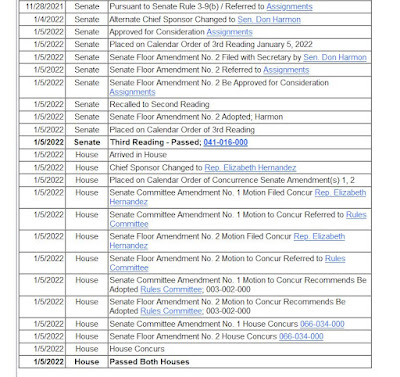
The almost leisurely pace of this bill, through the House and into the Senate, is reflected in the legislative history of the bill displayed on the General Assembly's website (click to enlarge or clarify):

As originally introduced, this bill was the model of bipartisanship; it passed the House 113-0.

It arrived in the Senate on April 23, 2001 and received its First Reading on April 28.

Then something happened. As HB3138 made its way through the Senate Committee structure, Senate President Don Harmon filed an amendment to the bill. This is the text of Senate Amendment 1 to HB3138, filed May 26, 2001:

1    AMENDMENT TO HOUSE BILL 3138

2    AMENDMENT NO. ___. Amend House Bill 3138 by replacing
3   everything after the enacting clause with the following:

4   "Section 5. The Supreme Court Act is amended by changing
5  Section 7 as follows:

6    (705 ILCS 5/7) (from Ch. 37, par. 12)
7    Sec. 7. The The supreme court shall be vested with all
8   power and authority necessary to carry into complete execution
9   all its judgments and determinations in all matters within its
10   jurisdiction, according to the rules and principles of the
11   common law and of the laws of this State.
12   (Source: P.A. 81-275.)"

Before this amendment, the statute was dull and lifeless. But then comes the amendment! As rewritten, the soaring language of that deathless prose sends little shivers up your spine, doesn't it?

Now I suppose, if any seasoned legislator or legislative staffer were to actually read this post, he or she might tell me to chill out. The experienced person might assure me that things like this have been done in Springpatch since before Abraham Lincoln jumped out of a window to try and avoid a quorum call.

And Abraham Lincoln did jump out a window once, for that very purpose. I looked it up. (See, David Herbert Donald's Lincoln, p. 77, Simon & Shuster, 1995.) And, as a lawyer, and therefore a sucker for precedent, I might be inclined to believe that the stockpiling of almost-passed bills has been in the General Assembly's toolbox since Vandalia was the state capital.

But -- even if that were true -- not the part about Lincoln -- that is true -- the part about almost-passed bills -- I really doubt that giant 389-page bills could have been swapped out for a single paragraph before the advent of modern word processing software.

But let us continue. After this thrilling amendment was introduced, it was quickly approved by committee and the bill, as now amended, received its Second Reading, and placed on the calendar for its Third (and final) Reading. And then it was placed on hold. On ice. In stasis.

Until it was needed. Here is the rest of the legislative history, taken from the GA website (click to enlarge or clarify):

Golly. Things sure happen fast when some folks make up their minds.

Now I know that I'm veering off topic here for a moment, but I'm afraid some readers might worry: What happened to the non-controversial, unanimously-passed amendment to §11 of the Supreme Court Act?

Well, it became law, right enough, this past July.

It seems that an identical piece of legislation was filed in the Senate as SB337. SB337 passed the Senate unanimously, too, and around the same time that HB3138 was adopted by the House. SB337 and HB3138 might have even passed by each other as they journeyed across the Capitol. Ultimately, it was the Senate version that passed the House on May 19, 2021 (becoming P.A. 102-94) and leaving HB3138 available to be hollowed out and put in storage until it was needed last night.

Which brings us to the Judicial Circuits Districting Act of 2022 itself.

A number of rumors are already swirling about the unintended consequences of this enactment -- for example, one rumor has it that this new law will hit the Cook County Democratic Party squarely in the pocketbook.

But -- unlike the stellar graduates of the Evelyn Wood Speed Reading Course who must predominate in the Legislature -- it will take me a little time to work through this lengthy bill. Bear with me a little while.

To be continued....

They put down the crayons alright: Cook County got a new subcircuit map last night

For the record, the new Cook County map, the one that got posted on the House Redistricting website just this past Monday, got joined by a few friends sometime yesterday afternoon or evening. Here's a screenshot:

All those links are active as of this morning.

But there still needed to be a vehicle, a vessel into which this carefully brewed cartographic data might be poured.

HB3138 was chosen for this task.

Until yesterday afternoon or evening (I'm not privy to the exact time), this was the text of HB3138:

1    AN ACT concerning courts.

2    Be it enacted by the People of the State of Illinois,
3  represented in the General Assembly:

4    Section 5. The Supreme Court Act is amended by changing
5  Section 11 as follows:

6     (705 ILCS 5/11) (from Ch. 37, par. 16)
7    Sec. 11. Marshals.
8    (a) The office of marshal for the Supreme Court is hereby
9   created, such marshals to be selected by the Supreme Court,
10  and the duties of such marshals shall be to attend upon its
11  sittings and to perform such other duties, under the order and
12  direction of the said court, as are usually performed by
13  sheriffs of courts. The salary of such marshals shall be fixed
14  by the judges of the Supreme Court, such salary to be payable
15  from the State treasury, upon bills of particulars, signed by
16  any one of the judges of the Supreme Court.
17    (b) Marshals are peace officers and have all the powers
18  possessed by police officers in cities and by sheriffs.
19  Marshals may exercise these powers throughout the State. No
20  marshal has peace officer status or may exercise police powers
21  unless: (i) he or she successfully completes the basic police
22  training course mandated and approved by the Illinois Law
23  Enforcement Training Standards Board; or (ii) the Illinois Law


    HB3138 Engrossed - 2 - LRB102 10630 LNS 15959 b

1  Enforcement Training Standards Board waives the training
2  requirement by reason of the marshal's prior law enforcement
3  experience or training or both.
4    (c) The office of marshal for the Supreme Court may also
5  employ court security officers to be responsible for
6  maintaining the security of any courthouse or courtroom
7  occupied by the Supreme or Appellate Court of this State. A
8  court security officer has the authority to arrest in the same
9  manner as authorized by similarly certified officers of a
10  county sheriff. However, the arrest powers of the court
11  security officer are limited to the performance of the
12  official duties of the court security officer. A court
13  security officer who is trained and qualified as permitted by
14  law may carry a weapon at his or her place of employment and to
15  and from his or her place of employment. No court security
16  officer authorized under this Section may exercise arrest
17  powers or carry a firearm unless: (i) he or she successfully
18  completes the basic court security officer training course
19  mandated and approved by the Illinois Law Enforcement Training
20  Standards Board; or (ii) the Illinois Law Enforcement Training
21  Standards Board waives the training requirement by reason of
22  the individual's prior experience or training or both.
23  (Source: P.A. 100-151, eff. 8-18-17.)

24    Section 99. Effective date. This Act takes effect upon
25  becoming law.

What, you may ask, does this have to do with judicial redistricting... in Cook County (or anywhere else)?

Absolutely nothing.

But... yesterday... things changed.

Wednesday, January 05, 2022

Ocasio appointed Acting Presiding Judge of the 4th Municipal District

Statement issued yesterday by the Office of Chief Judge Timothy C. Evans:

The Hon. Ramon Ocasio has been named acting presiding judge of the Fourth Municipal District in Maywood, said Chief Judge Timothy C. Evans.

“I am pleased to announce the appointment of Judge Ocasio to this new position of responsibility in our Fourth Municipal District, and I know he will strive for excellence, as he has done throughout his judicial career,” Judge Evans said.

Judge Ocasio was first elected in 2006, and has served in the Maywood branch for most of his judicial career. Currently a felony court judge, he has previously served in Central Bond Court (now the Pretrial Division) and in the First Municipal District.

A lifelong Chicago resident, Judge Ocasio received his bachelor’s degree from the University of Illinois at Urbana-Champaign and his law degree from Northeastern University School of Law in Boston. Before coming to the bench, he was a Cook County public defender and ran the Illinois attorney general’s regional consumer fraud office in Chicago. He also has served as president of the Puerto Rican Bar Association, and has served as the first president of the Illinois Latino Judges Association.

“I look forward to working with Chief Judge Evans to achieve our mutual goals of diversity, equity and justice in our courts and to understand and confront disparate outcomes,” Judge Ocasio said.

The appointment follows the announced retirement of the Hon. Cheryl D. Ingram, who had been the presiding judge of the Fourth Municipal District since 2010. She began her judicial career in 1992.

Judge Ingram's retirement, in turn, opens up that ninth countywide vacancy that the Cook County Democratic Party has already slated.

Judge Ingram was a recipient of the CBA's Dickerson Award in 2020.

Tuesday, January 04, 2022

A new draft of the 20-subcircuit map has been posted on the Ilinois Redistricting website

That's the Redistricting page of the Illinois House Dems website. Lest there be any confusion.

The link to the latest map can be found by clicking here. But here is a screenshot of the new map for general illustrative purposes:

At some point someone is going to have to put down the crayons and markers and actually draw up enabling legislation. I have not been informed of any proposed legislation at this time.

And, remember, new subcircuits are going to have to be drawn in several collar counties, too.

So stay tuned.

Stephen A. Swedlow to make 8th Subcircuit bid

Stephen A. Swedlow is planning to run for judge in the 8th Subcircuit, and he's already kicked in a half million dollars into his campaign warchest in a bid to overwhelm potential competition. (His Notification of Self-Funding was filed with the Illinois State Board of Elections on December 22. That disclosed that he had put $400,000 into his campaign. Another hundred thousand went in the following day, according to the ISBE website.)

The Co-Managing Partner of the Chicago office of Quinn Emmanuel Trial Lawyers, Swedlow made national news in August 2020 when, on behalf of his firm, he asked for an attorney fee award of $185 million "for representing a group of health insurers who will be paid about $3.7 billion from the U.S. government, reimbursing them for never-made payments promised under Obamacare." (While the fee request was almost entirely approved by Judge Kathryn C. Davis of the U.S. Court of Federal Claims on September 16, 2021, it is being challenged on appeal.)

Swedlow's campaign chair and treasurer is fellow Quinn Emmanuel partner Andrew H. Schapiro, the former U.S. Ambassador to the Czech Republic.

Licensed in Illinois since 1996, according to ARDC, Swedlow has not previously run for judge. He did, however, apply for associate judge in 2021.

Swedlow's campaign website, linked in the first sentence of this post, is still under construction as this is published. However, his firm biography notes that Swedlow "currently serves as court appointed lead counsel in multidistrict class action litigation against Facebook on behalf of all Facebook users for antitrust and privacy misrepresentations. He also serves as lead counsel in class actions against Amazon for privacy violations on behalf of children unlawfully recorded by Alexa." According to the firm biography Swedlow has represented both plaintiffs and defendants in over 100 class action cases in state and federal court across the country in technology, privacy, environmental and consumer protection cases. He has also served as a lecturer at Northwestern School of Law.

Wednesday, December 29, 2021

Office of the Chief Judge mandates COVID-19 vaccines for all employees

In announcing the employee mandate, the Office of Chief Judge Timothy C. Evans issued the following statement:

In recent weeks, the nation has seen a surge in coronavirus cases due, in large part, to the emergence of the highly contagious omicron variant. Because of this surge, and following discussions with public health experts and union representatives throughout the pandemic, the Office of the Chief Judge has determined that vaccination against COVID-19 will be mandated for all of its approximately 2,600 employees, with limited exceptions for those who receive accommodations for medical conditions or sincerely held religious beliefs.

“Public health experts have determined that unvaccinated individuals are more likely to contract and transmit the virus and to experience more serious symptoms of COVID-19 than those who are vaccinated,” said Chief Judge Timothy C. Evans. “This step is being taken to ensure the safest possible workplace for our employees, and to protect employees of our justice partners, court services patrons, residents of the Juvenile Temporary Detention Center, and the general public.”

Chief Judge Evans said he expects to distribute the full policy by the end of this week to all employees and judges, as well as to the unions representing the office’s employees, and anticipates discussions with those unions will commence shortly thereafter. Highlights of the policy include:

  • Unvaccinated employees must comply with the mandate within 21 days, meaning they must receive the first shot of either the Pfizer or Moderna vaccine, or one shot of the Johnson & Johnson vaccine. The second dose of the Pfizer or Moderna vaccine must be received as soon as practicable after receiving the first.

  • Employees may request exemptions from the requirement for medical or religious reasons. Anyone requesting an exemption must submit a medical or religious accommodation request form to Human Resources by January 17, 2022, to allow for evaluation and determination.

  • Failure to follow this policy may subject an employee to discipline, up to and including termination of employment.

Since I reported the Christmas Eve update on Covid cases among the judiciary and OCJ employees (only yesterday), the OCJ has announced that four more judges and 53 more OCJ employees have been diagnosed with COVID-19 (for a total, now, of 36 judges and 581 OCJ employees). That represents a significant increase in only five days, but it appears consistent with surging numbers reported among the general population locally and nationally.

Some OCJ employees have been diagnosed with Covid more than once, but are only counted once in the 581 total, according to statements issued by that office. Given that there are roughly 2,600 employees in the OCJ, that means that over 22% of the employees in that office have tested positive for Covid at some point since March 2020.

Another judge sent to 'judges' jail' -- but not for long

Yesterday the Office of the Chief Judge issued the following statement:

The Executive Committee of the Circuit Court of Cook County has determined that, on or about December 6, 2021, the Hon. Raúl Vega allegedly made a statement to another judge, which, if made, would likely be a violation of the Illinois Code of Judicial Conduct.

At the Committee’s request, Chief Judge Timothy C. Evans, who convened the committee, has ordered that this matter be referred to the Judicial Inquiry Board.

Judge Evans also has ordered that, until further order of the court, Judge Vega is assigned to restricted duties or duties other than judicial duties in the office of the Presiding Judge of the First Municipal District.

Judge Vega previously had announced his upcoming retirement, effective next month. He is the former presiding judge of the Domestic Violence Division. Chief Judge Evans named the Hon. Judith C. Rice as the acting presiding judge of the Domestic Violence Division on December 23.

According to the Illinois Supreme Court website, Judge Vega's retirement is effective January 28.

Tuesday, December 28, 2021

Who Sits Where: An authoritative list

Updated January 11, 2022 to reflect the addition of the Jacobius vacancy in the 9th Subcircuit
Updated January 5, 2022 to reflect the addition of the countywide Ingram vacancy

Herewith, an updated Who Sits Where. And -- for the first time ever -- this list starts with a vacancy list posted on the new Illinois Supreme Court website. (Thank you, Christopher Bonjean.)

Where a vacancy has been filled by an interim Supreme Court appointment, I have provided the identity of the appointee. If history is any guide, there will still be several more vacancies opening up in the months to come. One of the nine persons recently slated for supposedly existing countywide vacancies sure hopes so -- because, right now, just as I've been reporting, the Supreme Court's list of countywide vacancies stands at eight.

As always, all errors of omission or commission in this list are mine alone and I am grateful for additions and corrections provided.

Appellate Court Vacancy

Vacancy of the Hon. Shelvin Louise Marie Hall -- Robert E. Gordon

Countywide Circuit Court Vacancies

Vacancy of the Hon. Margaret A. Brennan -- Unfilled
Vacancy of the Hon. Diane Gordon Cannon -- Sanjay T. Tailor
Vacancy of the Hon. Michael B. Hyman -- Tracie R. Porter
Vacancy of the Hon. Cheryl D. Ingram -- Unfilled
Vacancy of the Hon. Pamela M. Leeming -- Rena Marie Van Tine
Vacancy of the Hon. Daniel Lynch -- Unfilled
Vacancy of the Hon. Kathleen M. McGury -- Ruth I. Gudino
Vacancy of the Hon. Joan M. O'Brien -- Araceli R. De La Cruz
Vacancy of the Hon. Sharon M. Sullivan -- Thomas M. Donnelly

Subcircuit Vacancies

1st Subcircuit
Vacancy of the Hon. Sharon O. Johnson -- John Wellington Wilson

4th Subcircuit
Vacancy of the Hon. James Gavin -- Unfilled
Vacancy of the Hon. Patrick T. Rogers -- Unfilled

5th Subcircuit
Vacancy of the Hon. Jackie Marie Portman-Brown -- David L. Kelly
Vacancy of the Hon. Diane Shelly -- Unfilled

6th Subcircuit
Vacancy of the Hon. Mauricio Araujo -- Unfilled
Vacancy of the Hon. Raul Vega -- Unfilled

7th Subcircuit
Vacancy of the Hon. Patricia Martin -- Unfilled

8th Subcircuit
Vacancy of the Hon. Robert E. Gordon -- Unfilled
Vacancy of the Hon. Thomas J. Lipscomb -- Unfilled

9th Subcircuit
Vacancy of the Hon. Jeanne Cleveland Bernstein -- Unfilled
Vacancy of the Hon. Moshe Jacobius -- Unfilled

11th Subcircuit
Vacancy of the Hon. Dennis M. McGuire -- Unfilled

14th Subcircuit
Vacancy of the Hon. James R. Brown -- Unfilled
Vacancy of the Hon. Raymond L. Jagielski -- Unfilled

15th Subcircuit
Vacancy of the Hon. Chris Lawler -- Unfilled

Judith C. Rice named Acting Presiding Judge of Domestic Violence Division

In a press release issued just before Christmas, the Office of Cook County Chief Judge Timothy C. Evans announced that Judge Judith C. Rice has been appointed Acting Presiding Judge of the Domestic Violence Division.

Rice is is the first African-American to hold this position, according to the court's statement.

"Judge Rice is an excellent judge and has spent many years as a dedicated public servant," said Judge Evans. "I am confident that she will succeed in this new leadership role as we continue to expand services and access in the Domestic Violence Division."

Rice was elected to a 7th Subcircuit vacancy in 2014. She faced no opposition in the general election. After winning the Democratic Party nomination for that seat in the primary, Rice was appointed to fill the vacancy she was seeking. She faced no opposition in the general election.

Before being elected to the judiciary, Rice served in executive positions at BMO Harris Bank, rising to the position of senior vice president and head of community affairs and economic development. Earlier in her career, Rice served as an Assistant Cook County State’s Attorney and as an assistant corporation counsel for the City of Chicago. She was director of the Department of Revenue between 1993 and 1995. Rice was elected Chicago City Treasurer after serving as the first female commissioner of two key city agencies -- the Department of Water from 1996 until 1999 and the Department of Transportation from 1999-2000.

Rice replaces Judge Raul Vega, who is retiring after almost 20 years on the bench. Vega was appointed head of the Domestic Violence Division in 2018.

Vega's retirement will create a second vacancy in the 6th Subcircuit. Maybe.

Another COVID Christmas in the books

That makes two now, if you're counting.

A remarkable number, inasmuch as we were supposed to need just a two-week shutdown to "flatten the curve." (The law firm of Husch Blackwell has maintained a state-by-state, day-by-day archive of COVID-19 related orders -- the link is to the 2020 orders -- and you will note that the original Illinois "Shelter in Place" order had to wait until after the March primary. Political priorities had to be maintained.) The original shutdown of the Cook County court system was only supposed to be for 30 days.

I haven't done a 'Rona post for some time now (the link will take you to all posts so labeled).

Back on August 5, when I last reported a COVID-19 update from the Chief Judge's Office, there were 337 employees of that office (out of a total of about 2,600) who'd been diagnosed with the virus.

The latest update I've seen from the Office of the Chief Judge (dated Christmas Eve) announced that another judge and 21 more employees have tested positive for COVID-19. A total of 528 employees of the Office of the Chief Judge have now come down with the virus, as have 32 judges. As is probably unsurprising, given the length of this never-ending plague, some of these 528 employees have caught the Covid more than once -- but are only counted once in these cumulative totals, according to the Chief Judge's Office.

There's been definite growth in the number of reported Covid cases generally.

Here is the most recent Covid Dashboard from the City of Chicago, released last evening:

Compare the above to the City Dashboard last issued before the Christmas holiday:

Looks like Santa brought quite a few Covid cases with his other gifts.

But these figures are only snapshots. To try and place these figures into some perspective, I suggest comparison of these numbers with those the City put out last August 21, around the time the mask mandate was reimposed (it was briefly withdrawn over the Summer, lest you forget). There were hundreds of cases reported then; there are thousands now.

And those August numbers were up substantially from those just the month before:

Depending on your "tribe" or "silo," you may interpret these numbers as "proof" of the devastating effects of the Delta or Omicron variants... or that mask-wearing is useless and may even be harmful.

As the old saying goes, figures lie, and liars figure.

Ugh.

Lawyers love to argue. Good lawyers ground their arguments in fact. However, when it comes to vaccinations, the facts are all over the board.

According to the Mayo Clinic vaccine tracker, 64.2% of all Illinois residents are fully vaccinated. (Numbers recently released by IDPH are consistent.)

If you look at the City's Covid Dashboard for December 27, we here in the Deep Blue City are only slightly behind the rest of the State. (And, if you look at the City's Covid Dashboard for December 27 and December 23, our fully vaccinated rate went up from 64% to 64.1% over the Christmas weekend, meaning that Santa brought Covid cases to some and shots to others.)

And Illinois is not faring much better the national average in terms of vaccine compliance: Per the Mayo Clinic site, only 61.8% of Americans are fully vaccinated.

Broken down by age group, in Illinois, only 19.3% of children aged 5-11 are fully vaccinated, and 57.2% of children aged 12-17. Among adults aged 18-64, 70.2% are fully vaxxed, while 91.5% of Illinois residents aged 65 and up have received all their shots. And, no, I can't tell from these charts if the "fully vaccinated" category includes boosters or not. I rather doubt it. Perhaps I am overly pessimistic.

The numbers for Illinois residents receiving at least one dose of vaccine are better, according to the Mayo Clinic (28.8% for ages 5-11, 63.6% for ages 12-17, 78.5% for the 18-64 group, and 99.9% of those aged 65 and up).

But the numbers are still awfully low for the very young.

This number supports at least a hypothesis that the virus is spreading fastest among kids -- just as the public health authorities are claiming -- which, in turn, supports the notion that it is spreading in our schools.

Except... schools that stayed open during the 2020-21 school year were among the safest public places to be. And that was without any vaccine for the students at all. So a number of things may be operating here, probably in combination: First, more schools are open this academic year than last. Personnel in newly opened schools may not be as vigilant as those that were working in schools open last year. Also, the availability of vaccines for kids may have caused some teachers and school administrators to relax more than the actual vaccination rates would suggest is prudent. Moreover, the new variants may well be more contagious than their predecessors.

Contrary to what you may hear on cable news, or in some other corners of the Intertubes, there is not always only one simple answer to every question.

The numbers are only going to go up, in the short term anyway, thanks to the unvaccinated and vaccinated alike getting together for Christmas cheer.

COVID-19 may never actually go away, the promises of our leaders notwithstanding. The latest scientific consensus, according to this recent NBC News article, is that the COVID-19 pandemic will subside into endemic Covid -- always with us, but kept largely at bay by vaccination and preventative measures.

Sort of like the flu.

But not exactly.

And even the flu manages to kill a whole bunch of people every year: over 20,000 Americans in 2019-20, and nearly 28,000 in 2018-19, according to the CDC.

COVID-19 was never the bubonic plague. But neither was it 'just a flu': Covid causes more and longer hospitalizations than does the flu, and in particular taxes the resources of intensive care units, and people who did not succumb to the virus often experienced long-lasting complications.

The Covid virus continues to mutate. Perhpas, as some are already speculating about the current Omicron variant, it will become more contagious but less serious.

The smart money should be put on this, our second Covid Christas, not being our last.

Monday, December 20, 2021

Judge Diane Shelley appointed HUD Regional Administrator, Region 5

The White House announced earlier this month that Cook County Circuit Court Judge Diane M. Shelley has been appointed Regional Administrator of Region 5 of the Department of Housing and Urban Development.

Judge Shelley was elected to the bench in 2006 and was serving in the Commercial Calendar Section of the Law Division at the time of her appointment.

A Commissioner of the Illinois Supreme Court Commission on Professionalism, Shelley has also served as President of the Illinois Judges Association and as Chair of the Illinois Judicial Council. Shelley is also a member of the Special Supreme Court Advisory Committee on Justice and Mental Health Planning. She received the Chicago Bar Association's Dickerson Award in 2020.

Judge Shelley's appointment as HUD Regional Administrator creates a new 5th Subcircuit vacancy to be filled in the 2022 election... at least it might create a 5th Subcircuit vacancy... depending on whether or not the Legislature rams through a new Subcircuit map for 2022 (and depending on whether any such last minute renewal is upheld in the courts).

Thursday, December 16, 2021

House and Senate Redistricting Committees differ over whether there may be a new Cook County subcircuit map for in time for the 2022 primary

That's probably the biggest news to emerge from this afternoon's joint meeting of the House and Senate Redistricting Committees: State Sen. Elgie R. Sims, Jr. (D-17), the Vice Chair of the Senate Redistricting Committee, who was presiding today over the Senate Committee, said he understood that the new map, whenever adopted, will not be effective until 2024. House Redistricting Chair Elizabeth Hernandez (D-24) said the "goal" is to pass a Cook County subcircuit map when the General Assembly reconvenes on January 4.

Could the new map possibly be implemented for the 2022 election cycle? Rep. Hernandez appeared to hold open the possibility that it might. If a new map could be agreed upon in time.

Two of the witnesses tesitifying today, Allen Manuel, on behalf of Judge David Kelly's judicial campaign, and former 8th Subcircuit candidate Brad Trowbridge, appeared to take this possibility quite seriously.

Kelly was appointed to a 5th Subcircuit vacancy by the Illinois Supreme Court this past summer. But, his spokesman pointed out, the proposed 20-subcircuit map would take Kelly out of the 5th Subcircuit and put him in the 1st Subcircuit. Where could he run? Could he run at all?

Trowbridge pointed out that there are two vacancies currently up for election in the 8th Subcircuit. That subcircuit has a significant LGBTQ population and has frequently elected judges who identify as LGBTQ. But the heart of that community would be in the new 20th Subcircuit, Trowbridge told committee members. Would the existing vacancies move to the new 8th? Would they stay with the new 20th? How would that be accomplished?

There is a proposed map. It is linked in the preceding sentence and picutred above. There is, however, as yet, no enacting legislation.

And petitions for the 2022 primary may be circulated as of January 13.

Adding five new subcircuits to the 15 existing ones may solve some political problems -- giving different communities more or better shots at electing members of those communities to the bench -- but the incredibly short timeline is not the only pracitcal problem that arises from increasing the number of subcircuits.

There are 165 currently authorized subcircuit judges in Cook County. That works out to 11 per each existing subcircuit. But even with the newest math, 165 slots can't be evenly divided across 20 subcircuits.

So... the Legislature would have to either decrease the authorized number, to 160 perhaps, or increase it to 180 (or more). FWIW readers may recall that there was a proposal to increase the number of subcircuit seats to 270 just this past May -- although 270 isn't even divisible by 20 eiather.

Moreover, new subcircuit vacancies would have to be divvied up among the 20 subcircuits in some order. When the 15 subcircuits were established, the Supreme Court drew lots to determine the order, 1 through 15, in which vacancies would be assigned to the subcircuits. Something like that would have to happen here. So when Judge Smith in the 10th Subcircuit retires, the vacancy would become Additional Judgeship A in the 19th Subcircuit, perhaps at the other end of the county.

FWIW has written the House Redistricting Committee about these questions; if any response is received, I will advise.

Meanwhile, just because it seems crazy and impossible to put a new map in place for 2022 doesn't mean it won't happen. Depending on who is pushing the proposal.

Wednesday, December 15, 2021

Twenty persons receive Democratic Party's endorsement for countywide judicial vacancies

Nine of the 20 persons referred to in the headline above were endorsed for current vacancies (I was aware of only eight, but the Cook County Democratic Party has access to more authoritative sources than I do).

That means 11 persons were asked to wait in line, just in case additional vacancies open up in time for the 2022 primary. These are the alternates -- slated automatically, in order, from first to eleventh, but only IF new vacancies crop up AND IF the designated alternate has not chosen to run against a slated candidate in the meantime.

There were no late-breaking vacancies in 2020, but there were three in 2018. While anything is technically possible, it is extremely unlikely that 11 more countywide vacancies are going to open up before the primary. So many -- probably most -- of the 11 alternates will wind up being endorsed... for nothing.

The Illinois Supreme Court has appointed persons to six of the existing eight (or nine) countywide vacancies.

Four of these six were slated by the Democratic Party yesterday: Judges Araceli De La Cruz, Tom Donnelly, Ruth Gudino, and Rena Van Tine. Judge Tracie Porter was passed over by the slatemakers for any existing vacancy... but she was designated as the Party's 1st Alternate. She is first in line if another vacancy opens.

The other judge currently sitting in a countywide vacancy pursuant to Supreme Court appointment, Sanjay Tailor, is not on the list at all... but is reportedly planning a run for a subcircuit vacancy in order to hold his place on the bench.

The Cook County Democratic Party does not endorse candidates for subcircuit vacancies. Subcircuit endorsements are made by the committeepersons whose wards or townships, or some parts thereof, are within the subcircuit.

The headline in the MSM about the judicial slating -- if there were one -- would be that 21st Ward Ald. Howard Brookins was chosen by the Party for a countywide vacancy. Perhaps of greater interest to FWIW readers is the fact that Tom Nowinski and Yolanda Sayre, the first and fifth of the alternates designated in 2020, have been actually slated and endorsed by the Cook County Democratic Party.

The 10th alternate designated in 2020, Ashonta Rice, has moved up to 4th alternate on the 2022 standby list.

Diana López, who just became an associate judge this year, also secured an endorsement for a countywide vacancy.

Here is the complete list of slated countywide candidates, in alphabetical order:

  • Howard Brookins,
  • Araceli De La Cruz,
  • Thomas M. Donnelly,
  • Ruth Gudino,
  • Diana López,
  • Tom Nowinski,
  • Yolanda Sayre,
  • Rena Van Tine, and
  • Michael Weaver.

The 11 designated alternates are, in order:

  1. Tracie Porter,
  2. Marcia O'Brien Conway,
  3. Jennifer Callahan,
  4. Ashonta Rice,
  5. Pam Saindon,
  6. James Murphy Aguliu,
  7. Steven McKenzie,
  8. James Gleffe,
  9. Debjani Desai,
  10. Joanne Fehn, and
  11. Tiffany Brooks.

For the sole Appellate Court vacancy, the Cook County Democratic Party slated Judge Dominique Ross. Judge John Ehrlich was designated as an alternate.

Appellate Court vacancies are rare, and late-opening Appellate Court vacancies rarer still. But I can recall one current Appellate Court justice who, after being designated by the Party as an alternate, was in position when a vacancy became available.

Clearly, with the alternate designation, the Party is hoping to encourage Ehrlich, who would be a well-funded candidate, not to challenge Ross. But it takes no gift of prophecy to predict that Judge Ross will face a number of challengers regardless of whether Ehrlich sits out or not: There are a great many Appellate Court hopefuls out there, announced or otherwise, and the opportunities for these persons are few.

Tuesday, December 14, 2021

And then there were 20? A new subcircuit map may be taking shape

This map was posted less than 24 hours ago on the House Redistricting website. It would increase the number of Cook County judicial subcircuits from 15 to 20. (Inflation is impacting everything these days....)

Capitol Fax reported on this yesterday. If you follow that link, you will see that there's a hearing on the proposed map coming up this Thursday afternoon.

I previously reported there would be no new subcircuit map in time for the 2022 primary.

But that may have changed....

Stay tuned.

Democratic Party of the 49th Ward elaborates on opposition to County Party "loyalty pledge"

This would be more newsworthy if the 49th Ward Committeeperson, St. Rep. Kelly Cassidy, were not already a signatory on this letter denouncing the attempt, by Executive Committee of the Cook County Democratic Party, to require a "loyalty pledge" of all candidates seeking slating.

But I saw that the Democratic Party of the 49th Ward had posted a link to this statement on Facebook and I thought it might be of interest to some readers.

An excerpt:

The 49th Ward, and our ward party organization, has a long history of independence. Unlike at the county party level, we have never told candidates seeking our endorsement that if they run in spite of not being endorsed, they’ll forfeit potential future endorsements. We make clear to candidates that if they choose to run anyway, we will still consider them for endorsement because we feel strongly about the importance of fielding the strongest candidates regardless of who sent them or to whom they’re related. As an organization, and as individuals associated with it, we can not abide by the use of retrograde loyalty oaths in the endorsement process. Running for office and voting are among the most sacred forms of free speech protected by our constitution and we categorically condemn the use of intimidation and unenforceable “oaths” to exert control over candidates.

As a result, our Ward Organization feels it important to convey to all candidates seeking our endorsement that they need not feel compelled to sign this oath or any other to seek our support and we urge the leadership of our county party to rethink this misguided and ham-handed attempt to move us back to the days of the old school machine politics we’ve worked so hard to relegate to the history books.

Sunday, December 12, 2021

Evaluation narratives from Chicago Bar Association for candidates seeking slating from Cook County Democratic Party

Candidates who had not previously been screened by the Chicago Bar Association but who did not submit a questionnaire will have another opportunity to do so should they actually file for judicial office next year.

However, pursuant to §27.4 of the JEC Resolutions and Procedures, candidates who received an unfavorable rating within the past three years retain that "NOT RECOMMENDED" rating without any further hearing. Favorable ratings also retain in force for some time. This is why some of the narratives you will read below, favorable or unfavorable alike, refer to individuals seeking the office of Associate Judge.

APPELLATE COURT CANDIDATES

JOHN H. EHRLICH – HIGHLY QUALIFIED

Judge John H. Ehrlich is “Highly Qualified” for the office of Justice of the Illinois Appellate Court. Judge Ehrlich was admitted to practice law in Illinois in 1988. Judge Ehrlich was elected to the Circuit Court in November 2012. Since 2014, he has been assigned to the Law Division, Motion Section. He previously served in the Chancery Division and Traffic Division. Before being elected, Judge Ehrlich was with the City of Chicago’s Corporation Counsel. Judge Ehrlich is highly regarded by his judicial colleagues and attorneys that have appeared before him for his excellent writing skills, work ethic, fine demeanor, and the breadth and depth of his legal knowledge.

CASANDRA LEWIS – NOT RECOMMENDED

Judge Casandra Lewis is “Not Recommended” for the office of Justice of the Illinois Appellate Court. Judge Lewis was admitted to practice law in Illinois in 1991 and elected a Circuit Court Judge in 2002. Judge Lewis presides over major jury trials in the Law Division. Significant concerns about Judge Lewis’s punctuality, diligence, and tardiness in issuing rulings resulted in a “Not Recommended” finding.

DOMINIQUE ROSS – QUALIFIED

Judge Dominque Ross is “Qualified” for the office of Justice of the Illinois Appellate Court. Judge Ross was admitted to practice law in Illinois in 1995 and has served as a judge since 2008. Since 2009, she has presided over a trial call in the Domestic Relations Division of Cook County managing complicated domestic relations matters. Judge Ross is well regarded for her legal experience, knowledge of the law, excellent demeanor, and temperament.

DEBRA B. WALKER – HIGHLY QUALIFIED

Judge Debra B. Walker is “Highly Qualified” for the office of Justice of the Illinois Appellate Court. Judge Walker was admitted to practice law in Illinois in 1987. She worked in private practice on complex litigation matters prior to becoming a Circuit Court Judge in 2008. She is currently assigned to the Domestic Relations Division, where she presides over financially complex cases. Judge Walker has written extensively for legal publications and spoken widely on legal topics. She is well regarded for her knowledge of the law, legal ability, demeanor, work ethic, and integrity.

CIRCUIT COURT CANDIDATES

DAN BALANOFF – NOT RECOMMENDED

Dan Balanoff declined to participate in the Judicial Evaluation Committee (JEC) screening process and, therefore, according to The Chicago Bar Association’s governing resolution for the JEC, his prior finding of NOT RECOMMENDED is carried over and remains in effect.

DEIDRE BAUMANN – NOT RECOMMENDED

Deidre Baumann is “Not Recommended” for the office of Associate Judge. Ms. Baumann was admitted to practice law in Illinois in 1992 and handles a variety of appellate and civil court matters. Significant concerns were raised about Ms. Baumann’s professionalism, diligence, and organizational skills in managing client matters. Additional concerns about Ms. Baumann’s knowledge of the law and knowledge and adherence to court rules and procedures resulted in her “Not Recommended” finding.

HOWARD BROOKINS – PROVIDED QUESTIONNAIRE BUT DIDN’T RESPOND TO MULTIPLE REQUESTS TO SCHEDULE HIS HEARING.

TIFFANY BROOKS – DID NOT SUBMIT A QUESTIONNAIRE

JENNIFER CALLAHAN – QUALIFIED

Jennifer Patricia Callahan is “Qualified” for the office of Circuit Court Judge. Ms. Callahan was admitted to practice law in Illinois in 2006 and is currently engaged in private practice concentrating in insurance defense, criminal law, and administrative law matters. Ms. Callahan also serves as an Administrative Law Judge for the Illinois Student Assistance Commission. Prior to entering private practice Ms. Callahan served as an Assistant Cook County State’s Attorney for 11 years. Ms. Callahan has an excellent temperament and demeanor and is well regarded for her knowledge of the law and legal ability.

MARCIA O’BRIEN CONWAY – QUALIFIED

Marcia O’Brien Conway is “Qualified” for the office of Circuit Court Judge. Ms. Conway was admitted to practice law in Illinois in 1984 and served from 1993-2018 as a Cook County Assistant State’s Attorney in the Real Estate Tax Litigation Unit. Ms. Conway has significant trial experience and is well regarded for her diligence and work ethic.

AUDREY VICTORIA COSGROVE – QUALIFIEID

Audrey Victoria Cosgrove is “Qualified” for the office of Circuit Court Judge. Ms. Cosgrove was admitted to practice law in Illinois in 1990 and has served as a Cook County Assistant Public Defender and in private practice. Ms. Cosgrove is currently serving as Deputy Chief Legal Counsel for the Illinois Department of Labor. Ms. Cosgrove is well regarded for her knowledge of the law, diverse practice experience, and fine demeanor.

ROCELL CYRUS – QUALIFIED

Rocell Cyrus is “Qualified” for the office of Circuit Court Judge. Ms. Cyrus was admitted to practice law in Illinois in 1997. Ms. Cyrus worked for the Cook County State’s Attorney, the Commodity Futures Trading Commission, the Illinois Department of Child ren and Family Services and is currently with the Illinois Commerce Commission. Ms. Cyrus is well regarded by judges and lawyers for her knowledge of the law, litigation and trial skills, and fine demeanor.

ARECELI DE LA CRUZ – QUALIFIED

Araceli De La Cruz is “Qualified” for the office of Circuit Court Judge. Ms. De La Cruz was admitted to practice law in Illinois in 2001 and served as an Assistant Cook County State’s Attorney from 2001-2009. From 2009-2014, Ms. De La Cruz served as Deputy Chief of Staff, Chicago Transit Authority, Chief Safety and Security Officer with Executive oversight for compliance. From 2014-2016, Ms. De La Cruz served as Chief of General Prosecutions for the Illinois Department of Financial and Professional Regulation. Since 2016, Ms. De La Cruz has served as General Counsel and Chief Administrative Officer for Acero Charter Schools. Ms. De La Cruz is hardworking and well regarded for her knowledge of the law, legal ability, trial and managerial skills, and excellent temperament.

DEBJANI DESAI – QUALIFIED

Debjani Desai is “Qualified” for the office of Circuit Court Judge. Ms. Desai was admitted to practice law in Illinois in 2008. She is currently the General Counsel for the Illinois Office of the Controller. Prior to that she was an administrative law judge at the Illinois Department of Healthcare and Family Services. She began her career as an Assistant State’s Attorney, first in the Child Protection and Enforcement Unit and then prosecuting cases in the Financial Crimes and Public Corruption Unit. Ms. Desai is well regarded for her knowledge of the law, diverse legal experience, and excellent demeanor.

THOMAS MORE DONNELLY – QUALIFIED

Judge Thomas More Donnelly is “Qualified” for the office of Circuit Court Judge. Judge Donnelly was admitted to practice law in Illinois in 1986. He has been an Associate Judge since 2003. Judge Donnelly has served in a number of divisions of the Circuit Court over his judicial career and is currently assigned to Law Division Jury Trials, a role in which he presides over major jury trials. He also teaches as an adjunct instructor at Loyola University’s law school and is involved in other law-related public service activities. Judge Donnelly is very well regarded for his knowledge of the law, legal ability, work ethic, diligence and excellent temperament.

KATHLEEN DUHIG – DID NOT SUBMIT A QUESTIONNAIRE

JOANNE FEHN - QUALIFIED

Joanne Fehn is “Qualified” for the office of Circuit Court Judge. Ms. Fehn was admitted to practice law in Illinois in 1993. She has experience in both the private sector and government. Ms. Fehn is well regarded for her diverse legal background, knowledge of the law, legal experience, work ethic, and exceptional temperament.

JAMES GLEFFE – NOT RECOMMENDED

James Gleffe is “Not Recommended” for the office of Circuit Court Judge. Mr. Gleffe was admitted to practice law in Illinois in 2007 and has worked for public agencies throughout his career. Mr. Gleffe is currently serving as Deputy Chief of Staff and Labor Counsel for the Cook County Clerk’s Office. Mr. Gleffe has very limited trial and litigation experience. At this point in his career, Mr. Gleffe lacks the depth and breadth of practice experience to effectively serve as a Circuit Court Judge.

DAWN GONZALEZ – QUALIFIED

Dawn M. Gonzalez is “Qualified” for the office of Circuit Court Judge. Ms. Gonzalez was admitted to practice law in Illinois in 1994 and has focused her practice on insurance coverage and insurance defense litigation. She is also active in bar associations and community organizations. Ms. Gonzalez is well regarded for her knowledge of the law, legal experience, integrity, diligence, and excellent demeanor.

COLLEEN GORMAN – DID NOT SUBMIT A QUESTIONNAIRE

RUTH GUDINO – QUALIFIED

Judge Ruth I. Gudino is “Qualified” for the office of Circuit Court Judge. Judge Gudino was admitted to practice law in Illinois in 1995. After short tenures in the Public Guardian’s Office and UAW-GM Legal Services Plan, she joined the Office of the State’s Attorney in 1998. She tried over 300 cases, including more than 50 jury trials, to verdict. She served as Supervisor of the Juvenile Justice Bureau and of Criminal Prosecutions at the Maywood Courthouse. Judge Gudino was appointed to Cook County Circuit Court Judge in October 2021. Judge Gudino is well regarded for her legal knowledge, extensive trial experience, and excellent demeanor and temperament.

MERIDTH HAMMER – NOT RECOMMENDED

Meridth Hammer is “Not Recommended” for the office of Circuit Court Judge. Ms. Hammer was admitted to practice law in Indiana in 2001. She was a sole practitioner with a focus on probate, trust, estate planning and real estate. Ms. Hammer became licensed to practice law in Illinois in March 2020. She recently served as Associate General Counsel at the Office of Clerk of the Circuit Court of Cook County. Ms. Hammer’s failure to disclose personal litigation along with concerns about her limited litigation experience resulted in the “Not Recommended” finding.

RUSSELL W. HARTIGAN – HIGHLY QUALIFIED

Russell W. Hartigan is “Highly Qualified” for the office of the Circuit Court Judge. Mr. Hartigan was admitted to practice law in Illinois in 1976 and practiced law from 1977-2010 concentrating in civil trial, workers’ compensation, municipal and appellate practice matters. Mr. Hartigan has handled a number of appeals in both the State and Federal Courts and authored many articles in the ISBA Journal. Mr. Hartigan was appointed to the Circuit Court of Cook County in 2010 and served as a judge until 2017. Mr. Hartigan is currently practicing law with a suburban firm. Mr. Hartigan has extensive experience as a lawyer and as a judge and possesses all the requisite qualifications to serve as Circuit Court Judge.

JOHN N. HOURIHANE, JR. – QUALIFIED

John N. Hourihane, Jr. is “Qualified” for the office of Circuit Court Judge. Mr. Hourihane was admitted to practice law in Illinois in 1998 and is currently engaged in private practice concentrating in commercial litigation, app ellate practice, probate and real estate matters. Mr. Hourihane has extensive experience in commercial litigation and appellate practice and has handled a number of complex legal matters. Mr. Hourihane is well regarded for his knowledge of the law, legal experience, fine demeanor and temperament.

NATALIE HOWSE – DID NOT SUBMIT A QUESTIONNAIRE

NICHOLAS KANTAS – QUALIFIED

Nicholas Kantas is “Qualified” for the office of Circuit Court Judge. Mr. Kantas was admitted to practice law in Illinois in 2004. He works in the Cook County State’s Attorney’s Office as a supervisor in the Juvenile Delinquency Unit. He previously served in the Office’s Abuse and Neglect Division, Preliminary Hearings Unit, Child Support Division, Civil Division, and the Felony Review Unit, where tried numerous jury trials. Mr. Kantas is well regarded by judges whom he has appeared before and opposing counsel for his calm demeanor, knowledge of the law, legal experience, and fine temperament.

DIANA LOPEZ – QUALIFIED

Judge Diana Lopez is “Qualified” for the office of Circuit Court Judge. Judge Lopez was admitted to practice law in Illinois in 2001. Prior to being appointed an Associate Judge in October 2021, she was in private practice representing clients in domestic relations and adoption cases. She also acted frequently as a Guardian ad Litem representing children. She is well respected for her legal knowledge, experience, work ethic, integrity, and temperament.

JENETIA MARSHALL – QUALIFIED

Jenetia Marshall is “Qualified” for the office of Circuit Court Judge. Ms. Marshall was admitted to practice law in Illinois in 2004. She practiced at the Office of the Public Guardian in Cook County prior to joining the Department of Children and Family Services in 2019 where she currently serves as Statewide Compliance Administrator. Ms. Marshall is highly regarded by colleagues and judges she has appeared before for her work ethic, diligence, and fine demeanor.

STEVEN MC KENZIE – QUALIFIED

Steven McKenzie is “Qualified” for the office of Circuit Court Judge. Mr. McKenzie was admitted to practice law in Illinois in 1997. Since 2006, he has been a Supervising Assistant Corporation Counsel, primarily dealing with Housing and Building Code issues. Mr. McKenzie is well regarded for his trial experience, legal knowledgeable and commitment to public service.

PETER McNAMARA – QUALIFIED

Peter McNamara is “Qualified” for the office of Circuit Court Judge. Mr. McNamara was admitted to practice law in Illinois in 2009. He has had an extensive and varied career as a labor and employment lawyer in the public sector and is currently the Chief Attorney for Labor and Employment at the Chicago Transit Authority. He is well respected for his commitment to public service, his work ethic, his diligence, and his excellent temperament.

JAMES MURPHY-AGUILU – QUALIFIED

James Murphy-Aguilu is “Qualified” for the office of Circuit Court Judge. Mr. Murphy-Aguilu was admitted to practice law in Illinois in 2006. He has experience in both civil and cr iminal litigation from his time in the Cook County State’s Attorney’s Office and in private practice. He is currently the Inspector General for the Clerk of the Circuit Court of Cook County. Mr. Murphy-Aguilu is well-regarded for his legal experience, diligence and calm demeanor.

MELANIE PATRICK NEELY – QUALIFIED

Melanie Neely is “Qualified” for the office of Circuit Court Judge. Ms. Neely was admitted to practice law in Illinois in 1996 and is currently a Supervisor and Senior Counsel in the Employment Litigation Division of the City of Chicago Law Department. Ms. Neely has considerable litigation experience and is well regarded for knowledge of the law, legal experience, and fine demeanor.

THOMAS NOWINSKI – QUALIFIED

Thomas Nowinski is “Qualified” for the office of Circuit Court Judge. Mr. Nowinski was admitted to practice law in Illinois in 2004 and is currently serving as Supervisor of the Litigation Unit of the Cook County State’s Attorney’s Office. Mr. Nowinski has substantial court and trial experience and is well regarded for his integrity, knowledge of the law, and legal experience.

KEVIN OCHALLA – QUALIFIED

Kevin Ochalla is “Qualified” for the office of Circuit Court Judge . Mr. Ochalla was admitted to practice law in Illinois in 2001. He has served as a Public Defender for the past 18 years in Cook County. Mr. Ochalla has extensive jury and non-jury trial experience and is well regarded for his knowledge of the law, legal ability, diligence, and fine temperament.

TRACIE PORTER – QUALIFIED

Judge Tracie R. Porter is “Qualified” for the office of Circuit Court Judge. Judge Porter was admitted to practice law in Illinois in 1994. Prior to her appointment to the bench in October 2021, Judge Porter worked in private practice i n the areas of real estate, probate, and general litigation. She also worked as a law professor teaching courses in legal writing, real estate, estate planning, and business organizations. Judge Porter is well regarded for her knowledge of the law, legal experience, integrity, diligence, and excellent demeanor.

ASHONTA RICE - QUALIFIED

Ashonta C. Rice is “Qualified” for the office of Circuit Court Judge. Ms. Rice was admitted to practice law in Illinois in 2005 and is currently in private practice concentrating in family law, juvenile Law, and social security. Ms. Rice has an excellent temperament and demeanor and possesses the requisite qualifications to serve as a Circuit Court Judge.

LORI ROPER – NOT REOMMENDED

Lori Ann Roper is “Not Recommended” for the office of Associate Judge. Ms. Roper was admitted to practice law in Illinois in 1994 and has served as an Assistant Public Defender in the Law Office of the Cook County Public Defender for 26 years. Ms. Roper is currently a supervisor in the Felony Trial Division. Concerns about the candidate’s candor and judgement regarding personal financial challenges resulted in a “Not Recommended” finding.

ELIZABETH RYAN – QUALIFIED

Elizabeth “Beth” Ryan is “Qualified” for the office of Circuit Court Judge. Ms. Ryan was admitted to practice law in 2004 and is currently a solo practitioner concentrating in personal injury, corporate litigation, and social security disability law. Ms. Ryan is well regarded by her peers and by the judges before whom she has appeared for her knowledge of the law and legal ability.

PAMELA SAINDON – QUALIFIED

Pamela Saindon is “Qualified” for the office of Circuit Court Judge. Ms. Saindon was admitted to practice law in Illinois in 1995. Ms. Saindon spent her first years in practice as a law clerk for an Illinois Appellate Court Judge and then an Illinois Supreme Court Judge. She has since worked for a government agency and currently works for the Metropolitan Water Reclamation District in the User Charge and Enforcement Division. Ms. Saindon is well -regarded for her legal experience, knowledge of the law and fine temperament.

YOLANDA SAYRE – QUALIFIED

Yolanda Sayre is “Qualified” for the office of Circuit Court Judge. Ms. Sayre was admitted to practice law in Illinois in 1995. Since 1997, Ms. Sayre has served as an Attorney for the Education and Training Division for the Chicago Police Department. In that role, Ms. Sayre is responsible for drafting materials for training police personnel on criminal, civil, and juvenile procedure. Ms. Sayre is also a hearing officer for the Cook County Board of Elections and has conducted over 50 hearings for the Board of Elections. Since 1996, Ms. Sayre has also maintained a general practice and has handled a wide variety of legal matters. Ms. Sayre possesses the legal knowledge, experience, and ability to serve as a Circuit Court Judge.

MONICA SOMERVILLE – QUALIFIED

Monica G. Somerville is “Qualified” for the office of Circuit Court Judge. Ms. Somerville was admitted to practice law in Illinois in 1990. She has varied practice experience and service in the public sector. Ms. Somerville is well regarded for her legal knowledge, temperament, and diligence. She has the requisite experience to serve as a Circuit Court Judge.

SANJAY TAILOR – HIGHLY QUALIFIED

Judge Sanjay T. Tailor is “Highly Qualified” for the office of Circuit Court Judge. Judge Tailor was admitted to practice law in Illinois in 1991 and was engaged in private practice prior to his appointment to the bench as an Associate Judge in 2003. Judge Tailor served in the Chancery Division, Municipal Division, Domestic Relations, and Law Division prior to his current position as Acting Presiding Judge of the County Division. Judge Tailor was appointed as a Cook County Circuit Judge in January 2021. Judge Tailor is highly respected by his fellow judges and the lawyers who appear before him in court. Judge Tailor is an experienced jurist highly regarded for his knowledge of the law, integrity, diligence, work ethic, and excellent demeanor and temperament.

LISA TAYLOR – QUALIFIED

Lisa Taylor is “Qualified” for the office of Circuit Court Judge. Ms. Taylor was admitted to practice law in Illinois in 2001. She has over 20 years of experience, primarily in private practice for several law firms working in insurance, tort, and other civil litigation areas. She is well regarded by judges and adversaries for her legal knowledge, temperament, and integrity.

BRADLEY TROWBRIDGE – QUALIFIED

Bradley Trowbridge is “Qualified” for the office of Circuit Court Judge. Mr. Trowbridge was admitted to practice law in Illinois in 2000 and is engaged in private practice concentrating in family law matters. Mr. Trowbridge has a fine demeanor and temperament and possesses the requisite legal knowledge and experience to serve as a Circuit Court Judge.

RENA VAN TINE – HIGHLY QUALIFIED

Judge Rena Van Tine is “Highly Qualified” for the office of Circuit Court Judge. Judge Van Tine was admitted to practice law in Illinois in 1986, became an Associate Judge in 2001 and was appointed a Circuit Court Judge in February 2021. Prior to becoming a judge, she had extensive litigation experience. Judge Van Tine was assigned to the Child Protection Division for 17 years. She currently sits in the Law Division. Judge Van Tine is an experienced jurist well regarded for her work ethic, integrity, and temperament.

TORRICK WARD – QUALIFIED

Torrick Alan Ward is “Qualified” for the office of Circuit Court Judge. Mr. Ward was admitted to practice law in Illinois in 1998. He has significant litigation experience in several substantive legal areas. He presently oversees labor matters for Cook County. He is well regarded for his legal knowledge, work ethic, temperament, and integrity.

MICHAEL WEAVER – QUALIFIED

Michael Weaver is “Qualified” for the office of Circuit Court Judge. Mr. Weaver was admitted to practice law in Illinois in 2006 and is engaged in private practice at a major Chicago law firm concentrating his practice in civil and commercial litigation. Mr. Weaver handles a variety of complex legal matters and is well regarded for his knowledge of the law, extensive experience, and fine demeanor.

ANTOINETTE WESTON – DID NOT SUBMIT A QUESTIONNAIRE

TIMOTHY WRIGHT, III - QUALIFIED

Timothy Wright III is “Qualified” for the office of Circuit Court Judge. Mr. Wright was admitted to practice law in Illinois in 1984. Mr. Wright has served in several roles in government and private practice. He has practiced in variety of areas of substantive law. His current practice includes commercial litigation and public finance. Mr. Wright is well-regarded for his legal knowledge and experience, his strong work ethic, and his calm demeanor.

Saturday, December 11, 2021

Chicago Bar Association reveals ratings for candidates expected to seek slating next week from the Cook County Democratic Party

Spotted on Facebook today.

This is something I've lobbied for for years now.

I only wish I had something to do with this.

*Sigh*

Anyway, the Chicago Bar Association has released ratings for those judicial candidates expected to present credentials next week at the Cook County Democratic Party's slating meeting. Here is the list (click to enlarge or clarify):

The Chicago Bar Association has released narratives for these candidates. These will be addressed in the next post.

39th Ward Democratic Organization makes recommendations for next week's slating meeting

From an email yesterday signed by State Sen. Ram Villivalam, the 39th Ward Democratic Party Committeeman:

After our thorough Questionnaire and Interview process, the 39th Ward Democratic Organization will recommend the following candidates for slating at the Cook County Democratic Party next week. The 39th Ward Democratic Organization is recommending Federal, Statewide, Countywide, and Judicial candidates at this time. District-specific positions (State Representative, State Senator, Cook County Commissioner, and so forth) will also go through a formal endorsement process at a later date and time.

A note at the end of the email addresses the recent "loyalty pledge" controversy: "The 39th Ward Democratic Organization will not factor whether or not a countywide candidate has signed the endorsed candidate pledge into its decision making process at slating."

In the list that follows, the abbreviation CDS means "Committeeman Discretion at Slating."

Herewith, then, the 39th Ward Democratic Organization's list of preferred candidates:

Federal:
Senator Tammy Duckworth (IL)
Congressman Mike Quigley (IL-5)

Statewide: Governor- JB Pritzker
Lt. Governor- Juliana Stratton
Attorney General- Kwame Raoul
Secretary of State- Alexi Giannoulias
Treasurer- Michael Frerichs
Comptroller Susana Mendoza

Countywide:
Cook County President- Toni Preckwinkle
Cook County Clerk- Karen Yarbrough
Cook County Treasurer- Maria Pappas
Cook County Sheriff- CDS
Cook County Assessor- CDS
Cook County Board of Review (District 2)- Michael Cabonargi

Metropolitan Water Reclamation District:
1. Mariyana Spyropoulos
2. Patricia Theresa Flynn
3. Yumeka Brown
4. Daniel Pogorzelski

Appellate Judge: CDS

Circuit Court Judges:
Rena Marie Van Tine
Araceli De La Cruz
Beth Ryan
Jennifer Callahan
Ruth Gudino
Pam Saindon
Yolanda Sayre
Diana López
Thomas Nowinski
Michael Weaver
Steven Q. McKenzie
Jim Gleffe
John Hourihane
Debjani Desai
Howard Brookins, Jr.
Thomas Donnelly
Ashonta Rice
Lisa Taylor

9th Subcircuit Judge: Sanjay Tailor

There are 18 names on that Circuit Court list. I know of eight countywide vacancies at this point. I may be off by one or two (and would be neither suprised nor embarrassed if I am) but I'm not off by 10.

Thursday, December 09, 2021

Five ward committeemen write letter protesting loyalty pledge to Chairman Preckwinkle

FWIW received this copy of this letter, dated December 9, and addressed to Cook County Democratic Party Chairman Toni Preckwinkle and Party Executive Director Jacob Kaplan. The letter is signed by 33rd Ward Committeeperson Iris Y. Martinez, 49th Ward Committeeperson Kelly Cassidy, 26th Ward Committeeperson Angee Gonzalez, 30th Ward Committeeperson Ariel Reboyras, and Raymond Lopez 15th Ward Committeeperson. I have reason to believe that this letter is genuine.

I don't know how many committeepeople object to the loyalty pledge, but this letter certainly suggests that the loyalty pledge has not exactly brought about the enhanced party unity that was intended. At least not so far.

Herewith, the letter in its entirety:

Dear Chairman Preckwincle & Executive Director Kaplan:

We, the duly elected committeepersons indicated below, object to the recent action taken by the Cook County Democratic Party’s Executive Committee.

To wit:

This past Monday, December 6, 2021, the Cook County Democratic Party sent an email to candidates wishing to file nominating papers to run in the Democratic primary election to be held on June 28 of 2022.

First and foremost it should be noted that the document titled “Potential Candidate Agreement, Promise and Pledge (herein after simply referred to as “pledge”) was conceived without the party engaging in due process or transparency in that, except for those members of the party’s executive committee, none of the other 80 Ward and Township Committeepersons were made aware that these meetings and/or deliberations were being held and that they were for the sole purpose of stifling open discourse and competition in the electoral process.

Further, it is ironic that in paragraph 1, sub-section “c”, the party talks about a “coordinated and unified effort including all 80 wards and townships and promulgating a cohesive slate of candidates rich in the diversity within Cook County without regard to race color creed, etc.” And yet, it is interesting to note that based on information and belief, this so-called pledge is designed to do completely the opposite. If, for example, women of color choose not to sign this pledge and submit it to the party bosses no later than 10:00 AM on Friday, it is implied that they will not be able to present their credentials to the Committeepersons for possible slating by the party for the offices they are seeking.

It is one thing for a slated candidate to sign the pledge once he or she has secured the party’s endorsement. It is quite another to not even be able to present their credentials because they did not sign the pledge in advance. This will have a chilling effect on those candidates that do not want to be bound by party rules in the event they are not chosen for slating. Our party does not stand for the stifling of competition. It stands for quite the opposite. An open and fair process to give every candidate the chance to be supported by the party.

Most troubling are the restrictions placed upon them pursuant to paragraph 3, sub-sections (a) and (b) as indicated in the pledge. Without a doubt this will place severe restrictions on their rights to freedom of association and assembly which is guaranteed to them under the First Amendment of the United States Constitution. In fact, this kind of speech (political speech) is at the very top of the different types of speech protected under the First Amendment because it is the fundamental to the principles of a Democratic Republic.

Those restrictions in and of themselves are very disturbing to us as Democratic Ward Committeepersons. Our party has always stood as a fierce defender of our first amendment rights and to restrict an individuals rights to associate themselves with any other candidate or campaign is abhorrent to our very sense of democracy.

Therefore, we respectfully ask that the party reverse the decision made by the party’s executive committee and that this unjust and unconstitutional edict be declared null and void.

Sincerely,

Iris Y. Martinez
33rd Ward Committeeperson

Kelly Cassidy
49th Ward Committeeperson

Angee Gonzalez
26th Ward Committeeperson

Ariel Reboyras
30th Ward Committeeperson

Raymond Lopez
15th Ward Committeeperson

The problem of the faithless alternates?

After posting yesterday's story on the Cook County Democratic Party's demand for a loyalty pledge from all prospective countywide candidates, I heard from a Cook County Democratic Party committeeperson who suggested that a motivation for this new demand was that three persons who were slated as alternates for the 2020 election cycle ran against the Party -- and that at least one of these participated in "detailed and sensitive strategy sessions with other members of the slate" (as might be expected of an alternate) before making a run.

I can't speak to whether someone sat in on 'strategy sessions' before making a run, but I can look at my archives and see which slated alternates did or did not run against the Party.

For the 2020 primary, the Cook County Democratic Party selected 10 alternates for potential countywide vacancies.

That's a huge number. In a typical election cycle one or two late vacancies may occur -- and there were none in 2020 -- but never, ever 10.

In theory, being selected as an alternate is good because if a vacancy does occur, the next alternate in line is, if you will, pre-slated. Where there is a realistic chance at winding up being an actual, slated candidate, it may make abundant sense to wait. The first in line would have a good chance of getting on the ballot. Case in point: Vacancies opened up for the first three of the eight alternates selected in the 2018 election cycle and all three ultimately won (two were unopposed).

But being the 10th alternate? That may be the political equivalent of a participation trophy.

With that background in mind, let's take a look at the 10 alternates selected for the 2020 election cycle and what happened to them since:

  1. Thomas Nowinski. Did not run against the Party. The fifth alternate in 2018, Nowinski jumped to the head of the line in 2020 because the 2018 alternate ahead of him -- an appointed judge who had to seek election to stay on the bench -- chose to run in a subcircuit. Nowinski appeared for the Party's pre-slating meeting.

  2. Travis Richardson. Did not run against the Party. A former appointed judge, Richardson did not appear for the Party's pre-slating meeting.

  3. Cristin McDonald Duffy. Ran against the Party for a countywide vacancy. She didn't win, but neither did the slated candidate.

  4. Eric Sauceda. Did not run against the Party. Selected as an associate judge this past September.

  5. Yolanda Sayre. Did not run against the Party. She did do a little fundraising to give her a leg up on 2022. And she did appear for pre-slating.

  6. Frank Andreou. Did not run against the Party. Selected as an associate judge in December 2019.

  7. Joseph Chico. Ran against the party for a countywide vacancy. And lost. The Party's slated candidate won.

  8. Diane Marie Pezanoski. Did not run against the Party. Selected an associate judge in December 2019.

  9. Amanda Pillsbury. Ran against the Party for a countywide vacancy. And lost. To the Party's slated candidate.

  10. Ashonta Rice. Did not run against the Party. Did appear for pre-slating in October.

So as my committeeperson source reported, three of the 10 alternates from 2020 did run against the Party. But all three lost.

Which doesn't say much for the value of those "detailed and sensitive strategy sessions with other members of the slate."

And the Party won two of the three races in which an alternate made a challenge -- a .667 batting average -- which was exactly how the Party fared as a whole in all contested countywide judicial races in 2020.

No harm, no foul?

Of the 10 alternates, three have likely forfeited consideration from the slatemakers, at least for the immediate future, on account of their failed 2020 bids for the bench. One may not be running this time. Three more have since become associate judges and may be considered 'off the market.'

That leaves three or possibly four (attendance at the Pre-Slating meeting is not required in order for someone to seek slating) looking to have their loyalty rewarded by receiving a spot next week.

But how many spots are actually open?

Therein lies the pitfall of patience. While the alternates are biding their time, new candidates continue to emerge. The Supreme Court fills many countywide vacancies before slating (at this point, I know of two unfilled countywide vacancies) and the Court's appointees (though not automatically slated) often wind up slated.

There may be more vacancies than I know about. There often are. But can there ever be enough?

And, if there aren't, what is the value of "loyalty" here?

But let's step back a bit: If the problem motivating the loyalty pledge is faithless alternates, why is only one subparagraph (¶3(c)) of the two-page document) devoted to this alleged problem? A "problem" which involves alternates running and losing.

With all due respect to my committeeman source -- who has, of course, asked not to be named -- there must be something more behind this written loyalty pledge than alternates who refuse to stay sidelined.

In his Sun-Times column yesterday, Mark Brown says he was told "the loyalty pledge requirement was enacted because of frustration by party leaders with the large number of judicial candidates especially who seek the party’s backing and then run without it, often successfully."

But nothing in the pledge prohibits a candidate neither endorsed nor named as an alternate from running against the Party. Nor could it.

Brown also quotes candidates and consultants who denouce the pledge as 'bullying' and something "out of the Communist Party playbook."

Brief aside here: Brown actually gets to quote people. By actual name. By contrast, almost anyone who communicates with me starts out with "this is off the record" or "keep my name out of this" or "you didn't hear this from me." Of course, none of the people Brown actually quotes are lawyers. Even if they are involved with judicial campaigns.

There is still the question of whether the pledge potentially puts a judicial candidate on the wrong side of the Code of Judicial Conduct. As I reported yesterday, the Party insists that it does not. Others say differently. But I am still endeavoring to find someone who will speak for the record.

Stay tuned.