Friday, May 23, 2025
Echoes of Ukraine exhibit extended through May 25 at Ukranian National Museum
The Ukranian National Museum is located at 2249 W. Superior in Chicago. It is open Wednesdays through Sundays from 11:00 a.m. to 4:00 p.m. There is a $10 charge for admission to the museum (Seniors and students are admitted for $5 each, children under 12 and museum members are admitted free).
The exhibit celebrates Ukrainians and their lasting contributions to the City of Chicago. Featured are well-known figures like Mike Royko, the legendary columnist who wrote over 7,500 daily columns for the old Chicago Daily News and, later, the Tribune, and who authored the best-selling book Boss: Richard J. Daley of Chicago (1971). Also in the spotlight are Chicago sports icon “Iron Mike” Ditka and the highly respected Cliff Koroll of the Chicago Blackhawks.
The exhibit delves into the rich history of Chicago’s Ukrainian neighborhoods and showcases stunning photography by Pulitzer Prize-winning photographer Charles Cherney, along with rare and unique artifacts.
Questions about the exhibit can be directed to Steve Demitro at SteveDemitro@gmail.com.
Wednesday, May 08, 2024
CBA's 150th Anniversary celebrations conclude with May 10 event at Union Station; tickets still available
Some readers may be grumbling that this is all too much already. But look at it this way: If you made it to 150, you might want to make a big deal about it, too.
Founded in 1874, CBA has become one of the oldest and most active metropolitan bar associations in the United States. During its 150 years of existence, the CBA has worked diligently to maintain the honor and dignity of the legal profession, cultivate relationships between members, and promote the administration of justice and the public good.
"We take enormous pride in the CBA's legacy of championing justice, building connections, and making an impact in Chicago and throughout Illinois. The CBA continues to lead the legal community by standing for the rule of law, upholding the values of diversity, equity, and inclusion, promoting equitable access to justice, and advocating for the just treatment of all people. It has been my honor to lead this organization during this milestone year," said Ray J. Koenig III, CBA President.
CBA members, community and civic leaders, and legal community members will gather on Friday, May 10, at Union Station’s historic great hall for a grand celebration. In addition to the celebration at Union Station, CBA President Ray J. Koenig will throw out the first pitch at the Chicago White Sox game on May 13 and the Chicago Cubs game on May 21. Earlier this month, Mayor Brandon Johnson, and members of the Chicago City Council, including 4th Ward Alderman Lamont J. Robinson (the CBA Building on S. Plymouth Ct. is located in his ward), honored the Association by passing a resolution to recognize the CBA for this special anniversary.
"As I look back on this wonderful year of celebration, I am reminded of all the fabulous events and activities our 150th Anniversary Committee brought forth for our community," said Judge Nichole Patton, a Co-Chair of the CBA’s 150th Anniversary Committee along with former Executive Director Terry Murphy. "From the Community Legal Fair we hosted with over 40 legal resource organizations, to our Know Your Rights Legal Series with the Chicago and Evanston Libraries to our 5K Impact Day Run/Walk and so much more. I am in awe of all we accomplished this year to engage with our members, inform the public and celebrate the legal community."
Since the CBA’s founding in 1874, the practice of law has undergone many changes. Through these changes, the CBA has continued to be a driving force in reshaping the law, advocating for change, and expanding the availability of legal services.
Championing Justice
Throughout its history, the CBA has been a proponent of a unified, fair, and available state and local court system. It has also worked to provide opportunities for all residents of Illinois and Chicago to have access to justice and the courts:
Building Connections
- The CBA supported legislation that impacted how the courts interpret matters, such as repealing the Torrens System and abolishing the Rule Against Perpetuities and the Rule in Shelley’s Case. Other legislation created new rights that involved families, children, the environment, public health, liens, human rights, real property, alternative dispute resolution, animal rights, mental health and developmental disabilities, aging, housing, insurance, business organization, business transactions, elections, employment, and education.
- The CBA was the driving force behind the creation of the nation’s first Juvenile and Family Court, a reform that has helped millions of children.
- The CBA Committee on Defense of Prisoners was established in 1912. Criminal Court judges appointed volunteer members as defense counsel for indigent defendants. The Committee pre-dated the Cook County Public Defender's Office, established in 1930.
- In 1948, The Chicago Bar Foundation was formed as the charitable arm of The Chicago Bar Association to improve access to justice for people in need and make the legal system fairer and more efficient for everyone. Through the years, the CBF has developed programs dealing with mortgage foreclosure, eviction, consumer credit, divorce, immigration, and other areas where representation of underserved people was needed.
- The CBA worked tirelessly for the passage of the Judicial Article of 1964, which established a unified court system, with judges reelected on their records without party labels; a Supreme Court with three justices from Cook County and four from downstate; an Appellate Court; and the creation of the Illinois Courts Commission.
With more than 17,000 members, including attorneys from every practice area of law, state and local judiciaries, law students from across Illinois, and non-lawyers working in the legal industry, the CBA is home to Chicago’s impressive legal community:
Making An Impact
- Through more than 300 CLE offerings, mentorship opportunities, and pro-bono projects, the Association provides resources for attorneys of all ages, equipping them with the skills and knowledge needed to navigate the modern practice of law.
- With over 100 substantive law committees, CBA members have countless speaking, leadership, and engagement opportunities.
- The CBA Young Lawyers Section (YLS) encourages young lawyers to collaborate on projects for their community and profession. It provides excellent opportunities for professional growth, community service, and networking to its approximately 9,000 members, which include attorneys in their first ten years of practice and law students.
- The CBA Law School Ambassador program appoints two to three CBA members to be Ambassadors to the ten Chicago area law schools to engage students at law student activity fairs and serve as a resource for law students’ representatives, law school career directors, and other law school staff.
- The CBA Leadership Institute is a unique training program that aims to increase leadership skills among excellent lawyers and enhance business development strategies essential for the ever more demanding practice of law. Fourteen young lawyers from Chicago-area law firms participate annually.
Throughout its history, the CBA has been committed to improving access to justice for people in need, making the legal system fairer and more efficient, and educating the public on our legal system:
150th Anniversary Celebration
- The CBA has a long history of judicial evaluation, dating from before the turn of the century. To this day, the CBA provides nonpartisan judicial evaluations for candidates seeking to become judges in Cook County, including those seeking a seat on the Illinois Appellate Court and the Circuit Court, as a public service to Cook County voters. The CBA’s judicial ratings, available in English, Spanish, and Polish, are provided to voters so they can cast informed votes for judicial candidates.
- The CBA provides legal resources, information, and education to the general public through public outreach programs like Law at the Library: a free, monthly, legal information series for Chicago residents in partnership with the Chicago Public Library system; Call-A-Lawyer: A monthly call-in program where the members of the public can call in for free general legal advice and self-help strategies provided by a CBA attorney; and Lawyers in the Classroom: a civic education program where attorney volunteers go into 2nd-8th grade classrooms to help students to understand better the U.S. Constitution, the legal system, and law-related careers.
- Implemented in January 1940, The CBA’s Lawyer Referral Service was the first of its kind in the United States. It served as a model for referral systems in large cities and continues to serve the public in need of legal advice and representation.
All are invited to join the CBA for the culmination of its 150th Anniversary year at Union Station on May 10. Guests will enjoy hors d’oeuvres and cocktails while mingling and dancing to big band music from the CBA’s Big Barristers Band. A highlight of the evening will be the presentation of a new annual award to CBA Past President and renowned attorney, Robert Clifford. Named in his honor, the Robert A. Clifford Champion of Justice Award will be presented annually to celebrate an outstanding member who champions justice in the Illinois legal community, just as Clifford has done throughout his distinguished career.
"Robert A. Clifford is a Champion of Justice, always embodying the historic underpinnings of our 150-year-old organization," said CBA Immediate Past President Timothy Tomasik. "Bob’s extraordinary professional and charitable accomplishments have benefited the nation, the State of Illinois and Chicago. He is a superior trial lawyer who has always fiercely protected the rule of law by adhering to the highest ethical principles and at all times demonstrated outstanding integrity and character."
Visit here for more information and to purchase tickets: https://www.chicagobar.org/150.
Sponsors of the CBA 150th Anniversary include Clifford Law Offices; Jenner & Block; Tomasik, Kotin, Kasserman; Tully & Associates; Aronberg Goldghen; CBA Insurance Agency; JAMS; ADR Systems; Elrod Friedman LLP; Katten; Taft; Valentine, Austriaco & Bueschel PC; Holland & Knight; Nijman Franzetti LLP; and Laurel and Joel Bellows | David C. Hilliard.
Friday, April 26, 2024
Guest Post: Sean Tenner puts the 2024 primary into perspective
by Sean Tenner
I appreciate the opportunity provided by Jack to provide my view – in a historical context - on voter turnout figures in the 2024 Cook County Democratic Primary, as well as some thoughts on trends in judicial elections.
I don’t know anyone in our field who thinks that today’s general level of voter participation, or civic engagement writ large, is where it should be for a healthy democracy. It is heartbreaking that, for example, only 613,795 people in the City of Chicago chose to vote in the 2023 Brandon Johnson / Paul Vallas runoff. Chicago has approximately 2.7 million residents and approximately 1,600,000 registered voters. In my experience, nearly all of them have strong opinions about the state of the city, crime, schools, property taxes, homelessness and whomever is serving as Mayor – or running for Mayor.
And in the April 2023 Chicago municipal election – in which only 38.67% of registered voters and 22.73% of all Chicagoans voted – the choices could not have been more clear or the process more accessible. In most wards the ballot had one question on it: Brandon Johnson or Paul Vallas for Mayor; as clear a distinction and ideological choice as one can hope for. In some wards there were Aldermanic run-off elections which should have increased – rather than decreased – turnout. Voters were given the option of voting by mail, voting at any of 50 early voting locations starting over two weeks before election day, or voting in their neighborhood precinct on election day.
Yet, nearly one million Chicago registered voters chose not to vote in this most personal and impactful of elections. And on a global level, the United States falls behind so many countries around the world – including those with far fewer resources and far less developed election infrastructure – in their voter turnout. Something is deeply wrong; and trends such as reverse-partisanship (voters who vote Republican not because they like Republicans, but because they really hate Democrats – and vice-versa), gerrymandering, polarization that discourages moderate voters from participating, and the ceaseless negativity and unpleasantness of modern politics all play a role.
However, I disagreed with characterizations in the media both before, during and after election day, that the 2024 Cook County Democratic Primary turnout was somehow catastrophically low in comparison to similar elections. Would it benefit our society if it was higher? Yes, of course. Should we work to increase it? Yes, absolutely and I am glad there are groups throughout Illinois working to do so as we prepare for the 2024 General Election. But, in a true historical context, it just was not a particularly low turnout and, in some ways, exceeded expectations and projections.
First let’s dispense with the notion that the 2024 Cook County Democratic Primary is comparable to any recent election is which a competitive Presidential race was on the ballot. This is apples and oranges. For many Cook County residents, and many Americans, Presidential races are all they care about. No competitive presidential race (the case in the 2024 primary) equals no trip to the polling place. 2008, 2016 and 2020 had competitive Presidential Primaries on the Cook County Primary Ballot. Even in 2020, during the “COVID Primary” about a million people voted despite all the challenges of that awful time.
Next we must eliminate, for comparison sake, elections where there is a competitive U.S. Senate or gubernatorial primary. Candidates spend millions of dollars on these races, and the airwaves are flooded with commercials. In blue Illinois, Democratic primaries in particular dominate ad spending, news coverage and voter engagement. In 2010 we had the extremely (near-recount) close Dan Hynes vs. Pat Quinn gubernatorial primary and the relatively close David Hoffman vs. Alexi Giannoulias US Senate Primary (among other races). In 2018 we had a surge of Democratic enthusiasm in the anti-Trump blue wave year. The Democratic gubernatorial primary between now-Governor JB Prtizer, then-State Senator Dan Biss, and business leader Chris Kennedy was hotly contested with millions of dollars in ads hitting airwaves and mailboxes across the state. The open Attorney General seat also drew a large field of credible and well-financed candidates, with then State Senator Kwame Raoul emerging victorious over 2nd place finisher, former Governor Pat Quinn.
So that leaves us with three recent primary elections with no competitive Presidential, Senatorial or Gubernatorial races on the ballot: 2012, 2014 and 2022.
The recent 2024 Democratic primary had a higher number of Cook County Democratic primary voters (630,444) than any of these three. This is despite the fact that 2022 (625,622) featured a competitive and expensive statewide primary for Secretary of State, won by Alexi Giannoulias. 2024 featured no competitive statewide constitutional office primaries.
Prior to 2024, 2012 was the last Presidential Primary year without a competitive Democratic nomination contest – President Obama was running unopposed for renomination. There were, however, competitive primaries for Illinois Supreme Court and Clerk of the Circuit Court, along with a slew of Congressional and legislative primaries. Yet only 440,873 voters turned out.
2014 was the year the bottom fell out. Only 285,728 voters turned out, with a suburban turnout percentage of just 7.13% and a city turnout of 13.32%.
So, why was turnout in 2024 higher than in these other years? A few thoughts:
Every campaign cycle is different. The great thing about politics is that there is always another election coming up. Hopefully the high stakes of the Presidential race lead to a turnout that Cook County can be truly proud of in November.
- Voters understanding the importance of the judiciary in the wake of years of groundbreaking court decisions on issues such as marriage equality / LGBTQ rights, voting rights, guns and abortion. In other words, voters saying to themselves “Even though I don’t get very excited by judicial races, I know how important this stuff is and I should do my research and vote. It really matters now.” A competitive Illinois Supreme Court race surely had an impact.
- Expansions of early voting and vote by mail options as well as greater public awareness of these options.
- Get out the vote operations and communications by groups that became extremely energized during the backlash to Trump’s election (for example, Indivisible) and have continued their voter education and turnout work.
- Personal PAC has always been a major force in voter mobilization – particularly in Democratic primaries – but it grew even more impactful after the Dobbs decision. Its endorsements move people to the polls.
- Groups like ONE Northside worked hard at a grassroots level to turn out voters for Bring Chicago Home.
- A crop of new leaders around the county deploying data-driven and innovative voter mobilization tactics.
- The appearance of progressive voter guides and media outlets such as Injustice Watch and Girl, I Guess which generate more awareness of downballot races and their importance. If people have no clue how to vote in downballot races, they won’t vote. If they are told that their vote truly matters in downballot races and are given easier access to information (such as bar ratings), they will.
- The ease of finding candidate bar ratings online has, I believe, made voters much more confident in voting all the way to the end of the ballot for Judges. The percentage of voters voting for Judge keeps increasing, as pointed out by Jack and Dr. Klumpp.
- Finally, the Bring Chicago Home referendum in the city, and the State’s Attorney primary countywide, began to garner more significant voter interest in the closing sprint of the campaign, as evidenced by the large number of late arriving vote by mail ballots.
Tuesday, August 01, 2023
Lawyers asked to volunteer as elementary school tutors
Tutoring would take place at the Chicago Bar Association, 321 S. Plymouth Ct., on Tuesday evenings during the school year, from 5:30 to 7:00 p.m. Students would be transported to and from the CBA Building by bus.
The in-person tutoring sessions will focus on reading and writing skills. Lend-A-Hand provides a curriculum, learning materials, and training for volunteer tutors.
For more information about the program, or to sign up for a training session, email Kathryn McCabe at kmccabe@lawyerslendahand.org.
Sunday, February 05, 2023
Paczki Day Fundraiser for Polish American Association
Except that, under the old Julian calendar, Washington was actually born on February 11. In 1750, under the Calendar (New Style) Act, Britain, and all its colonial possessions, including Virginia, where Washington lived, adopted the Gregorian calendar and Thursday, September 14, 1752 was officially the day after Wednesday, September 2.
To conform with the new calendar, Washington, like many of his contemporaries, simply kicked his birthday forward 11 days, from February 11 to February 22, and we have followed this convention ever since.
But it's apparently more complicated than that: History tells us that, according the Julian calendar, Washington was born on February 11, 1731, while, under the Gregorian update, Washington's birthday was reckoned as February 22, 1732. This probably has something to do with the fact that, under the Calendar (New Style) Act, the year 1751 began on March 25 (the traditional New Year's Day on the Julian calendar) but ended on December 31.
Now -- you may ask -- what does any of this stuff about Washington's Birthday have to do with the Paczki Day Fundraiser for the Polish American Association? And the answer, obviously, is not a whole lot.
Except that, this year, since the observance of Washington's Birthday and Ash Wednesday coincide, one need not have to observe the latter in order to indulge in Paczki Day the day before: Any excuse for pastry will do.
And, in this case, a paczki purchase will support the work of the Polish American Association: The PAA provides a comprehensive range of bilingual and bicultural services of all kinds to Polish and other diverse immigrant and refugee communities in need of resources for changing lines.
The PAA is offering three options for this fundraiser:
Paczki orders must be received by no later than noon on Saturday, February 18. An order form is available at this link.The Fat Tuesday Mixed Dozen ($48), which includes a mix of:
The Carnivale Mixed Dozen (also $48), which includes a mix of:- Semi-tart fresh apple filling with powdered sugar dusting
- Traditional apricot filling with a sweet glaze
- Rich Bavarian Cream with powdered sugar dusting
- Homemade custard filling with chocolate frosting
The PAA Special Low Fat Mix (any amount you choose), which includes:- Homemade cherry preserves with a sugar glaze
- A tart lemon mousse filling with a sweet glaze
- Rich raspberry filling with glaze
- Fresh strawberries with whipped cream and powdered sugar topping, or
- No paczki... but is
- Healthy for the waist and the soul
- Supports programs
- And is a charitable donation
Pastry pickups begin at 8:00 a.m. on Fat Tuesday, February 21, at the PAA's northside office, 3834 N. Cicero.
For any questions about this fundraiser, contact Susanne Beddell at susanne.bedell@polish.org or Sonji Jones at sonji.jones@polish.org.
Wednesday, January 25, 2023
Alderperson in need of lawyers... as donors
Tickets are $100 apiece and, of course, sponsorships are available (Friends and Neighbors - $150, Fighting the Good Fight - $250, Zealous Advocate - $500, and Good Government Ally - $1,000). For tickets, follow this link.
Event sponsors have included the following statement at that link, "Given higher Covid rates, we'll ask that people bring and wear masks when not eating or drinking."
Wednesday, January 11, 2023
District Court offers child care option for ILND General Bar members
The CCC Learning Center is now enrolling new students at the newly renovated childcare facility at 78 W. Van Buren Street, Chicago, adjacent to the Ralph H. Metcalfe Federal Building. The CCC Learning Center offers quality childcare and learning to children aged 6 weeks to 5 years old at a location convenient to federal employees and attorneys with downtown offices.
Members of the ILND General Bar are invited to take advantage of this service.
The CCC Learning is a NAEYC (National Association for the Education of Young Children) accredited facility and is open from 7:00 a.m. to 5:00 p.m. With bright and inviting amenities, they offer flexible care options ranging from one to five days per week.
For information on enrollment, tuition, or to schedule a tour, call 312-886-0834 or email ccclearningcenter78@comcast.net. A "virtual tour" of the facility is available at this YouTube link.
Friday, November 11, 2022
CBA Young Lawyers Section promotes Dear Santa Letters Program
The expectation is that responding lawyers will spend $25 or $30 to purchase some or even a few items on each letter writer's list. Packages will be sent directly to each child's school.
For those too busy responding to discovery requests to shop even on line, donations may be made to Direct Effects Charities via Zelle (at 312-296-5311) to help defray the program's administrative costs.
No word yet on whether a Dear Santa program has been set up to fulfill the holiday hopes of deserving lawyers....
Wednesday, October 26, 2022
A Tweet about CTA safety from the Chief Judge's Director of Communications
But, just in case, here's a screenshot:I have ridden the @cta all my life. It has many great employees, and public transit is essential. However, after some scary incidents after dark, I will no longer take the El after evening rush hour. I’ll do Metra, bike or taxi. The system is failing us, especially women alone.
— Mary Wisniewski (@marywizchicago) October 25, 2022
Tuesday, August 30, 2022
Out of the Darkness Chicagoland Walk set for September 17 at Montrose Harbor
But if you, Mr. or Ms. Judicial Wannabe, are looking for a different way to increase your 'brand awareness' or whatever we're calling these things currently, you may wish to consider participating in the Out of Darkness Chicagoland Walk, sponsored by the American Foundation for Suicide Prevention, on Saturday, September 17, at Montrose Harbor.
There are -- just as there are in political fundraisers -- sponsorship opportunities:
And, if you've really got some spare cash laying around, ask whether the Lifesaver sponsorship opportunity is still available. Persons working for big firms or companies may find that there are matching donation opportunities -- or you could set one up. All sponsorship information is available at this link. For more information about the September 17 Chicago walk, visit this page or email Diana Cazares at chicago@afsp.org.
- Hope - $1,000
Your logo on event materials, including official t-shirt, website, and e-newsletters;
- Support - $2,500
All Hope benefits plus metnions in social media and in event announcements and Talk Saves LivesTM Suicide Prevention for Workplace Settings for your workplace;
- Prevention - $5,000
All Support benefits plus featured placement of logo/sign on walk route, featured social media posting and email outreach;
- Change Maker - $10,000
All Prevention benefits plus onsite walk tent with permission to distribute materials.
Thursday, March 03, 2022
Initial thoughts on the occasion of Mr. Madigan's indictment
At least that's the plan. If my techological skills have once again failed me, readers can nevertheless find the indictment by following links from yesterday's press release from the United States Attorney's Office for the Northern District of Illinois.
The gentleman at right is not Mr. Madigan, of course.
He is in fact General George B. McClellan, one-time Commanding General of the U.S. Army, the Democratic nominee for President in 1864, and, until yesterday at least, the figure from history who most reminded me of Michael J. Madigan.
McClellan built and shaped and nutured the enormous Army of the Potomac out of eager, but raw, volunteers. He had remarkable skills in logistics: McClellan's troops were well-supplied, well-equipped, well-drilled -- but they were hardly ever used.
If only McClellan had been chief of staff to a better general, one who knew how to use the machine McClellan made for its intended purpose of restoring the Union, McClellan might be regarded today as among the greatest heroes of the Republic. But it was not to be: Even when he had in his hands Lee's written deployment instructions for the invasion of Maryland (Special Order 191), the best he could do, at the Battle of Antietam, was fight Lee to a draw.
Madigan built a great army, too. Two great armies, perhaps: His supermajority in the Illinois House of Representatives and the army of volunteers and staff that delivered votes for that supermajority. Madigan was either the greatest cartographer of our age or he showed great managerial skill in recognizing and promoting cartographic talent in others. Either way, he deserves credit for the Illinois legislative maps that were drawn. In 2014, for example, when Bruce Rauner won 50.3% of the vote and was elected Governor of the State of Illinois (carrying every Illinois county except Cook), Madigan retained a 71-vote supermajority in the Illinois House, just more than 60% of the total membership, on only 50.49% of the statewide party vote.
Any candidate recruited by Mr. Madigan for a House district worked that district, door-to-door, day in and day out, long, long before any votes were cast. Madigan candidates (and their handlers) took extensive note of what their would-be constitutents wanted, and what they feared, and then (at least according to his critics) preyed on those fears in endless mailings, tying the opposition candidate in any way imaginable to those fears. These tactics turned many "no" votes into no-shows and many "maybes" into yeses. It didn't always work -- but it worked often, and for a long time.
Madigan knew the rules. He wrote many of them, starting with his participation in the Constitutional Convention that produced our current Illinois Constitution.
But how did he use the machine he built?
Illinois went without a budget for the first three year's of Bruce Rauner's gubernatorial term. And, yes, it is the Governor's responsibility, not the House Speaker's, to craft and submit a balanced state budget. But Rauner came into office with an apparent lack of knowledge of the workings of state government. He seems to have thought he could somehow actually "fire Madigan" (as the chants went at Republican rallies). I wrote in 2016, when the state marked its second anniversary without a budget, that Illinois had become a "national joke." I suggested that Mr. Madigan (and then-Senate President Cullerton, who also had a veto-proof majority) should have taken matters in hand and used their supermajorities to pass a veto-proof budget. Another year went by before that happened.
At the time I wrote about it, it was pointed out to me that Madigan's "supermajority" only existed on paper. He couldn't count on some votes on many issues, and perhaps he would lose many votes on some others. But isn't that where leadership and vision and maybe even compromise can come into play? What good was a supermajority if no attempt was ever made to use it? As Lincoln kept asking, what good was the Army of the Potomac if it always stayed in camp?
McClellan's soldiers initially loved "Little Mac." They were fed and fit and alive.
The problem was that army camps, in the Civil War, were actually more dangerous, ultimately, than battlefields. Twice as many Civil War soldiers succumbed to death from disease as from bullets, shells and bayonets.
Was that what happened to Madigan's army, too? Did corruption seep into Madigan's camp like disease into an army camp?
Until yesterday's indictment, I thought that Madigan failed to use the great power he accumulated because he lacked a plan, or vision, of what to do with that power -- and also becaue he lacked, as McClellan lacked, confidence in the judgment of others about how to use that power. And on this latter point perhaps not entirely without reason: Rod Blagojevich, for example, was no Lincoln.
But now the United States Attorney suggests another, and altogether tawdry explanation: The machine was not idle. It was used. But only for individual gain. For money.
If the U.S. Attorney is correct, a number of Madigan's cronies were active participants in a criminal enterprise headed by Madigan himself. But McClellan had many good officers who acquitted themselves well under subsequent commanders. Mr. Madigan had a number of good people working for him, too. Dedicated public servants. Interested in what was best for the State. If the allegations of the lengthy indictment are proven, these good people were poorly served. But, then, so were we all.
Friday, October 15, 2021
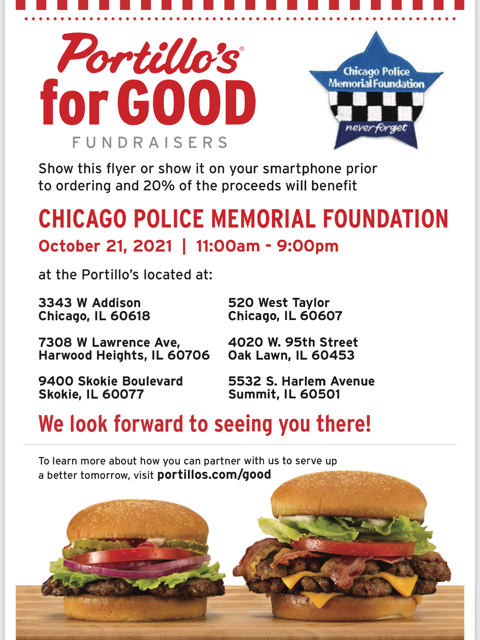
Portillo's fundraiser next Thursday for Chicago Police Memorial Foundation
Anyone buying lunch or dinner at six Portillo's locations on Thursday, October 21, can benefit the Chicago Police Memorial Foundation by showing this flyer before ordering, on paper or on their phone.
Specifically, the CPMF will receive 20% of the proceeds for food orders placed, using the above flyer, between 11:00 a.m. and 9:00 p.m. on the 21st. Not all Portillo's restaurants are participating; the participating locations are in Oak Lawn, Summit, Harwood Heights, Skokie, and in Chicago at 520 W. Taylor St. and 3343 W. Addison St.
In September 2021, the CPMF provided $103,700 in assistance including:
- $5,000 in Non-Line of Duty Death Assistance,
- $11,200 in Officers in Need of Assistance,
- $2,000 in Disability Assistance,
- $8,500 in Education Assistance, and
- $75,800 in Gold Star Families Memorial & Park Maintenance.
In addition, the CPMF provided assistance to Gold Star Families, Chicago Police Survivors, and Widows of CPD Officers killed in the line of duty. The toal assistance given so far in 2021 comes to $769,700.
Thursday, October 07, 2021
Did Confederate die-hards start the Great Chicago Fire? New book suggests they did
![]() |
| Currier & Ives lithograph obtained from the Chicago Historical Society |
Tomorrow marks the 150th anniversary of the beginning of the Great Chicago Fire. Although it is an event so important in our civic history that it merits one of the four stars on the Chicago flag, it is also shrouded in myth and mystery.
And maybe this is so for a very good, and hitherto unsuspected, reason: To paraphrase Jack Nicholson in A Few Good Men, perhaps we can't handle the truth.
That's a conclusion you may come to if you read a new book by Robert P. Hillmann, The Great Chicago Fire: The Southern Rationale.
Full disclosure: I've known Bob Hillmann since we were both history majors at Loyola University in the 1970s and I can vouch for his assertion, in the book, that it was many years in the making.
A goodly portion of the book is devoted to an utter demolition of a number of popular understandings of the fire. Mrs. O'Leary, and her cow, and Peg Leg Sullivan are all exonerated. What is compelling in Hillmann's step-by-step, moment-by-moment account, drawn from original sources, is the conclusion that there was no one Chicago Fire; there were many. And windblown embers or flying, flaming timbers did not kindle these many fires, or certainly not all of them: The immediate eyewitness testimony suggests that many buildings caught fire from within -- and in a pattern that had nothing to do with documented wind patterns.
And, yes, we all know that the Water Tower did not burn... but the nearby Water-Works (which should have supplied water to fight the fires) did. And it was supposed to have been fireproof.
Once you realize that there were not one, but many Chicago Fires that erupted on the evening of October 8, 1871, a number of uncomfortable questions arise.
To ease into this... back when I was representing insurance companies in fire cases I learned that multiple points of origin are indicative of arson. As it is with suspicious residential fires, so it is with burning cities. But... if all of these fires... or even if only some of these files... were set, who were the arsonists? And if the facts, then as now, pointed to arson, why did the authorities gloss over these facts, spreading malarkey about cows and hurricanes instead?
Hillmann's book suggests some new, intriguing, and very unsettling answers.
We all think of the Civil War ending when Lee met Grant at Appamattox Court House in April 1865. That's the way it was taught in school. But Joe Johnston was still in the field when Lee surrendered, as was Kirby Smith. The Juneteenth holiday commemorates the Federal reoccupation of Galveston, Texas (a full two months after Lee handed over his sword). The Rebellion did not end neatly or suddenly; it sputtered out here and there and (based on personal observations during a 2015 driving trip through the South) in some places maybe not at all.
And at least two types of Reconstruction followed. Andrew Johnson's personal Reconstruction policy allowed all the Rebel leaders to remain at large (even Jefferson Davis spent no more than a couple of years in custody). Though the "Radical" Republicans could and did overturn his equally lenient political settlement, requiring, if only for a brief time, the Southern States to allow Black votes and accept Black elected officials, the persons most implacably opposed to Congressional Reconstruction were free to work -- and work together -- to undermine it.
And, as Hillmann's book makes clear, the political and military leaders of the failed Rebellion had more tools at their disposal than sympathetic Democratic politicians and editors in the North. The Confederates had developed an extensive secret service during the war years, operating out of Canada, and arson was a favorite tactic for their covert operators. And Southern arsonists used a particular type of incendiary, referred to as "Greek fire," after the legendary superweapon of the Byzantines. The similarities in properties between these documented Confederate incendiary devices and incendiary devices discovered in Chicago after the Great Fire provides some important circumstantial evidence for Hillmann's hypothesis of Southern involvement.
And that's not the only evidence Hillmann offers -- but you may want to read about it yourself. Among the questions you may ask: What was P.G.T. Beauregard hoping to give President Grant on that train? An olive branch? Or a threat? Both?
We can never know for sure whether the Great Chicago Fire was really a die-hard Confederate werewolf operation. It's an explanation that fits a lot of the facts -- although not all of them, certainly. There were two other massive fires in the Midwest at the same time, one in Peshtigo, Wisconson, and the Great Michigan Fire. By some measures, both of these other fires were worse than the Chicago Fire. But the Southern Rationale checks a good many boxes. Hopefully Hillmann's new book will spark (if I can use that word here) further academic inquiry.
What we do know for sure is that the political will to support Reconstruction began to fade well before the disputed presidential election of 1876. Did the vulnerability of northern cities to organized bands of die-hard Rebel arsonists contribute to that erosion of political will? The abandonment of Reconstruction lead to 90 years of Southern White Supremacist domination in Congress and 90 years before the Reconstruction Amendments acquired any meaningful statutory teeth. The surrender of the promise of Reconstruction, for mere partisan advantage, is a matter of national embareassment, which continues to damage the nation today. If part of the explanation for the failure of the political will to support meaningful Reconstruction was capitulation to terrorist threats---if we shifted the blame for the Fire to poor Mrs. O'Leary's cow to preserve a fragile peace, at the expense of the nation's Black population---our national shame is even greater.
But, as my mother used to say, tell the truth and shame the Devil. The way forward requires looking back honestly. And accurately. And it may require looking South.
Tuesday, July 13, 2021
Get the kids vaccinated against COVID-19 almost anywhere you want
The messaging is still a bit muddled -- the post for this week's vaccination event at Wright College (click here to sign up) speaks of eligibility for all 16 and older (persons under 18 must be accompanied by a parent or guardian who can give consent) -- but the City's website says kids as young as 12 can get vaccinated.
The City says that Jewel-Osco, Walgreens, CVS, and Walmart will all vaccinate kids 12 or older.
A list of City-operated sites offering vaccines to kids 12 and older is on that same linked page. I've reproduced it here (click to enlarge or clarify):
Did you notice? Loretto Hospital is back on the list. How about that?
Thursday, July 23, 2020
Website may explain why there are so many protests these days
Most are reportedly peaceful, though not all. Almost all, however, are "Prohibited Gatherings" within the meaning of the current (June 26) Order (No. 2020-9).
Still, the protests go on.
And many seem to be covered faithfully on the day's newscasts.
Why are these events drawing such large numbers?
The Observer Paradox plays a role, surely. The Observer Paradox states that any phenomenon being observed is unwittingly influenced by the presence of the observer. In other words, a TV camera will attract people who want to get on TV just as surely as a bug zapper in the backyard will attract mosquitoes.
And some will say it's the result of boredom (beaches and movie theaters closed, bars closed, hardly any sports on TV), or pandemic-related layoffs or unemployment.
These probably play a role.
But I recently stumbled across another possible explanation: A webiste, called Protest Chicago. The mission statement of the site reads as follows:
The rise of activism has made it difficult for action-minded people to find out where and when people are gathering to raise their voices. The volume of protest events is large and increasing, and it’s hard to find a comprehensive list of events in one place. ProtestChicago.com is an online guide to Chicago-area protest events, striving to consolidate all area protests into one easy-to-use website.Notice that only "progressive" protests may apply for inclusion on the Protest Chicago site. A pro-police rally, or a pro-life prayer vigil, will not receive any mention.
ProtestChicago.com accepts any protest and rally event notifications from progressive organizations and lists them in a simple, clean format. Events are displayed in chronological order, and include all the relevant details – including links to organizers’ own promotional media – with no analysis, opinion, or comment.
Please note that ProtestChicago does not organize events. All information is posted in good faith, from public sources, and may not reflect any last minute changes orchestrated by event organizers. If you wish to contact event organizers, please use the links provided to reach out to them.
Content is limited to progressive public rallies and protests.
Anyway, thanks to Protest Chicago, when the woke awake each morning, or afternoon, they can merely reach for their phones to find where they can next parade their virtue.
Some days, like today, are doubleheader days.
It's already begun, so unless you're already downtown, you'll probably miss the No Cops No Feds No Secret Police rally now ongoing at the Federal Plaza. Listed sponsors of the event are Black Lives Matter Chicago, Chicago Democratic Socialists of America, the #LetUsBreathe Collective, Brighton Park Neighborhood Council, BYP 100 Organized Communities Against Deportations, Chicago Alliance Against Racist and Political Repression, Northside Action For Justice, Chi-Nations Youth Council, SOUL - Southsiders Organized for Unity and Liberation, and United Working Families.
Later, everyone can head over to Logan Square Park, starting tonight at 7:00 p.m., for the Logan Square Lockdown:
Sponsors of the event are GoodKids MadCity & Blck Rising.
And tomorrow night the big event is the Freedom Square Anniversary Rally to #DefundCPD, starting at 4:00 p.m., in time for the early evening newscasts, at Homan & Filmore. Sponsoring organizations are listed on Protest Chicago as The Let Us Breath Collective, Chi-Nations, Black Abolitionist Network (BAN), Chi Resists, Black Youth Project 100, and Black Lives Matter Chicago.
The event summary describes what organizers envision for the event... and the future:
DEFUND CPD • DECOLONIZE ZHIGAAGOONG • DEMAND THE CLOSING OF HOMAN SQUARE | Four years ago, we liberated the vacant lot across from CPD black site Homan Square and held a protest encampment for 41 days. We made art, met survivors, fed hundreds of neighbors daily, and declared it an autonomous zone where we imagined our liberated future without police.I'm afraid I did not know what was meant by "DECOLONIZE ZHIGAAGOONG." Perhaps I have sheltered in place for too long.
Join us this Friday as the campaign to #DefundCPD celebrates the 4 year anniversary of Freedom Square. Our city and our mayor spend $1.8 billion on police each year, and in return they terrorize our youth and brutalize people to protect property. Meet us at Homan & Fillmore on Friday to imagine a world where we divest from torture, genocide, and slavery and invest in our beautiful future....
But, once I knew this was a matter of concern to some people, I was able to obtain a translation. From the Triibe website:
In Chicago, Black, Brown and Indigenous organizers have been fighting for the city to recognize and honor a variety of truths. On July 17, at a Black and Indigenous solidarity rally in Grant Park, they called for the city to defund the Chicago Police Department (CPD) and decolonize Zhigaagoong, a movement to restore native lands to the Indigenous people who lived in Chicago before they were forcibly removed by the U.S. military in 1833. The word “Zhigaagoong” derives from the Native Anishnaabemowin language and refers to the unceded Niswi-mishokdewinan territory east of Michigan avenue.I mean to express no opinion about the seriousness or sincerity or practicality of the issues put forward by the organizers of these events.
But it occurs to me that we are in the fifth month now of what was supposed to be a two-week shutdown caused by a public health emergency. A public health emergency exacerbated, and extended, by persons gathering in large groups.
The City of Chicago faces any number of serious issues, including an alarming rate in the increase of murders and shootings in several areas, even downtown. Many businesses that closed their doors at the outset of this emergency will never reopen. The jobs and tax revenues produced by those enterprises are gone forever. How long will courts be able to function half-open, half-closed? Traffic court reopened... and closed again. Other businesses reopened but, like bars and restaurants in the City of Chicago, they, too, may close again. Schools, though promising to reopen, may or may not.
If one faithfully follows all the links in this post, one will see that organizers all encourage the use of masks. And that's great. Really. But until we get our world back -- if we can get our world back -- are these gatherings really helpful? Or do they prolong our collective shutdown?
Tuesday, July 21, 2020
When does Phase IV apply and when does it not?
- Bars, taverns, breweries and other establishments that serve alcohol for on-site consumption without a Retail Food license will no longer be able to serve customers indoors.
- Restaurants that serve alcohol will be allowed to continue to operate as long as they abide by ongoing COVID-19 guidance and existing regulations.
- Establishments without food may still provide outdoor service as they did under phase three.
- Maximum party size and table occupancy at restaurants, bars, taverns and breweries will be reduced to six people.
- Indoor fitness class size will be reduced to a maximum of 10 people.
- Personal services requiring the removal of face coverings will no longer be permitted (shaves, facials, etc.).
- Residential property managers will be asked to limit guest entry to five per unit to avoid indoor gatherings and parties.
There was quite a bit of social activity and interaction in Grant Park on Friday, July 17.
The above two images are taken from video footage released by the Chicago Police Department concerning this incident. To watch the entire six-minute video, click here.
These two images are taken from footage taken by WGN-TV:
The good news, I suppose, is that many of those shown in the above photograph are wearing masks.
Still, this seems quite a lot of social activity and interaction, without a bar or restaurant in sight.
Despite the crackdown on bars and restaurants, the City of Chicago says that we are in Phase IV of its reopening plan. Whereas in Phase III of the City plan, social gatherings were to be limited to 10 or fewer persons, no numeric restriction is specified on the linked page for Phase IV.
But a numeric restriction is specified by the City in Order No. 2020-9 issued by the Commissioner of the Department of Public Health. Attachment A specifically provides:
PROHIBITED GATHERINGSBut there are a few exceptions to this definition, and the potentially relevant one for our purposes is paragraph (c). The following is not a Prohibited Gathering:
Any Gathering of more than 50 people, any two or more of whom are within six feet of each other, convening for more than ten minutes, is a Prohibited Gathering. To the extent possible, individuals in gatherings of 50 or fewer are still encouraged to maintain six feet of social distancing with individuals who are not members of the same household.
A grouping of people: (1) located outdoors; (2) for a meeting at which participants will be sitting, standing, or otherwise remaining stationary for ten minutes or more; (3) the total of all people at the meeting is limited to 100; and (4) each person or household is separated from each other person or household by a minimum of six feet.Clearly there were more than 100 people at Grant Park last Friday. There have been numerous protests since of one kind or another -- watch the news any night -- which would likewise appear to fall within the City's definition of Prohibited Gatherings.
Reimposing restrictions on bars and restaurants is all well and good, but if we are ever to emerge from this Never Ending Year of Pandemic, won't these Prohibited Gatherings also have to stop?
Or does Phase IV not apply to gatherings deemed righteous?
Is the COVID-19 virus really that woke?
Please note that I am expressing no opinions whatsoever. I am merely asking questions.
Wednesday, March 11, 2020
BREAKING: St. Patrick's Day Parades cancelled!
Canceling parades just before the primary? I would not have believed it possible.
Friday, June 14, 2019
Election lawyer co-authors book; book signing Tuesday, June 18 at Lizzie McNeill's
Fellow election lawyer James P. Nally reports that Dorf will be signing copies of his book at Lizzie McNeill's, 400 N. McClurg Ct., on Tuesday, June 18, from 5:00 to 7:00 p.m.
I am speculating here, admittedly, but I suspect that copies of the book may also be available for purchase at the book signing event.
Tuesday, June 14, 2016
Sometimes you gotta maintain perspective....
It's not 'sour grapes' to harrumph about the prior association. Please. I am certain that there were a great many applicants for the Circuit Court appointment (Justice Theis uses a committee to screen judicial wannabes) who were at least as qualified and capable and smart as Ms. Quish. And who'd do as good a job in office, too.
On the other hand, when your sink backs up, do you call the plumber who fixed your hot water heater last year? Or do you ignore that good experience and pick a name out of the phone book? You might ask your neighbors who they've used -- and your neighbors probably know some excellent plumbers, too -- but (in Chicagoese) if you've 'got a guy,' why would you look elsewhere?
Human nature is hard to overcome. We tend to rely on those we know, those we've met before, those with whom we have some 'history.' (This, I think, is the true value of diversity programs -- these help us meet people we'd not otherwise have met and find we share things in common we would otherwise never know. Our list of 'who to call' -- or who might call us -- grows.)
One of the anonymous comments (they're all anonymous, of course; only an idiot blogger gives his name) was signed "The Guy Nobody Sent." Another, after venting about Ms. Quish, added, "please do not get me started on the Mikva appointment to the Appellate Court. If the Mikva name sounds familiar to anyone with respect to Democratic Politics, it should."
Yes, the name Abner Mikva is familiar... former State Representative, former Congressman, former Judge of the United States Court of Appeals for the District of Columbia Circuit. Former White House Counsel (during Bill Clinton's first term). Mentor to a then-young Barack Obama. The ultimate insider.
Except... on my bookshelf is a book, yellowing slightly now with age, by the late Milton L. Rakove, titled We Don't Want Nobody Nobody Sent (Indiana University Press, 1979). It's an "oral history" of the Daley years (that's the Richard J. Daley years for you young people out there). Think Studs Terkel, only Professor Rakove was interviewing politicians, not war veterans or people along Division Street.
Here is Abner J. Mikva, quoted by Professor Rakove (p. 318):
I guess I had always an interest in politics. The year I started law school, 1948, was the year that Douglas and Stevenson were heading up the Democratic ticket in Illinois. I was all fired up from the Students for Douglas and Stevenson and passed this storefront, the 8th Ward Regular Democratic Organization. I came in and said I wanted to help. Dead silence. "Who sent you?" the committeeman said. I said, "Nobody." He said, "We don't want nobody nobody sent."Abner Mikva may be as much of an "insider" as anyone can imagine... now. But he was the original nobody that nobody sent.
Things change. Today's outsiders may be insiders tomorrow. I don't pretend to know what alchemy or magic spell converts an outsider to an insider. But history shows that it happens. Sometimes.
Monday, May 30, 2016
Norwood Park observes Memorial Day
The 2016 Norwood Park Memorial Day Parade was held this morning under picture postcard conditions.
We can't have a parade without politicians -- maybe this could happen elsewhere, but never in Chicago. The first political group down the street Monday morning was Water Reclamation District Commissioner Frank Avila... and family.
There were more politicians on the march, but first there were old police cars...
... and historical reenactors....
They were far enough away when they loosed a volley that my granddaughter Diana was fascinated, not frightened.
The parade Grand Marshal was 95-year old Army vet Morris Factor. According to Heather Cherone's article, posted May 2 on DNAinfo, Factor served with Merrill's Marauders in Burma (now Myanmar).
Smyser Elementary School's marching band provided entertainment.