Sunday, February 27, 2022

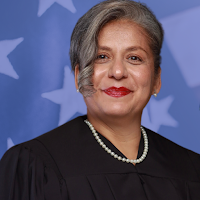
Funeral arrangements announced for Judge Susanne Groebner

A number of readers called this to my attention. This is from Facebook:
Most of you know that Susanne Groebner passed away suddenly on Friday. She was the most amazing mother, a supporting and loving spouse, a dedicated daughter, a compassionate fearless prosecutor, and a proud serving judge. Bob has asked that I share the following with everyone. The obituary is to follow.

The visitation will be on Wednesday March 2, 2022 at 3:00 to 8:00 p.m. at Morizzo Funeral Home, 2550 Haskell Road, Hoffman Estates, Illinois 60169.

Visitation will will also take place on March 3, 2022 at 12:30 to 1:30 p.m. at Holy Family Church 2515 W. Palatine Road, Inverness, Illinois 60667. Mass to follow at 1:30 p.m.
Judge Groebner was elected from the 13th Subcircuit in 2020.

Thursday, February 24, 2022

Volunteer judges needed for Student Trial Advocacy Competition

UIC Law School (the law school previously known as John Marshall) will be co-host to the Midwest 2 Region of the American Association of Justice's 2022 Student Trial Advocacy Competition (STAC) from March 10 to March 13.

According to Kelly Navarro, Director of the UIC Law Trial Advocacy and Dispute Resolution Program, 160 teams will compete in three STAC qualifying rounds, semi-finals, and a final round where winners will move onto the national finals. National winners will receive scholarships and the opportunity to attend the AAJ Annual Convention.

The Chicago portion of the event, at least, will be held online.

Volunteers are needed to serve as judges for the Chicago event on any of these dates or times:
  • Thursday, March 10: 4:30 - 7:30 p.m.
  • Friday, March 11: 2:30 - 6:30 p.m.
  • Saturday, March 12: 9:30 a.m. - 12:30 p.m.
  • Saturday, March 12: 1:30 p.m. - 4:30 p.m.
  • Sunday, March 13: 9:30 - 12:30 p.m.
CLE credit is available for lawyers who assist in judging the STAC competition.

Interest persons need to complete and return this form. The 2022 AAJ STAC Problem Rules are also available from that linked signup page. Questions about the event should be directed to Ms. Navarro at navarrok@uic.edu.

Gudino campaign website goes live

A campaign website has been established in support of Judge Ruth Isabel Gudino's effort to hold onto her countywide seat. That's a link to the site in the preceding sentence; a link has also been added to the Sidebar on this site.

The Illinois Surpeme Court appointed Gudino to the bench last fall. She was previously a finalist for Cook County associate judge in 2019. Gudino is running for the court with the endorsement of the Cook County Democratic Party.

Licensed in Illinois since 1995, according to ARDC, Gudino's campaign bio stresses her lengthy career as a Cook County Assistant State's Attorney. She joined that office after beginning her legal career with the Cook County Public Gaurdian's Office.

Gudino actually served two hitches with the State's Attorney's Office, according to her campaign bio. In her first stint in that office, from 1997 to 2001, Gudino served in a variety of capacities. But she left that office to work for the UAW-GM Legal Services Plan as a staff attorney, handling small claims, probate, real estate, and breach of contract cases for Ford and General Motors union employees, according to her campaign bio.

Gudino returned to the State's Attorney's Office in 2003, working in the Juvenile Justice Bureau at the time of her appointment to the bench.

According to her campaign bio, Gudino was a volunteer firefighter with the Roberts Park Fire District from 1999 to 2001. She served on the Fire and Police Commission for the Village of Westchester from 2012 to 2017 and, from 2011 to 2015, was a member of the school board for Divine Infant Jesus School in Westchester.

Wednesday, February 23, 2022

Judge Araceli De La Cruz campaign website launched

A campaign website is now up and running for Judge Araceli De La Cruz. That's a link to the new website in the preceding sentence; a link has also been added to the site Sidebar.

Appointed to a countywide vacancy by the Illinois Supreme Court, De La Cruz began her judicial career quite recently. Shortly after her appointment was announced, De La Cruz was slated for a countywide vacancy by the Cook County Democratic Party.

This is the second time De La Cruz has run for judicial office. She also ran, with Democratic Party backing, for a countywide vacancy in the 2020 election cycle.

De La Cruz was first licensed to practice law in Illinois in 2001, according to ARDC. Her campaign biography notes that she spent the first eight years of her legal career as a Cook County Assistant State's Attorney. She moved over to the Chicago Transit Authority in 2009, starting as Chief of Safety and Security Compliance, then serving as Deputy Chief of Staff in 2010 – 2011, before becoming the CTA's Chief Safety and Security Officer, Senior Vice President.

In 2014 De La Cruz became Chief of General Prosecutions in the Division of Professional Regulation of the Illinois Department of Financial and Professional Regulation. Then, in 2016, De La Cruz became General Counsel and Chief Administrative Officer for Acero Schools of Chicago, a non-profit unionized public charter school network comprised of 15 schools serving some 7,000 students, according to her campaign bio. She was working for Acero Schools at the time of her judicial appointment.

Campaign website found for Judge John W. Wilson

A campaign website has been launched in support of the campaign by Judge John Wellington Wilson to hold the 1st Subcircuit seat to which he was appointed last summer. That's a link to the new website in the preceding sentence; a link has been added to the site Sidebar.

Licensed as an attorney since 1996, according to ARDC, Wilson's campaign bio discloses that he was serving as the acting Chief of the Public Defender's Office in the Sixth Municipal District – Markham Division at the time of his bench appointment. Previously Wilson the homicide and felony supervisor in the Public Defender’s Markham Division. Before that, Wilson was a member of the elite Homicide Task Force Unit (HTF) in the George S. Leighton Criminal Courts Building.

Wilson's campaign bio notes that, before he went to law school, Wilson worked as an administrator for the City Colleges of Chicago. He was also an Assistant Men's Basketball Coach for Wilbur Wright Community College. He has also served as an adjunct professor at UIC John Marshall Law School’s Summer College to Assess Legal Education Skills (SCALES) program.

Friday, February 18, 2022

Koula Alevizos Fournier to seek 4th Subcircuit vacancy

Koula Alevizos Fournier is planning to seek one of the two 4th Subcircuit vacancies in the 2022 Democratic primary. A campaign website has been established in support of that candidacy. That's a link to the campaign website in the preceding sentence; a link has also been added to the Sidebar on this site.

Fournier has been licensed to practice law in Illinois since 2000, according to ARDC. Her campaign bio says that Fournier has spent her career in the Cook County State's Attorney's Office. She is currently assigned to the Criminal Appeals Division. Before this assignment, Fournier was a Sex Crimes Trial Specialist, handling "high-profile sexual assault and domestic violence cases."

According to her campaign bio, Fournier has served on the School Board for Pythagoras Children’s Academy in Elmhurst, Illinois and is also actively involved in her church, St. Demetrios Greek Orthodox, where she serves on the Board of the Philoptohos (friend of the poor) Society, which helps those in need in the community.

Fournier was president of the Hellenic Bar Association in 2020-21 and currently serves as chairperson of its Board of Directors, according to her campaign bio.

Nick Kantas announces for Gavin vacancy in the 4th Subcircuit

There are two vacancies in the 4th Judicial Subcircuit this year. Assistant State's Attorney Nick Kantas' new campaign website is unusual in that it specifies that Kantas will be seeking the Gavin vacancy there. That's a link to Kantas's website in the preceding sentence; a link has been added to the site Sidebar as well.

Kantas has been licensed to practice law in Illinois since 2004, according to ARDC. A career prosecutor, Kantas worked his way up to a First Chair in the Felony Trial Division before being appointed Supervisor in the Juvenile Justice Division, according to his campaign bio.

According to his campaign bio, Kantas serves as Commissioner for the Lyons Township Mental Health Commission and as Coordinator for the Western Springs Peer Jury Program. He also has served as a Trustee of the Lyons Township School Treasurer's Office.

A recent Sun-Times article noted that Kantas is married to Maren Ronan, a lawyer and lobbyist, and the daughter of retired State Rep. Al Ronan. Kantas' campaign bio notes that he and his wife have two children.

Chloé Pedersen to make 4th Subcircuit run

A campaign website has been established in support of the 4th Subcircuit judicial campaign of Chloé Pedersen. That's a link to her campaign website in the preceding sentence; a link has been added to the site Sidebar as well.

Pedersen, a partner with the firm of Fletcher & Sippel LLC, has been licensed to practice in Illinois since 2007, according to ARDC. Before joining that firm, Pedersen was Chief Legal & Labor Counsel for the Cook County Recorder of Deeds. Before that, Pedersen was as an Assistant Attorney General in the Illinois Attorney General's Government Representation Division. She was Assistant General Counsel to Speaker of the House of Representatives in 2009. Pedersen began her legal career as an associate at Querrey & Harrow, Ltd.

According to her campaign biography, Pedersen has been an active member of the Illinois State Bar Association, serving on the Board of Governors, on the Assembly, the Steering Committee on Racial Inequality, Legislation Committee, and the Women and the Law Committee. She is the Vice-Chair of the American Short Line & Regional Railroad Association's (ASLRRA) Human Resources Committee. She also serves as a member of the Illinois Supreme Court Commission on Professionalism's Mentor Expansion Committee, according to her campaign bio. Over the last two decades has also volunteered as a voter protection attorney or worked as an election judge on election days.

In addition, according to her campaign bio, Pedersen is a former Commissioner for the Proviso Township Mental Health Commission. She has also served on the board of the Women’s Bar Association of Illinois. Pedersen was the treasurer for the Chicago Spirit Brigade, a 501(c)(3) non-profit community-based fundraising organization whose purpose is to raise money and awareness for non-profit groups that provide direct care services to individuals with life-altering challenges. Pedersen was also a member of the Illinois High School Association (IHSA) Competitive Dance Officials Ad Hoc Committee.

According to a recent Sun-Time article, Pedersen is a niece of Cook County Clerk Karen Yarbrough.

FWIW scooped again: Capitol Fax reports 4th Subcircuit bid by ShawnTe Raines-Welch

I check in with Rich Miller's Capitol Fax regularly, often more than once a day.

Unfortunately, I missed the announcement there yesterday that ShawnTe Raines-Welch would be seeking a 4th Subcircuit vacancy in this year's primary. But she is.


Her campaign website is up and running. That's a link to the site in the preceding sentence; a link has also been added to this site's Sitebar.

On Chicago Public Square this morning, Charlie Meyerson linked to Robert Herguth's article about the Raines-Welch announcement in the Chicago Sun-Times

(Between the coverage and comments on Capitol Fax and in the Sun-Times, we now have the names and campaign websites of several other candidates seeking one of the two posted 4th Subcircuit vacancies this June. We will get to each in their turn, but, for the moment, we will focus on Ms. Raines-Welch.)

ShawnTe Raines-Welch has been licensed as an attorney in Illinois since 2009, according to ARDC. She is presently a partner in the law firm of Ancel Glink P.C.

Her campaign bio stresses that Raines Welch has experience "in over ten areas of law including personal injury, civil rights, contracts, municipal law, school law, land use, administrative review and labor and employment law. She currently serves as general counsel for multiple Illinois municipalities and suburban school districts." It also notes that she also serves as a hearing officer for several suburban municipalities (the actual language used is that she "presides over local municipal court," which may sound like an overstatement of the case to a lawyer's ear, but reasonably conveys the idea to voters that she has actual adjucative experience).

There is a picture, on the campaign website, of the candidate with her husband, Illinois House Speaker Emmanuel "Chris" Welch, and their two children. The Speaker is not identified in the photograph. A press release, quoted extensively in the Capitol Fax post linked above, addresses the 'issue' that some may see in the candidate having a well-known spouse: "I know that my husband’s name will be evoked in this election many times. It’s the challenge of having a high-profile family and husband. It’s the challenge of professional women everywhere. The way I see it, Chris is creating his imprint on history, but it in no way vanishes mine. I believe in justice–using laws to fairly judge and determine consequences especially in black and brown communities. I also believe in inclusion-– the practice of providing equal access to opportunities and resources to all. My work is my own, and I look forward to making a difference for my children and all of the families in the 4th Subcircuit."

Tuesday, February 15, 2022

The 2020 election isn't quite over yet....

A number of readers have alerted me to a February 3 Memorandum Opinion and Order by Judge Patrick T. Stanton in the case of DiFranco v. Fallon, et al., 2020 COEL 000032. Here is a link to the decision; you can read the entire thing yourself. There has also been coverage in the Law Bulletin (although I can't link to that... my subscription was a Covid casualty).

Nearly every judicial race in Cook County was uncontested in November 2020. There were only two, in fact, where voters could choose between a Democratic and Republican candidates, one in the 12th Subcircuit, and the other in the 13th.

On Election Night, it looked like there might be a split decision: Although both Republican candidates were leading in early returns, the margin in the 13th was razor-thin. By 9:43 p.m., when I checked in again on these races, Democrat Susanne Michelle Groebner had taken a narrow lead in 13, but, with 229 of 241 precincts reported, 12th Subcircuit Republican candidate Frank DiFranco's margin had substantially increased, to 9,553 votes.

If 2020 had been an ordinary election, with the numbers reported, DiFranco would have been pretty well assured of victory. One can hardly blame DiFranco or his supporters for thinking, on Election Night, that he had won.

But 2020 was not an ordinary election. It was a Covid election, and, in the 12th Subcircuit, as indeed across the country as a whole, the major political parties had employed wildly different get out the vote strategies.

(Why not? They don't agree on anything else either.)

The Republican strategy was traditional, the global pandemic notwithstanding: Get its supporters to the polls on Election Day. The Democrats, however, took advantage of new laws passed for the 2020 election, encouraging their potential supporters, who might have been skittish about showing up in person on Election Day, to instead vote by mail.

Pundits -- for once -- made an accurate prediction: The national electoral map would look surprisingly red on Election Night, but the colors would change as the VBM ballots were tallied. (They made this prediction -- and then, on Election Night, promptly forgot it, losing their dang minds on live TV when it looked like Trump might pull out a second term.)

There were a lot of VBM ballots in Cook County's 12th Subcircuit. And these ultimately proved decisive.

But it took awhile.

On November 12, when I looked at the race again, DiFranco was still ahead, but his margin had declined precipitously, from 9,500 to 2,500:
By November 16, DiFranco's was clinging to a 485-vote lead.

By November 24, when the final results were made known, appointed Judge Patricia M. Fallon had eked out a narrow win over DiFranco, by 502 votes, 82,976 to 82,474.

I have run for judge twice and I know how terrible it feels to lose. How devastating.

But I had the decided advantage -- or so it would now appear -- of being trounced. Rejected. Destroyed. In crowded fields both times I finished dead last.

I have a hard time imagining how much worse it would be to come so close -- to in fact be seemingly far ahead, only to see that lead melt away and, ultimately, vanish. I thank heaven that my imagination is insufficient to the task; what I can imagine is bad enough, thank you.

None of this is meant to excuse or justify the conduct that Judge Stanton found so egregious in the February 3 order linked above. It does, perhaps, explain that conduct, at least a little. If you try and put yourself in DiFranco's shoes, you can perhaps better understand why things have proceeded to this point. He spent nearly $700,000 on the campaign alone (and certainly much more besides in the aftermath). It must be tremendously hard to let this go.

However, in expressing some empathy for how Mr. DiFranco must feel, I do not mean to deny or diminish the different, but still real, anguish that Judge Fallon must be experiencing as this post-election litigation drags on. I have never actually won a judicial election (obviously) but I have been involved in litigation that dragged on for seemingly forever, long past the point where the likely outcome should have become clear to the other side. I can empathize with Judge Fallon here, too.

Unfortuntately, there is no happy medium that can be found in this case. No compromise. No shared custody of the gavel, or visitation in the courtroom on alternate weeks.

The end must come soon.

Even if we assume the best, if we assume that the unmasking of 22,000 redacted signatures on the County Clerk's summary judgment exhibit/thumbdrive (without at least first telling the court and the other parties about this) was not unethical but merely unwise, so that no one is actually looking down the barrel of an ARDC beef, the end result is still the same. The odds of success in the trial court, which were never much to begin with (just considering the history of Illinois election challenges generally), have diminished still further, and considerably so. I seem to recall learning somewhere that it is never a good idea to employ a tactic that the alienates the trial court. (Actually, this is another area in which I have, unfortunately, first-hand experience.) If nothing else, Judge Stanton's order makes clear that he is not pleased with the litigation tactics of Mr. DiFranco's counsel.

Were mistakes made in the vote count?

Undoubtedly.

There is no human enterprise, espcially one this complex, that is free from human error. Only God is perfect.

Were there more than 502 votes counted for Judge Fallon that should not have been counted?

Perhaps there were.

But it would be the height of folly to admit that possibility and then deny that Mr. DiFranco also likely received credit for votes that were improperly tallied.

DiFranco got thousands of mail-in votes too. It's just that he got only two (roughly) for every three that Fallon got.

I suspect -- mind you, I suspect but do not accuse -- that at least some of the people who contacted me about this recent decision were rejoicing, just a bit, in DiFranco's downfall. I understand that impulse, too. A lot of people worked very hard for Judge Fallon and they are pleased, to put it mildly, at this latest vindication.

But that is not what is called for here and now. What is needed now is an end to this, giving all parties the opportunity to recover their dignity and move on.

And, as long as I am giving unsolicited advice, let me say that there is a much bigger problem with VBM than this one suburban judicial race.

Extensive voting by mail -- so that meaningful, potentially result-changing returns trickle in for a week or more after the polls close -- is a really bad idea.

I understand and sympathize with the idea that voting should be made as easy as possible for as many as possible. But the advantage of VBM is outweighed and overcome by the interjection of doubt and uncertainty that VBM adds to our election process. We already have far too many people -- including a great many who should know better -- who are all too willing to cast doubt in advance on the integrity of our electoral process (if it looks like their candidate might be behind in the polls). In the last national election, where the results were close in several swing states, partisans on both sides impugned the election system repeatedly, up to and beyond Election Day, the better to support a possible claim that their candidate, who might lose, actually won. And then the party that actually lost did in fact follow through with unfounded claims that it won.

VBM isn't worth it. No one election contest -- no one election cycle -- is worth risking a loss in the faith and trust and confidence of the American people in their institutions.

In 2022 there will be VBM. The wise candidates will figure out how to maximize their turnout among these voters, too. But we will all be better off if we eliminate, or at least greatly restrict, this potential source of post-election mischief. *Steps down from soapbox.*

Friday, February 11, 2022

Claudia Silva-Hernandez campaign website launches

A campaign website has gone live supporting a bid by Claudia Silva-Hernandez for election to the Cook County bench. That's a link to the site in the preceding sentence; a link has also been added to the site Sidebar.

Licensed as an attorney in Illinois since 2007, according to ARDC, Silva-Hernandez currently works for the Clerk of the Circuit Court. Her campaign bio notes that she has previously worked as an Administrative Law Judge with the Illinois Department of Human Services and, at various times, Silva-Hernandez has worked for the Will County Public Defender's Office, for the Independent Police Review Authority, the Chicago Housing Authority, and the Illinois Attorney Registration and Disciplinary Commission.

Before becoming a lawyer, according to her campaign bio, Silva-Hernandez was a Limited English Proficiency Specialist and taught Latin American Studies, both at Morton Community College in Cicero. She also worked as a counselor at the Chicago office of INROADS, a company dedicated to training young people of color and matching them with corporate employment opportunities.

Silva-Herndandez was born in Blue Island, the child of Mexican immigrants from San Luis Potosí, Mexico, according to her campaign bio. Her father is a retired union boilermaker and her mother is a businesswoman and a dentist, practicing over 30 years in the South Suburbs.

Silva-Hernandez and her husband, a union ironworker, reside with their two children in Gap district of Bronzeville, according to her campaign bio. She and her husband are members of the Gap Community Organization and parishioners at Providence of God/St. Procopius Catholic Church. Their children attend Chicago Public Schools. This is Silva-Hernandez's first attempt at seeking judicial office.

Campaign website up and running for Jacqueline Griffin

A campaign website is now operating on behalf of Cook County Assistant State's Attorney Jacqueline Griffin. That's a link to the new campaign website in the preceding sentence; a link has also been added to the site Sidebar.

Licensed to practice law in Illinois since 2005, according to ARDC, her campaign biography notes that she has spent her entire career in the State's Attorney's Office, starting in the Child Support Enforcement Division before moving to the Juvenile Justice Bureau, as an ASA in the Child Protection Division. Griffin now works as a trial specialist in the Sexual Assault and Domestic Violence Unit within the Felony Trial Division.

Griffin participates in ‘Lawyers in the Classroom’ program, helping middle school students learn about constitutional issues. She has also lectured about sexual assault and consent to high school students.

Griffin sought a countywide vacancy in the 2020 election cycle.

Currently a Bridgeport resident, according to her campaign biography, where she resides with her husband and their two children, Griffin is a native south sider, and a graduate of Mother McAuley Liberal Arts High School. She notes that her husband is a member of the plumber’s union and that she has many family members who belong to the Fraternal Order of Police or the Chicago Firefighters Union.

Monica Somerville campaign website goes live

A campaign website has been launched in support of Monica Somerville's 2022 judicial campaign. That's a link to the site in the preceding sentence; a link has been added to the site Sidebar.

Licensed in Illinois since 1990, according to ARDC, Somerville's campaign biography describes a varied legal career. According to her campaign biography, Somerville has, at one time or another, served as an Assistant Corporation Counsel (rising to Chief Assistant Corporation Counsel of the Torts Division) for the City of Chicago, as an attorney for the United States Postal Service, as Supervising Administrative Law Judge for the Illinois Department of Employment Security in the Appeals Division, and as litigation counsel for the Attorney Registration & Disciplinary Commission.

Her campaign bio also notes that Somerville is a founder of the South Cook Jaguars, a youth travel basketball program. Somerville has also volunteered with the Chicago Bar Association’s “Lawyers-Lend-A-Hand to Youth” and “Lawyer-to-Lawyer Mentoring Program.”

This is Somerville's first campaign for election to the bench. She did apply for associate judge in February 2021.

Dan Balanoff campaign website launched

A campaign website has been launched in support of Dan Balanoff's 2022 judicial campaign. That's a link to the campaign website in the preceding sentence; a link has been added to the site Sidebar.

Licensed in Illinois since 2007, according to ARDC, Balanoff practices with the firm of Balanoff & Associates on the Southeast Side.

Balanoff was a candidate for an 8th Subcircuit vacancy in 2020, but withdrew before the primary.

Balanoff's campaign website includes a reproduction of a lengthy 1989 Sun-Times article profiling the Balanoff family. Balanoff's father is Robert Balanoff, the Acting Presiding Judge of the Child Protection Division. Robert Balanoff was not yet on the bench when the 1989 Sun-Times article first appeared. The Balanoff on the bench then was Dan Balanoff's grandmother, Miriam. That's her picture with Tom McNamee's article.

I appeared before her.

Hmmmmm.

While his campaign website includes the lengthy article about his family history, Balanoff does not include much by way of a personal campaign biography. But it does include a lengthy personal statement. An excerpt (emphasis as in original):
If you entrust me with your safety and your vote, I'll be a guardian of justice for all citizens, both in and outside of the courtroom. Everyday on the bench, I'll embody the fairness and compassion we so desperately need in these troubling times, while doing my part to keep our streets, our neighborhoods, and our families safe.

You have my word.

Tuesday, February 08, 2022

Volunteers needed for Illinois State Bar Association High School Mock Trial Invitational

The 2022 ISBA High School Mock Trial Invitational will be held virtually on March 11 to 13 via Zoom.

The ISBA is inviting judges, lawyers, paralegals, law students, and other legal professionals to act as "presiding judges, jurors/evaluators, and bailiffs for each trial." The deadline to sign up is February 28, 2022.

Interested persons need to complete this volunteer form.

After signing up, all volunteers will will receive information about the program, including how to participate virtually. Volunteers will need an Internet connection sufficient to participate via Zoom and (the organizers stress this point) volunteers will have to log in to the competition one hour prior to their sessions for orientation and placement into trial rooms.

For questions, or for more information about the event, contact Kim Furr at kfurr@isba.org.

Catholic Lawyers Guild of Chicago offers Lenten retreat on March 11

Ash Wednesday is March 2.

Somehow Lent did not get moved to June along with the primary.

Thus, on Friday, March 11, the Catholic Lawyers Guild of Chicago will offer a Lenten Retreat at the Mission of Our Lady of the Angels, 3808 W. Iowa Street, Chicago. (If you are from Chicago, and that name sounds just a bit familiar to you, it should.)

The Most Rev. Robert J. Lombardo, CFR, Auxiliary Bishop of Chicago, will conduct the retreat, which will begin for in-person attendees at 5:00 p.m. with the Stations of the Cross. Livestream attendees can join at 6:15 p.m., when Bishop Lombardo will begin his initial presentation. Here is the complete schedule for the event:
4:30 p.m. – On-site Confession (available until 6:15pm)
5:00 p.m. – On-site Stations of the Cross
5:30 p.m. – Sharing of a light meal (if conditions allow)
6:15 p.m. – Presentation by Bishop Lombardo in the Chapel
6:45 p.m. – Break
7:00 p.m. – Tour of the Facility
7:30 p.m. – 2nd Presentation by Bishop Lombardo
8:10 p.m. – Closing Remarks with Discussion & Questions
There is no charge to attend this event, whether in person or online, but donations are welcome, with all proceeds being donated to the Mission of Our Lady of the Angels. Registration is required and proof of COVID-19 vaccination is required for all in-person attendees. Parking will be availabe in the lot across the street from the school. Street parking is also available. For registration, click here.

Advertisement: Victory Research offers assistance with signature gathering

We're about halfway through the petition season. If, like many others, your campaign is behind, please know we have experienced circulators on the street waiting to help you get on the ballot. We have helped put literally dozens of Judicial candidates on the ballot over the years. Call (312) 388-1782 to see how we can help. Visit https://www.illinoispoliticalblog.com.

Monday, February 07, 2022

Don Sampen to make 9th Subcircuit bid (and other things discovered on the ISBE website)

The Illinois State Board of Elections does not provide a link to Don R. Sampen's new campaign website, but it did reveal that Sampen has recently put $15,000 into a campaign fund that had lain dormant for some time. (That's a link to Sampen's campaign website in the preceding sentence; a link has also been added to the site Sidebar.)

FWIW readers may recall that Sampen ran for the Appellate Court in 2010 and 2012. According to the ISBE records, Sampen's current campaign committee was created in time for the 2020 primary, but he did not seek either of the two 9th Subcircuit vacancies then.

Licensed as an attorney in Illinois since 1975, according to ARDC, Sampen is a partner with the law firm of Clausen Miller, P.C. His campaign bio notes that Sampen was an Assistant Attorney General before joining Clausen Miller (rising to Chief of the Public Interest Division and Special Litigation Bureau). According to his campaign bio, Sampen has spent his legal career focusing on commercial litigation and appeals. He also taught an insurance law course for 13 years at Loyola University School of Law and, over the years, has handled a number of pro bono cases "in the prisoner rights area," according to his campaign bio.
* * * * * * * * * * *

FWIW readers will also recall that nearly 40 would-be candidates presented their credentials to the Cook County Democratic Party at its slating meeting this past October. Nine of these were slated; another 11 were named as "alternates."

Though Audrey Victoria Cosgrove (who ran a 10th Subcircuit race in 2020) and Jenetia Marshall (who sought a 5th Subcircuit vacancy in 2018) were among those presenting credentials, neither was chosen as a candidate or as an alternate.

According to the ISBE website, Cosgrove has recently filed a final report for her campaign committee. Marshall, on the other hand, just loaned her committee $25,000.

That doesn't mean that Marshall is running for a vacancy in this cycle. But the loan does suggest that possibility. Meanwile, Cosgrove folding her committee does not guarantee that she won't run in 2022 -- but it strongly indicates that possibilty, too.

And, speaking of possibilities, a campaign committee supporting a Cook County judicial bid for ShawnTe Raines-Welch has been set up, according to the ISBE website. Raines-Welch, the wife of Illinois House Speaker Emmanuel "Chris" Welch, applied for associate judge in 2021.

Friday, February 04, 2022

No limits for some Cook County judicial candidates

FWIW readers already knew that Judge Rena Marie Van Tine had filed a Notification of Self-Funding in her race to hold the Leeming vacancy (the vacancy to which she was appointed by the Illinois Supreme Court).

Van Tine is slated for the Leeming vacancy by the Cook County Democratic Pary. One of her slatemates, Michael Weaver, the Party's candidate for the Lynch vacancy, has also filed a Notification of Self-Funding.

And FWIW readers will also remember that John H. Ehrlich and Stephen A. Swerdlow have also filed Notifications of Self Funding.

While her likely candidacy has been mentioned in some comments here, FWIW has not previously reported that Elizabeth "Beth" Ryan, who sought a countywide vacancy in the 2020 primary, is running again this year. But she is. Ryan has also filed a Notification of Self-Funding. This may not come as a particular surprise to FWIW readers who will remember that Ryan filed a Notification of Self-Funding in the 2020 election cycle as well.

But here's one you may not have heard about: Orland Park attorney Bernadette Garrison Barrett has filed a Notification of Self Funding in support of her bid for a judicial vacancy in the 2022 election.

Licensed in Illinois since 1991, accroding to ARDC, Barrett practices with the Barrett Law Group. Her firm website says she handles "divorce and family law litigation, civil litigation and corporate matters."

Her firm website says Barrett "maintains an aggressive litigation style." While acknowledging that "all cases have options of settlement," Barrett knows "that preparation is key and establishes a firm foundation for all cases."

A former President of the Southwest Bar Association, Barrett's firm website also notes her membership in the Illinois State Bar Association, the Will County Bar Association, and, the DuPage County Bar Association.

Barrett also serves on the Board of Trustees for Moraine Valley Community College and as a Board Member of Rise From The Ashes, a non-for-profit organization that provides pro bono legal services to victims of domestic abuse and violence.

Ordinarily, there are limits on what an individual, corporation, or PAC can donate to any Illinois candidate (for the forthcoming election cycle, the individual limit is $6,000; for more, click here). But there is an exception set out in §9-8.5(h) of the Illinois Election Code, 10 ILCS 5/9-8.5(h). This provision states:
Self-funding candidates. If a public official, a candidate, or the public official’s or candidate’s immediate family contributes or loans to the public official’s or candidate’s political committee or to other political committees that transfer funds to the public official’s or candidate’s political committee or makes independent expenditures for the benefit of the public official’s or candidate’s campaign during the 12 months prior to an election in an aggregate amount of more than (i) $250,000 for statewide office or (ii) $100,000 for all other elective offices, then the public official or candidate shall file with the State Board of Elections, within one day, a Notification of Self-funding that shall detail each contribution or loan made by the public official, the candidate, or the public official’s or candidate’s immediate family. Within 2 business days after the filing of a Notification of Self-funding, the notification shall be posted on the Board’s website and the Board shall give official notice of the filing to each candidate for the same office as the public official or candidate making the filing, including the public official or candidate filing the Notification of Self-funding. Notice shall be sent via first class mail to the candidate and the treasurer of the candidate’s committee. Notice shall also be sent by e-mail to the candidate and the treasurer of the candidate’s committee if the candidate and the treasurer, as applicable, have provided the Board with an e-mail address. Upon posting of the notice on the Board’s website, all candidates for that office, including the public official or candidate who filed a Notification of Self-funding, shall be permitted to accept contributions in excess of any contribution limits imposed by subsection (b). If a public official or candidate filed a Notification of Self-funding during an election cycle that includes a general primary election or consolidated primary election and that public official or candidate is nominated, all candidates for that office, including the nominee who filed the notification of self-funding, shall be permitted to accept contributions in excess of any contribution limit imposed by subsection (b) for the subsequent election cycle. For the purposes of this subsection, “immediate family” means the spouse, parent, or child of a public official or candidate.
There is no guarantee, of course, that all of these candidates will actually file for the 2022 primary. There's no law that requires a declared candidate to file, even after they make such a splashy financial declaration. There's no law that requires a candidate to file even if he or she has exerted great effort in gathering petition signatures.

However, any of these candidates who do file have the privilege of accepting unlimited funds from any legal donor, if such persons or corporations can be found. On the other hand, anyone running against these candidates, for the same vacancy, will have that same privilege. If other well heeled, generous donors may be found.

There have been previous instances of one self-funded judicial candidate squaring off against another self-funded candidate. There was at least one such contest in the 2020 primary season. The problem there, of course, is that, when two lavishly-funded candidates square off, one must lose. And only the winning candidate, and the losing candidate's consultants (assuming they collect on their bills), can be happy then.

Michael Weaver campaign website up and running

Michael Weaver, the Cook County Democratic Party's endorsed candidate for the countywide Lynch vacancy, now has a campaign website up and running. That's a link to the site in the preceding sentence; a link has also been added to the Sidebar on this site.

Licensed in Illinois since 2006, according to ARDC, Weaver is currently the Pro Bono Litigation Partner with McDermott Will & Emery LLP.

In that role, according to his campaign bio, Weaver "cultivates and enhances pro bono litigation opportunities available to the Firm’s attorneys in a wide array of substantive areas that impact the communities in which we work and live." Weaver was previously the Partner-in-Charge for McDermott's LGBTQ+ Diversity and Inclusion Committee. As an associate, according to his campaign bio, Weaver "organized a legal clinic for LGBTQ+ individuals with the Center on Halsted and the Broadway Youth Center of Howard Brown."

Weaver has also spent many years working with the non-profit Family Defense Center (n/k/a Ascend Justice). According to his campaign bio, Weaver was a long-time member of the Board, including as a four-year stint as Board President.

Before joining McDermott, Weaver served as a law clerk for Chief Justice F. Michael Kruse and Associate Justice Lyle L. Richmond of the High Court of American Samoa. He maintains a license to practice there as well, and represents various clients in that territory.

Weaver announced interest in a judicial position during the 2020 campaign cycle, but never filed. He earned his law degree from Loyola University Chicago School of Law. He also holds an M.A. in Higher Education Administration and Human Resource Development from George Washington University.

Weaver lives with his husband, Paul, and their two Pugs, Magnum and Louie, in Edgewater.

Wednesday, February 02, 2022

Circuit Court takes a couple of snow days, sort of; Clerk takes exception

As anybody having business with our local courts today has already found out, the Circuit Court canceled most in-person sessions for both today, Groundhogs's Day, and tomorrow, the Feast of St. Blaise. The Office of the Chief Judge issued this statement on February 1 in conjunction with the announcement:

Due to predictions of significant snowfall in Cook County, Chief Judge Timothy C. Evans today ordered that courts and related operations of the Circuit Court of Cook County may conduct business remotely on Wednesday and Thursday, with some exceptions.

In criminal cases, initial bail hearings and juvenile detention hearings may be held in person. Anyone previously scheduled to appear in court by Zoom in a criminal case shall still appear by Zoom Wednesday and Thursday. Unless otherwise ordered by the judge presiding, cases involving defendants in custody shall be continued until Monday, Feb. 7.

In civil cases, all jury trials now in progress or scheduled to begin on Wednesday or Thursday will be continued until Friday.

In the Domestic Violence Division at 555 W. Harrison St., all petitions for emergency civil no contact orders, emergency civil orders of protection, emergency firearms restraining orders, or emergency stalking no contact orders may be filed by email sent to the Domestic Violence Courthouse and will be heard remotely.

All orders resulting from proceedings held February 2 and 3 and not entered by the circuit clerk during that period shall be entered by the clerk no later than February 9.

Zoom rooms and Help Desks may be closed Wednesday and Thursday, depending on location. No person who is unable to attend a court proceeding shall suffer any adverse legal consequences as a result of a Zoom room being closed. The circuit clerk shall send notice of the new date to all parties no later than Feb. 18.

All employees of the Circuit Court who are able to perform their duties remotely on Wednesday and Thursday will do so, according to the order.

If the COVID-19 pandemic has taught us anything, it has taught us that a lot of business we used to do in person can be conducted remotely, and without cleaning off the car, or shoveling the driveway.

But this is not true for everyone.

In a memo dated yesterday, addressed to Judge Evans and copied to all presiding judges (and obtained by FWIW today), Clerk of the Circuit Court Iris Y. Martinez acknowledged that, while it was appropriate for Judge Evans to consider the safety of "safety and welfare of judges, court system employees, and persons having business with the court," his order did not sufficiently take the welfare of court clerks into account. She elaborated:

As you know, and as your Presiding Judges know, whenever there are court proceedings, whether in-person or remotely over Zoom, my employees must report to the office to conduct their duties and responsibilities. Unlike the judiciary, my clerks do not have the ability to run the court calls remotely. While the judiciary, employees of the Circuit Court of Cook County. and the public do not need to travel to a courthouse tomorrow or Thursday and can safely remain in their homes, my clerks will have to risk their safety and welfare as they report to work.

Martinez expressed disappointment that she "was not consulted or given the opportunity to raise my concerns about the safety of my employees."

She concluded by saying her employees would make their way to their courthouses today and tomorrow -- but said that judges will have to be patient with any weather-related delays.

Some parts of Cook County have been impacted more severely by Winter Storm Landon than others.

While the system snow may be completely out of the area this evening, forecasters are still predicting lake effect snow tonight and tomorrow.

Tuesday, February 01, 2022

Circuit Court to fill 10 associate judge vacancies; filing deadline is March 3

Press release issued today by the Office of Chief Judge Timothy C. Evans:
Chief Judge Timothy C. Evans today posted a notice of ten vacancies for the office of associate judge of the Cook County Circuit Court.

While circuit judges are elected by the public, associate judges are appointed by the circuit judges in a selection process conducted by the Administrative Office of the Illinois Courts. Licensed attorneys submit applications for consideration and undergo evaluations by bar associations. A nominating committee, which includes the chief judge and the presiding judges of various court divisions and districts, then interviews the applicants and selects finalists.

Under Illinois Supreme Court Rule 39, the nominating committee must select twice as many qualified candidates as there are vacancies to be filled; in this case, the nominating committee will select 20 candidates from which the circuit judges will fill the 10 vacancies. Circuit judges then vote on candidates.

The associate judge positions are due to the retirements of Associate Judges John T. Carr, John L. Huff, and Elizabeth Loredo Rivera, the resignations of Associate Judges Timothy J. Chambers, Arthur F. Hill, Jr., Mark Joseph Lopez, and Thomas R. Mulroy, Jr., the appointment of Associate Judge Thomas More Donnelly to the office of circuit judge, and the authorized increase of two (2) associate judgeships for the Circuit Court of Cook County as a result of the 2020 Federal census-based associate judgeships pursuant to 705 ILCS 45/2.

Applications are now being accepted for these vacancies, as well as additional vacancies which may occur during the nomination process. The form and instructions for electronically submitting an application are available on the Supreme Court’s website here. If unable to electronically submit an application, an applicant must submit two (2) signed originals of the prescribed application to Marcia M. Meis, Director, Administrative Office of the Illinois Courts, 222 North LaSalle Street, 13th Floor, Chicago, Illinois 60601.

Note that the application for appointment to the office of associate judge was revised on September 17, 2019, and only applications on the revised form will be accepted.

Whether electronically filed, mailed, or hand delivered, all applications must be received in the Administrative Office within 30 days after the date of the notice. If filed electronically, the deadline is 11:59 p.m. on Thursday, March 3, 2022. If mailed or hand delivered, the deadline is 5 p.m. on that day. A form for application may be obtained from the AOIC or be downloaded from the Supreme Court's website https://illinoiscourts.gov and downloaded from the Judicial Vacancies link. Applications submitted via facsimile will not be accepted.

Applicants should be aware that their names will be released to the media to allow public comment on their candidacy and that a bar evaluation may also be requested.

A couple of notes: Pursuant to Supreme Court Rule 39(a)(1), the terms of all associate judges across the state will expire on June 30, 2023. So whenever this next class is selected, the members of the class will almost immediately have to worry about retention.

The most recent class of associate judges (in 2021) was chosen quite promptly: But last year's six-month turnaround is the exception, not the rule. It took a good 13 months (from the close of applications on August 31, 2018) to the November 5, 2019 announcement of the finalists for the class selected in December 2019. Applicants selected for the short list announced on April 18, 2018 were in an application pool that closed 14 months earlier, on February 8, 2017. It was at least 13 months between the formation of the applicant pool in 2015 and the announcement of the Short List from that group on March 18, 2016.

Judge Sophia Hall named "interim presiding judge" of Chancery Division

Judge Sophia H. Hall has been appointed interim acting presiding judge of the Chancery Division. Hall takes over for Judge Moshe Jacobius, whose retirement was effective January 30.

Judge Hall is not expected to hold the job for long.

FWIW readers will recognize that, in recent presiding judge appointments, Chief Judge Timothy C. Evans, designates the new PJ as an "acting" presiding judge. Assuming the appointment works out as expected, the "acting" designation has been quietly dropped. Eventually. On now clearly discernable schedule. In other contexts, "acting" might be used to mean "temporary" but, given the current use of the word, another word had to be found to indicate a temporary state.

Thus... interim.

And, indeed, in a press release announcing the appointment, Judge Evans said he is interviewing candidates for the Chancery position, and that Judge Hall will serve until a permanent candidate is found. According to the Chief Judge's announcement, Judge Hall has been serving in the Chancery Division for approximately half of her more than 40 years on the bench, and has been serving as administrative presiding judge of the Resource Section of the Juvenile Justice and Child Protection Department since 1995.

In yesterday's press release, Judge Hall was quoted as stating, “I’m deeply honored and privileged to be asked by the chief judge to serve the Circuit Court of Cook County in this capacity.”

Hall was first elected judge of the Circuit Court of Cook County in 1980, serving in the Criminal Division and the Chancery Division before becoming presiding judge of the Juvenile Division in 1992. She was the first female presiding judge of any division or district in the Circuit Court of Cook County.

Hall is past chair of the National Conference of State Trial Judges of the Judicial Division of the American Bar Association and past president of the National Association of Women Judges and the Illinois Judges Association.

Meanwhile, now-retired Judge Jacobius recently told FWIW that he is planning to pursue a new career as a mediator. While JAMS-Endispute hasn't put up a press release yet, Jacobius indicated that he will be joining the JAMS organization shortly. He indicated that he has already received expressions of interest from family law practitioners concerning his services. Before leading the Chancery Division, Jacobius served as presiding judge of the Circuit Court's Domestic Relations Division from 2000-2010.

Thursday, January 27, 2022

How to get petitions signed in the frigid winter

No matter what some liar tells you, it is never easy to get people to properly sign nominating petitions for judicial office. It's difficult to get friends to do it, much less strangers. And you need a whole lot of strangers to sign if you have any hope of surviving a petition challenge. You need a whole lot more signatures than that if you have any hope of avoiding a challenge completely.

And as hard as it is to go knocking on the doors of people you don't know, even on a glorious afternoon in autumn, knowing there are registered voters peering out at you from behind the blinds, actually seeing them, and standing there feeling like an absolute fool until the persons inside give up and open the door or you give up and slink away, how much harder it must be in this Covid-afflicted primary year, when signatures must be gathered in the dead of winter.

What strategies can be employed?

The Cook County Democratic Party has always done petitions in bunches. All nine countywide slated candidates are listed on one petition; one signature thereon is a signature that counts for all nine. The ward organization of, say, a hypothetical Ald. Filch cares nothing for eight of the nine, but pushes the paper for all to help out the one in the alderman's favor. Meanwhile, on the other side of town, an equally hypothetical Ald. Grab likewise cares nothing for eight of the nine, but the one favored by Ald. Grab's organization is not the same one who enjoys the blessings of Ald. Filch. And so Ald. Grab's people push paper to support that candidate -- but all nine benefit. The signatures add up.

However, how does one garner signatures when the ink in the pen may be frozen?

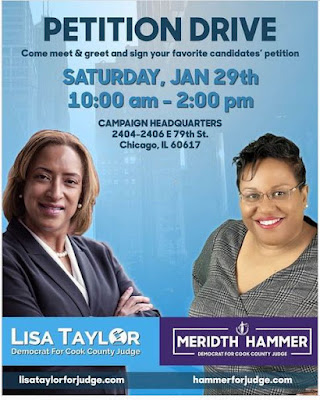
I've been looking online to see what candidates are doing. Here's a screengrab from an Instagram post I saw this morning:

I can't tell from this if these two candidates are circulating joint petitions or merely having an event where persons may sign their individual sheets.

But the idea of running as an alternate ticket is not new this year; it has been done forever. Some of these "tickets" are the most temporary of coalitions -- banding together just long enough to get the joint petitions filed, then all proceeding individually. Some counter-tickets actually share resources and provide mutual assistance after the petitions are filed. At this stage of the campaign, it is hard to tell which is which.

Readers may have seen non-slated candidates circulating joint petitions already; I'm working on verifying some reports of these now. If you have information about petition signing events or alternate tickets, email me at jackleyhane@yahoo.com.

Wednesday, January 26, 2022

Carmen Quinones to seek countywide Hyman vacancy

Family law practitioner Carmen Quinones has announced plans to seek the countywide Hyman vacancy in the 2022 Democratic primary. That's a link to Quinones' campaign website in the preceding sentence; a link has also been added to the Sidebar on this site.

Licensed in Illinois since 1989, according to ARDC, Quinones is a solo practitioner from Wilmette. Her campaign biography notes that she used to have her office in the Humboldt Park and Logan Square area. Initially she handled criminal cases before 'gravitating' to a family law practice, including work as a guardian ad litem and child representative. According to her campaign bio, Quinones has served on the Child Representative Steering Committee and has been involved with the Chicago Bar Association Lawyer-to Lawyer mentoring program.

Her campaign bio also notes that, before becoming a lawyer, Quinones did graduate work in psychology, participating in a doctoral program at Maryland State University from 1970-74, and working as a Manager/Supervisor for the Virginia Department of Corrections.

Tuesday, January 25, 2022

John Fritchey to make 8th Subcircuit run. Apparently.

Former Cook County Commissioner John A. Fritchey is apparently planning to seek an 8th Subcircuit vacancy in the 2022 primary.

So far it's a quiet affair -- an announcement has apparently been made on his private Instagram account -- I can verify that Fritchey has an IG account, and that it's private. That means I can't vouch for the announcement personally. The copy of the brief announcement that has been forwarded to me contains the following statement:

I am confident that my experience, background and beliefs would enable me to be an effective judge who can apply the law fairly while never forgetting the impact our system has on all of us. Whether dealing with criminal cases, custody cases or business disputes, our judges have a major impact on our residents and our residents need to put experienced people on the bench.

According to ARDC, Fritchey has been licensed to practice law in Illinois since 1989. ARDC says that Fritchey now works for F4 Consulting Ltd. His LinkedIn profile says that Fritchey serves as Government Relations Director for that firm.

Before his service on the the Cook County Board, from 2010-2018, Fritchey served as a member of the Illinois House (from 1996). Fritchey did apply for associate judge in 2021.

My search of the State Board of Elections website this morning revealed no obvious Fritchey judicial campaign committee. But whether he's begun raising money yet or not, he should automatically be a credible candidate for whichever 8th Subcircuit vacancy he chooses. Name recognition is important for any political candidate, especially for those in down-ballot races, and Fritchey, as a long-time serving elected official, should have significant name recognition right from the start.

Saturday, January 22, 2022

Guest Post: New election law targets judicial campaign fundraising

A reader alerted me to this article, by Appellate Court Justice Mathias W. Delort, which first appeared in The Gavel, the newsletter of the Illinois Judges Association. It is reprinted here with the kind permission of the author and of the IJA's president, Hon. Barb Crowder (Ret). The accompanying graphic is no doubt obsolete (I'm obviously not a subscriber) but it's what I could find. -- Ed.

by Justice Mathias W. Delort

Every year, legislators in Springfield introduce countless bills to amend the state’s election laws. Most of those bills never see the light of day, because the legislature’s practice was to consider only a single omnibus election bill each term, and then only in the waning hours before both chambers adjourned. This year was no exception.

During the veto session held in late October 2021, the General Assembly adopted this year’s omnibus election bill, Senate Bill 536. On November 15, the Governor signed the bill into law as Public Act 102-668. The new law is almost 100 pages long. Among other things, it moves the 2022 General Primary Election from March to June, temporarily reduces petition signature requirements, and delays the associated petition filing deadlines to accommodate the late-enacted redistricting of congressional, legislative, and other districts. It also delays the long-awaited redrawing of judicial subcircuit boundaries in the 12th, 16th, 17th, 19th, 22nd, and Cook County Judicial Circuits from 2021 to 2022.

The most significant changes of interest to judges and judicial candidates in the new law, however, are its amendments to Article 9 of the Illinois Election Code (10 ILCS 5/9-1 et seq.) which relate to campaign financing. These changes became effective immediately when the Governor approved the bill on November 15.

The first of these changes regulates what commentators call “dark money.” The new law provides that political committees of candidates seeking nomination to the Illinois Supreme Court, Appellate Court, or Circuit Court may not accept contributions (except de minimis ones) from any group that is not required by law to disclose the identity of its contributors. In this context, “contribution” is specifically, and broadly, defined to include “expenditures made by any person in concert or cooperation with, or at the request or suggestion of, a candidate, his or her designated committee, or their agents,” and “the financing by any person of the dissemination, distribution, or republication, in whole or in part, of any broadcast or any written, graphic, or other form of campaign materials prepared by the candidate, his or her campaign committee, or their designated agents.” In practice, “dark money” usually comes from nonprofit organizations such as “social welfare” groups, unions, and trade associations that are not required to disclose their donors.

The second change is an apparent attempt to halt the use of “outside” interest money in Illinois judicial elections. The law contains a new blanket prohibition against the same judicial campaign committees from accepting contributions from any “out-of-state person.” Article 9 of the Election Code defines “person” broadly to include “a natural person, trust, partnership, committee, association, corporation, or any other organization or group of persons.” The new law does not define “out-of-state,” but it appears that it might, for instance, prohibit a candidate from even accepting a contribution from a parent, child, or family member who happens to live outside of Illinois.

Campaign finance regulation had its genesis in the enactment of federal restrictions enacted after the Watergate scandal of the early 1970’s. Most, if not all, states have followed suit by enacting campaign finance laws that promote disclosure of campaign donations and expenditures, and that impose limits on how much a campaign may accept from particular donors. In cases such as Buckley v. Valeo, 424 U.S. 1 (1976) and Citizens United v. Federal Election Commission, 558 U.S. 310 (2010), the United States Supreme Court determined that campaign finance restrictions must be analyzed in light of the First Amendment’s free speech protections, because spending campaign money facilitates political speech. This doctrine, sometimes characterized as “money equals speech,” has led to an avalanche of litigation challenging many campaign finance and disclosure restrictions on the basis of the First Amendment. A good deal of this litigation has been successful. Whether the new Illinois law will pass muster under these precedents remains to be seen. But for now, judicial candidates and those working with their campaign finance committees should be aware of these new restrictions.

Thursday, January 20, 2022

The show must go on....

It's 7 degrees outside in Chicago this morning, but at least it's sunny, right?

I found this picture on Facebook this morning. Volunteers working for Maine Township Committeeperson (and State Sen.) Laura Murphy look happy and warm in this photo, which I'm guessing was taken before they ventured out into the elements. Some judicial candidates may be dismayed to see the emphasis made on the MWRD candidates in the accompanying text....

If you have a photo of persons circulating for a Cook County judicial candidate that you'd like to share, email me by clicking here. Attach the photo (.jpg format) as you would any other file. I don't promise to post them all (and I don't know if I'll get any) but I will try to post where possible. And appropriate.

Zoom Fundraiser tonight for Judge Thomas More Donnelly

Supporters of Judge Thomas More Donnelly's bid for the countywide Sullivan vacancy are planning an online fundraiser for their candidate this evening, from 5:30 to 7:30 p.m. U.S. Senator Dick Durbin is scheduled to make a "special appearance," and the event hosts are Pat Salvi, Tim Eaton, and retired Illinois Supreme Court Justice Thomas Kilbride.

Tickets for the event are $100 each, but government and public interest lawyers will be admitted for $50 apiece. And, of course, sponsorships are available ($500 - Bronze, $1000 - Silver, $2500 - Gold, and $5000 - Host). Tickets may be obtained by clicking here. Links to the Zoom meeting will be provided upon registration. In accordance with the new campaign finance laws, the ticket purchase site contains the following disclaimer: "In accordance with recent changes to Illinois campaign finance laws, contributions are limited to residents of Illinois. If you are not a resident of Illinois, we thank you for your interest, but can not accept a donation."

Wednesday, January 19, 2022

Judge Raines to receive sensitivity training following comments made to courtroom personnel

For anyone who may be unfamiliar with the circumstances, or who may be interested in more context, I link herewith to a post by Debra Cassens Weiss on ABAJournal.com, "Judge disparaged lawyer, apparently unaware of livestream: 'Can you imagine waking up next to her every day?'"

What follows is the statement issued by the Chief Judge's Office concerning the comments made by Judge William B. Raines following a recent Zoom hearing.

The Executive Committee of the Circuit Court of Cook County has determined that the Hon. Judge William B. Raines must receive sensitivity training and gender bias counseling following comments he made to courtroom personnel earlier this month.

Judge Raines made the comments on January 11 while on the bench in his courtroom to an assistant public defender and assistant state’s attorneys, according to an order issued late Tuesday by Chief Judge Timothy C. Evans, who convened the committee. The comments were likely a violation of the Illinois Code of Judicial Conduct, and the committee directed that the incident be referred to the Judicial Inquiry Board.

Judge Raines appeared with counsel at the Tuesday committee meeting and expressed contrition, the order said.

The Hon. Sophia H. Hall, presiding judge of the Juvenile Justice and Child Protection Resource Section, will monitor and mentor Judge Raines and report to the Executive Committee within 90 days on the status of the training and counseling, the order said.

Because Judge Raines has been “publicly implicated in conduct that would likely constitute impropriety or an appearance of impropriety which threatens irreparable injury to the public,” Judge Evans ordered Judge Raines assigned to restricted duties or duties other than judicial duties in the office of the Presiding Judge in the First Municipal District.

The Executive Committee is comprised of the supervising judges of all divisions and districts of the Circuit Court of Cook County.

A lesson in civility from the U.S. Supreme Court

Everyone saw the headlines. The Rolling Stone headline was particularly pungent: "Neil Gorsuch Stands Up for His Right to Endanger Sonia Sotomayor’s Health." Charlie Meyerson's Chicago Public Square newsletter linked to Nina Totenberg's January 18 story, "Gorsuch didn't mask despite Sotomayor's COVID worries, leading her to telework," the story that started it all, before citing to the Urban Dictionary's definition of "maskhole."

Without a fresh angle, there was no reason for FWIW to jump in on a story, even about judges, that was being done to death. I struggled for awhile before one came to me: The courts are always preaching at us about civility. We must be civil to our brothers and sisters at the bar, civil to unrepresented litigants, civil to court staff, and, of course, especially civil to the judges. But... *stepping on soapbox*... how can we be criticized for our many failures when persons at the very apex of the legal profession can not be civil to one another....

Oh, yeah. I was working myself into a state of high dudgeon, which is like low dudgeon, only there's a risk of nose bleed.

But there was a problem: Click on that Rolling Stone link now and you'll see this inserted:

Supreme Court Justices Sonia Sotomayor and Neil Gorsuch released a joint statement on Wednesday pushing back on a report that Sotomayor worked remotely because Gorsuch refused to wear a Covid-19 mask. "Reporting that Justice Sotomayor asked Justice Gorsuch to wear a mask surprised us. It is false," the statement read. "While we may sometimes disagree about the law, we are warm colleagues and friends."

Here's the Tweet from @SCOTUSblog:

There was a major hole in that statement, and the Twitterati were quick to point it out: NPR did not say that Sotomayor asked Gorsuch to mask up; supposedly, that request came from Chief Justice Roberts.

(Apparently, even justices of the United States Supreme Court have diminished comprehension when reading online. And yet, the legal profession marches ever deeper into the realm of efiling. Makes you think, doesn't it? No? Well, it should.)

So the Supreme Court issued another statement, this one from Roberts:

The focus in this brouhaha has been on Gorsuch. But Marcia Coyle reports this afternoon on Law.com, in an article entitled, "Chief Justice Roberts Denies Asking Gorsuch to Wear a Mask," that Gorsuch was not always the only unmasked person in the courtroom:

Sotomayor has worn a mask on the bench since the high court’s return to in-person arguments in October. While it may be coincidental with the rise of the omicron variant, she has participated in arguments telephonically from her chambers during the two-week January argument session. The other justices, with the exception of Gorsuch, began wearing masks on the bench during this month’s arguments.

Even some of the masked justices have at times during arguments removed their masks to ask questions. And since October, some advocates at the court’s lectern have not worn masks while arguing. Many advocates describe the distance between the bench and the lectern as little more than outstretched handshake between them and the chief justice.

I don't know that anyone can make a Justice of the United States Supreme Court do much of anything when he or she is not inclined to do it. But you would think that, if masking were a serious concern for the Court as an institution, they could make counsel wear masks throughout the proceedings. However, Coyle raises a valid question: "Why isn’t Gorsuch wearing a mask like his other colleagues?" Especially to help out a warm colleague and friend....

Still, it is heartening to see that the Supreme Court is concerned about projecting an image of being above the political fray, despite the attempts of so many people to drag it down into the hyperpartisan hellscape on which our public 'discourse' is too often otherwise conducted. The Court is teaching by example: Civility is important. And necessary to the continued viability of our cherished institutions.

(But, Neil, a word of advice here? Wear a mask. As the nuns used to tell me, offer it up, if it makes you feel better.)

Statement from Chief Judge Timothy C. Evans in response to Mayor Lori Lightfoot's requests about electronic monitoring

Statement released by the Chief Judge's Office yesterday. Links are as in original.

Chief Judge Timothy C. Evans responded Tuesday to Mayor Lori Lightfoot’s request for a moratorium on use of electronic monitoring for defendants accused of certain violent crimes by pointing out the national and state constitutional issues raised by imprisoning people before they are convicted of anything. The chief judge also noted multiple problems with the data the mayor provided to back up her request.

The chief judge also pledged continued cooperation with the mayor and the police superintendent in the interests of promoting public safety.

“Regarding your letter of December 29, 2021, I respectfully disagree that the automatic detention in jail of defendants facing certain categories of charges is a constitutional practice under the United States and Illinois constitutions,” Judge Evans wrote. “Pretrial detention serves a legitimate purpose, preventing the serious risk of committing crimes while on pretrial release… Its purpose is not, however, to punish preemptively, by depriving people of their liberty for crimes for which they have not yet been convicted.”

To promote public safety, the court continues to collaborate with the City of Chicago Department of Family and Support Services (DFSS), the SCaN program, and the Courage to Change program to access additional programming for young people involved in the court system, Judge Evans said. The court’s Juvenile Probation and Court Services Department has referred more than 200 youth to SCaN providers since March 2021. Also, DFSS’s One Summer Chicago program has been an integral component of summer programming for court-involved children for at least the past five years.

One aspect of DFSS programming is the Trauma-Informed Centers of Care Network. “We will coordinate with this network of clinics and behavioral health providers to respond to the trauma affecting most court-active young people,” Judge Evans said in the letter. He said that the court welcomes the chance to continue and strengthen these partnerships, and that he has appointed attorney Diane Walsh of the Juvenile Justice Division as the representative to the mayor’s working group on this issue. Judge Evans also noted a recent meeting between Chicago Police Superintendent David Brown, judges, and members of the state’s attorney’s and the public defender’s offices, which included discussion of improving communication between police, the courts, and attorneys, and the appointment of court liaisons.

Judge Evans acknowledged the tragic wave of violent crime in the past year that has afflicted Chicago and other American cities. However, he said that there is no evidence that individuals released from pretrial detention are driving this wave of violence, which, since the beginning of the COVID-19 pandemic, has struck both cities like Chicago that have undergone bail reform and cities that have not.

Judge Evans wrote that if, after a judge hears specific facts of the case, the presumption is determined to be great that an individual is guilty of the crime, that he or she poses a danger to any person if released pretrial, and that no condition or combination of conditions of pretrial release can reasonably assure the physical safety of other persons, then he or she may be detained. In fact, the vast (969 of 1150, 86%) of defendants charged with murder or attempted murder in Cook County between October 2019 and September 2021 were detained in jail for the duration of their case.

However, for 19 percent (6,039) of the 31,946 cases disposed between October 2017 and November 2021 in which the top charge was an offense listed in the mayor’s letter, it was determined through due process of law that the evidence was insufficient even to prosecute them; an additional 1,168 (3.7%) were found not guilty at trial. Those who were detained in jail but not convicted were deprived of liberty without having been found guilty of the charges, and were unable to pursue education, work, or support their families while in jail.

Between October 2017 and November 2021, the Circuit Court of Cook County adjudicated 25,359 cases in which the defendant was charged with one or more of the offenses listed in the mayor’s letter. In 24,191 (95%) of those cases, defendants were convicted. These individuals were held legally accountable for their illegal activity with sentences to prison terms ranging from an average of 3 years for weapons possession to an average of 27 years for murder and attempted murder.

“At all stages of the justice system, the adjudicator must be unbiased,” Judge Evans wrote. “In our justice system, the accuser is not the adjudicator; a judge, not a prosecutor or law enforcement official, must decide whether an individual shall be deprived of his or her liberty.”

The law requires that defendants shall be released on the least restrictive conditions that will reasonably ensure they will appear in court, and that will reasonably protect the community, witnesses, victims or any other person. Research by the Illinois Criminal Justice Information Authority has shown that restrictive conditions such as house arrest on electronic monitoring (EM) should be reserved for higher risk offenders.

The seriousness of the charge does not always reflect the underlying risk of failure to appear or danger to the community, Judge Evans wrote. The number of arrests for new crimes by individuals on pretrial EM is relevant for evaluating whether the program is effective. An independent study in 2020 by the University of Chicago Crime Lab found that more than 95 percent of individuals with gun-related charges released in Chicago on EM were not arrested for a new crime during the year following their release. Of the small minority (less than 5%) of individuals released on EM pretrial who were rearrested, the majority were accused of committing a misdemeanor. The same study found that rearrests on gun charges among this population (pretrial defendants released on EM) represented less than one percent of gun arrests in Chicago during the period.

“As I have stated previously, I do not believe EM is the most effective way to prevent offending while on pretrial release. I believe programs providing cognitive behavioral therapy are a better means of bringing about long-lasting changes in individual behavior,” Judge Evans wrote. “Such programs are already in place, but should be greatly expanded. I welcome additional discussion of ways to fund effective programming for people on pretrial release, to attain our shared objective of a safe and peaceful community.”

The research staff for the Office of the Chief Judge found numerous problems with the data Mayor Lightfoot submitted to support her argument for a moratorium on EM. For example, the research staff examined electronic court docket records and found that, for 5 of the 15 individuals who the mayor’s list indicated were arrested for murder in 2021, the alleged murders occurred in 2020, at a time when the defendants were not on EM. A sixth was placed on EM for a violent offense, and then arrested on murder charges stemming from the same violent incident, not for a new pretrial crime. Issues with the data the chief judge’s office received also were discovered in an independent study by Chicago Tribune reporters. https://www.chicagotribune.com/news/criminal-justice/ct-em-data-misleading-20220114-5i4sngpfszfgfdmgt5zytzfghe-story.html.

The chief judge’s office was unable to find a court filing for murder for five of the cases cited in the mayor’s request. Among new arrests listed for Unlawful Use of a Weapon (gun possession), Aggravated UUW, Felon in Possession of a Weapon, Armed Habitual Criminal (a gun possession charge), and Vehicular Hijacking, the chief judge’s research staff similarly found defendants originally released with nonviolent drug charges and defendants not on EM at the time of the arrest, and were unable to find others.

A list of the charges facing the current defendants on the curfew program may be found on the court’s website at https://www.cookcountycourt.org/ABOUT-THE-COURT/Office-of-the-Chief-Judge/Court-Statistics-and-Reports. In addition, the Office of the Chief Judge publishes a dashboard of quarterly bond court performance measures that include a snapshot of the sheriff’s EM population. This dashboard has been nationally recognized as providing a comprehensive picture of pretrial release in Cook County, and would be the appropriate place to publish statistics on the pretrial curfew population moving forward.