Thursday, March 24, 2011

Supreme Court decides judicial residency case

In Goodman v. Ward, the Illinois Supreme Court today ruled that a candidate for a subcircuit judicial vacancy must be a resident of the subcircuit at the time he or she files for office.

Chris Ward wanted to run for judge in the 4th Subcircuit of the 12th Judicial Circuit (Will County) in last year's primary. Ward was not a resident of that subcircuit when he filed his nomination papers and he did not misrepresent his address. He did, however, execute a Statement of Candidacy, required by law, in which he swore, "I am legally qualified to hold the office of Circuit Court Judge, 12th District [sic], 4th Judicial Subcircuit."

But was he legally qualified? Ward's petitions were challenged by Daniel Goodman (whose wife, Carmen, was the only other aspirant for the Democratic nomination in that subcircuit) on the grounds that Ward was not eligible for office because he was not a resident of the subcircuit. Two members of the Will County electoral board, "mindful of the precept that ballot access should be favored," concluded that "that the governing provisions of the Illinois Constitution were 'arguably ambiguous and uncertain'" and that Ward should therefore be permitted to run (slip op. at 2).

Goodman appealed. The Circuit Court agreed with Goodman, knocking Ward off the ballot. The Appellate Court also agreed with Goodman, though there was a dissent.

The Illinois Supreme Court agreed to hear Ward's appeal, but not to expedite it. In the meantime, Carmen Goodman remained unopposed for the Democratic nomination. She defeated the Republican nominee in November of last year and took office in December. The Supreme Court stated, however, that it would decide Ward's appeal under the public interest exception to the mootness doctrine (slip op. at 4-5).

In ruling against Ward's candidacy today, the Court stated that a candidate for judicial office must be a resident of the unit from which he or she seeks election at the time he or she files to run. Section 7-10 of the Election Code (10 ILCS 5/7–10) prescribes the form that a candidate must file (slip op. at 8):
The form’s language calls for a candidate to swear or affirm that, among other things, “I am legally qualified (including being the holder of any license that may be an eligibility requirement for the office I seek the nomination for) to hold such office ***.” (Emphasis added.) 10 ILCS 5/7–10 (West 2008). Because “am” indicates present tense and because the signed statement must accompany the nominating petition when it is filed, the statute can only be understood to mean that a candidate must meet the qualifications of office at the time he or she files a nomination petition with electoral authorities. No principle of English grammar or statutory construction permits an interpretation of the law which would allow candidates to defer meeting the qualifications of office until some later time.
The Supreme Court noted, too, that the Will County electoral board did not misinterpret §7-10; instead, the board "looked directly to provisions of the Illinois Constitution governing eligibility for judicial office (Ill. Const. 1970, art. VI, §11) and the election of judges (Ill. Const. 1970, art. VI, §12(a)). It interpreted those provisions as requiring only that a person be a resident of the subcircuit at or after the time he or she is actually elected. * * * Implicit in the electoral board majority’s approach was that the Constitution’s eligibility requirements differed from those contained in the Election Code and that to the extent of the difference, the provisions of the Election Code were unconstitutional and could be
disregarded. This was a determination the electoral board had no authority to make." (Slip op. at 9-10).

Some in the news media may be surprised by today's decision in Goodman v. Ward. After Maksym v. Board of Election Commissioners of City of Chicago, --- Ill.2d ---, --- N.E.2d --- (2011) (2011 WL 242421) -- the Rahm Emanuel case -- some may have imagined that a new age of relaxed ballot access had dawned. They may have actually believed that candidates will no longer have to worry about slick political operatives poring over stacks of petitions, looking for picayune or technical defects with which to knock good candidates off the ballot.

But there should be no surprise. Barring major legislative reform of the State's election laws, prospective candidates remain well advised to seek competent counsel familiar with every twist and turn of ballot requirements. And keep in mind, too, that different ballot access rules apply to candidates for different offices. As the Supreme Court pointed out today (slip op. at 13), "No rule of law forbids states from imposing different eligibility requirements for membership in the different branches of its government, and no principle of legal reasoning permits an inference that the framers did not intend to do precisely that here."

Sunday, March 13, 2011

Northwest Side Irish Parade draws aldermanic runoff competitors

The increasingly popular Northwest Side Irish Parade today drew spirited demonstrations of support for each of the candidates in the upcoming 41st and 45th Ward Runoff Elections.


41st Ward Candidate Maurita E. Gavin's large group marched first along Northwest Highway.


Not all of the candidates' supporters are of legal voting age -- or even human. That's an underage Gavin supporter above. At right is a picture of a little dog marching with the group supporting Gavin's opponent, 41st Ward Democratic Committeeman Mary E. O'Connor.

Do not adjust the color on your monitor: Yes, that dog does indeed have a greenish tint. Presumably, this color scheme was adopted for the occasion.


Both aldermanic candidates in the 45th Ward made a showing as well. Candidate John Garrido was at the head of this group:


Garrido's opponent, John Arena, followed soon after. Here a couple of photos of his group:


Thirty-eighth Ward Ald. Timothy Cullerton was not represented in today's Northwest Side Irish Parade, but challenger Tom Caravette was represented:


The runoff election is Tuesday, April 5. Early voting, however, starts Monday.

For more pictures from today's parade, turn to page two.

Thursday, March 10, 2011

Associate Judge applicants: Have you heard from the Alliance yet?

Per email received from the ISBA's Joyce Williams, who (among other things) coordinates the sending and receiving of judicial candidate questionnaires for the Alliance of Bar Associations for Judicial Screening: The Alliance has focused on reaching out to first-time applicants for Associate Judge in the current cycle. Some persons who've applied before might not yet have been contacted (full disclosure: I recently reached out to Ms. Williams for this very reason).

Ms. Williams advises that, if an applicant has not yet heard from the Alliance, please send her an email at jwilliams@isba.org. She will provide you with the appropriate questionnaire.

Thursday, February 24, 2011

Six Chicago wards have better than 50% turnout in Tuesday's primary

Voter turnout in Tuesday's primary was just under 42%.

Yesterday, Progress Illinois published this chart of voter turnout by ward:


Note that the 19th Ward led all Chicago wards with a 74.25% voter turnout. Speaker Madigan's 13th Ward came in next, with a 58.35% turnout, followed by Ald. Michael Zalewski's 23rd Ward at 58.07%.

There were only three other Chicago wards that had a better than 50% turnout -- 41, 45 and 47 -- wards in which there were spirited contests for open City Council seats. In the 41st and 45th Wards, those contests are continuing.

Wednesday, February 23, 2011

Runoffs in 41 and 45

41st Ward Democratic Committeeman Mary O'Connor will face off against Maurita Gavin, an Administrative Aide to outgoing Alderman Brian Doherty.

Lawyer and Chicago Police Lt. John Garrido will meet John Arena (who received the endorsements of the Tribune and the Sun-Times) in a runoff in the 45th Ward.

Something tells me that the Northwest Side Irish Parade will be particularly well-attended this March 13th.

Sunday, February 20, 2011

Getting a clearer picture of speed cameras and other surveillance devices

In yesterday's post, we saw that, in Illinois, neither red light cameras nor Chicago Police surveillance cameras, like this one, can be used to nab speeders -- not without new legislation.

But speed cameras are in use in other American jurisdictions and are quite controversial. See, for example, this page on the National Motorists Association website, from which one may navigate to a number of articles about the perceived evils of speed cameras. (The biggest objection, if I can presume to summarize, is the disconnect between speed cameras and safety. Speed cameras are all about revenue, the objectors claim, and there is mounting evidence that, not only do such cameras not enhance driver safety, they may actually cause an increase in traffic accidents.)

But speed cameras, if I understand the technology, are activated only when a vehicle passes by at a pre-set velocity. That is merely the tip of the surveillance camera iceberg. Here, you're looking a pavement camera. From the Highway Safety Group website:
Astucia's hugely imaginative patented Camera Stud may sound like the stuff of science fiction but is an extremely effective tool of traffic management. Housed within a strong metal casing that protrudes a mere 4 mm from the road surface, the camera is a full–function digital video device producing pin–sharp images of approaching or passing vehicles and their registration plates.

The unit is suitable for use on and off the public highway and is capable of operating in practically all environments. The camera also comes with a computer controlled self cleaning unit so that road dirt and grime are removed regularly to maintain the quality of the image captured.
When I found this site, researching this post, the page linked to a video of cars driving over the camera -- and the license plates were clearly visible. And this was from the obsolete model -- the site was reluctant to show the really "pin sharp" videos for "security reasons." And -- when I went back to check the links before publishing this post -- they were gone.

Yikes.

The Highway Safety Group website touts using this pavement camera with an Astucia speed detection stud, "the newest member of its Intelligent Road Stud family." Data from the stud "can be linked with the Astucia camera stud providing an opportunity to also send Automatic Number Plate Registration (ANPR) data of the vehicle captured simultaneously by the camera stud."

Astucia, despite the Spanish name, is an English company. It seems that Mr. Orwell may have been right, just premature.

It may not be true that the average Briton is caught on surveillance video 300 times a day, but there are apparently a lot of cameras pointed at the streets of England.

There are quite a few in Chicago, too. According to a couple of articles earlier this month in the Chicago Sun-Times, there are more than 10,000 public and private surveillance cameras in the city, "the most extensive and integrated in the nation," according to a February 8 article by Fran Spielman and Frank Main. Their article noted a request by the American Civil Liberties Union for a "moratorium on expanding" Chicago's video-surveillance system until "new rules" are enacted "to safeguard citizens’ privacy."

Spielman and Main reported that Chicago aldermen like the surveillance system "because of the sense of security that cameras can bring to residents of high-crime neighborhoods." But the ACLU questions "the effectiveness of the cameras. The city says they accounted for 4,500 arrests from 2006 through May 2010, which the ACLU pointed out is less than 1 percent of the total number of arrests over that period."

The ACLU did not "identify any misconduct involving Chicago’s camera system," according to the Sun-Times article but instead "highlighted problems in England and other cities." The Sun-Times article didn't specify the problems highlighted in the report, but the executive summary of the ACLU report claims:
Male camera operators have ogled women. Sensitive images have been improperly disclosed – like the image of a person committing suicide, which was later posted to a violent pornography website. A study from England found that camera operators targeted black civilians, substantially out of proportion to both their suspicious conduct and their presence in the population being monitored.
You can read the entire ACLU report here.

Fran Spielman's follow-up article for the February 9 Sun-Times noted Mayor Daley's prompt rejection of the ACLU report. Spielman quotes Daley:
“What cameras are is to prevent crime — to tell criminals, ‘Yes, you are gonna be focused [on].’ There’s nothing wrong with that. And to have the good citizens use our sidewalk and our parks, have our children go to and from school. Have our families go to and from church and feel comfortable. We’re not spying on anybody. This is the public way. We’re not spying or identifying or racial profiling anyone.”
But the unblinking eye of the surveillance camera sees, and perhaps records, everything in its view, both the comings and goings of the innocent as well as the actions of criminals.

The outgoing Daley administration touts surveillance cameras as a useful crime-fighting tool. But the cop on the street may not agree, at least if the popular Second City Cop blog is any indication. Commenting on the ACLU report, SCC stated, "cameras don't prevent anything. That armored car robbery in 011 last week? Directly under a POD camera. It didn't deter anything and didn't even provide decent footage of the event."

Not that SCC welcomed the ACLU report, mind you:
What worries us is the ACLU taking a very close interest in anything to do with the Pods. We figure it's only a matter of time before they file some sort of lawsuit against the Department over camera usage and some copper who was only trying to generate activity for some mission is dragged into Federal court and finds his house is on the line for civil rights violations.
But Chicago is about to elect a new mayor. There will be significant turnover in the Chicago City Council as well. Perhaps these new elected officials will want to take a new look at the cameras around our city and the ways in which they should be used. Certainly the cameras are looking at us.

Saturday, February 19, 2011

Chicago makes Top 10 List of cites with most speed traps, but not all of the charges in the indictment are true

Our fair city has made yet another unhappy Top 10 List, this one a list of the country's worst speed traps. According to the linked article by Cindy Perman, posted yesterday on Yahoo! Autos and provided by cnbc.com, Chicago has the dubious distinction of being the ninth worst city in the country for speed traps. According to Perman's article, we have 153 (and, no, I don't know who counted). However, as will be seen, at least some of Perman's information is inaccurate.

Of Chicago, Perman writes:
Chicago now uses red-light cameras to nab motorists for running lights and speeding, which increases the city's ticketing power. And, while, speed limits are supposed to be determined by engineering studies, [Chad Dornsife, director of the Highway Safety Group,] notes that the last study on one red light speed trap here was done in 1994 and the Department of Transportation deemed the safest speed was 43 miles per hour. The posted limit? 30.

Dorsnife notes two problems here: First, some of the traffic-control devices are 20 and 30 years old. And second, on the interstates, local politicians control the speed limits — and the enforcement in the courts. So, good luck fighting a ticket.

Barnet Fagel, aka "The Ticket Doctor," noted one particularly tricky speed trap: Motorists have to drive at a snail's pace leading up to the entrance to Lake Shore Drive, which then opens up into a six-lane highway. A half-mile in is the speed trap, where the speed limit is 40 and police nab drivers just as they're starting to pick up speed. "Comparable divided highways carry higher speed limits by as much as 10 to 20 mph more," he said.
While I'm certain that Chicago has its share of speed traps, I'm pretty sure that not only are red-light cameras not being used as speed traps, they can't be used for this purpose.

And I refer to not to technological limitations, but legal ones.

There was legislation pending in Illinois to permit the use of cameras to nab speeders; I wrote about it on this blog in March 2009. That speed camera bill failed. Currently, as far as I know, with the exception of the Automated Traffic Control Systems in Highway Construction or Maintenance Zones Act, 625 ILCS 7/1, et seq., "no photographic, video, or other imaging system may be used in this State to record vehicle speeds for the purpose of enforcing any law or ordinance regarding a maximum or minimum speed limit unless a law enforcement officer is present at the scene and witnesses the event." See, 625 ILCS 5/11-612.

The Automated Traffic Control Systems in Highway Construction or Maintenance Zones Act gives the State Police the authority to set up a candid camera in construction zones on expressways or on Illinois Tollways, but, since section 5 of the Act expressly provides that its purpose is safety in construction zones, section 10 imposes a burden on the State to prove, in any prosecution brought under the Act, "that one or more workers were present in the construction or maintenance zone when the violation occurred."

So maybe there are 153 speed traps in Chicago, but "red light cameras" are not victimizing hasty Chicago drivers. At least, not yet.

Gosh -- does this mean that you can't believe everything you read on the Internet after all?

Saturday, February 12, 2011

Real-world evidence supporting non-partisan judicial primaries in Illinois

Albert J. Klumpp, PhD, a Research Analyst with the Chicago firm of McDermott Will & Emery LLP, read my post last month endorsing the concept of non-partisan judicial primaries and left this comment:
Any sort of significant change to our selection system needs to be based on real-world evidence that a different system would be an improvement. (Such as by comparison across systems in different jurisdictions.) Unfortunately that evidence hasn’t been produced—not yet. And the legal community has always been too content to simply offer theoretical arguments without supporting evidence. The electorate that needs to approve a change isn’t likely to be convinced by theory.
These are valid points. People are unlikely to support constitutional change unless they are convinced a proposal is valuable and useful. I can't provide comparisons to different states.

But I can provide some real-world evidence to show why a change to a non-partisan judicial primary is warranted.

According to the Illinois State Board of Elections, a total of 761,626 Cook County voters took ballots in the 2010 primary election.

But nearly 22% of these (21.72706814% if we're being fussy) were denied the opportunity to vote in ten of the 11 countywide judicial primary elections (eight Circuit Court races and three for the Appellate Court). And of these 165,479 voters, only the 161,878 Republican primary voters had the opportunity to choose between two candidates for the countywide McCarthy vacancy.

None of these 165,479 voters had the opportunity to vote for subcircuit judicial candidates, no matter what subcircuit they lived in. There no candidates except Democrats in any subcircuit primary this year.

In 2010 there were, according to the ISBE, 1,424,959 total Cook County voters in the November general election. Why one of every two general election voters is willing to let others narrow the field for them is a question best left to the academics. But primary voters are not content to let others limit their choices; by definition, they show up to make their own choices. But when it comes to judicial candidates, 165,479 voters were essentially shut out of the process, even though they were at the polls.

One may say that this is the fault of the Republican Party. The Republicans could, in theory, furnish their own slate of candidates in every judicial race, thereby insuring that every voter in the fall would have choices. But, in recent years, successful Republican candidates in Cook County are about as common as unicorns. It is understandable, then, that persons seriously aspiring to judicial service in Cook County do not seek office as Republicans.

This, of course, will change. Change is the one constant of the universe. (At one time, the peaks of the Himalayas were a primeval ocean floor.) Frankly, a Republican revival could happen as soon as the next election cycle. But I won't take bets on it.

The Democratic judicial primary functions as a de facto non-partisan primary anyway: For example, in 2008 and 2010, Thomas "TJ" Somer, who was once elected Bloom Township Supervisor as a Republican, filed for 15th Subcircuit vacancies. Other examples could probably be found. But if the Democratic primary attracts all candidates, why shouldn't that primary also be open to all voters?

Where judges are elected, denying one in five voters the chance to choose their judges is a scandal. But it's easily remedied and won't cost voters a dime.

Is there any interest in Springfield?

Judge Marcus R. Salone appointed to Appellate Court

Cook County Associate Judge Marcus R. Salone has been appointed by the Illinois Supreme Court to fill a vacancy on the First District of the Appellate Court. The vacancy was created by the retirement of Justice Sheila M. O'Brien.

Judge Salone is a one-time Chicago Police officer and assistant State's Attorney. He's been an associate judge since 1992.

Judge Salone's appointment is effective March 8 and will terminate December 3, 2012.

Friday, February 11, 2011

Lionel Jean-Baptiste appointed to 9th Subcircuit vacancy

The Illinois Supreme Court has appointed Evanston attorney Lionel Jean-Baptiste to the 9th Subcircuit vacancy created by the recent death of Judge Gerald C. Bender.

Jean-Baptiste is currently alderman of Evanston's 2nd Ward. Jean-Baptiste was born in Haiti, arriving in Evanston with his family in 1964. Jean-Baptiste graduated from Evanston Township High School in 1970. A 1974 graduate of Princeton, Jean-Baptiste later graduated from Chicago-Kent Law School and was admitted to the Illinois Bar in 1991.

Jean-Baptiste's appointment is effective March 4 and terminates December 3, 2012.

---------------------------------------------------------------
Updated 2/14/11 to link to Chicago Tribune coverage.

Friday, February 04, 2011

Peter J. Vilkelis appointed to Cook County bench

The Illinois Supreme Court has appointed criminal defense attorney Peter J. Vilkelis to the countywide vacancy created by the recent retirement of Judge Donald J. O'Brien, Jr.

Vilkelis is a 1980 graduate of John Marshall Law School. He was an Assistant States Attorney for nine years before setting up his own defense practice.

Vilkelis's appointment is effective February 7, 2011 and expires December 3, 2012.

Saturday, January 29, 2011

Judicial election reform in the wake of the Emanuel case

Rahm Emanuel said, "You never let a serious crisis go to waste," and, whether one calls it irony or karma, the now-resolved crisis over Mr. Emanuel's ballot status has provided an opportunity for critics of the way we choose judges in Illinois to once again pitch merit selection as an alternative.

While waiting for Thursday's Supreme Court decision, the Tribune announced that it was shocked, shocked to find out that politics was involved in the selection of judges.


From David Kidwell's article, posted on the evening of January 24:
Longtime Appellate Court Judges Thomas E. Hoffman and Shelvin Louise Marie Hall — who on Monday ruled that Emanuel's stay in Washington precludes him from running for mayor this year — were both judicial candidates slated for election by the Cook County Democratic Party judicial slating committee chaired by Ald. Edward Burke, 14th.

Burke, one of Chicago's most powerful politicians, holds huge sway in the election of judges at every level, including the Illinois Supreme Court, where his wife, Anne, sits as a justice and where the Emanuel ballot question is now headed for a final decision.
An article by Kidwell and Rick Pearson, posted on the evening of January 26, was headlined "Will Emanuel ruling rise above politics?" The article carried the breathless subhead, "The 4 Democrats, 3 Republicans on state Supreme Court all have political ties." (Who knew?) And from the article:
"This is not something that is unique to these judges," said Malcolm Rich, executive director of the Chicago Council of Lawyers, a group that pushes for merit selection. "For all judges, there is a strong likelihood that once you are slated by the political organization, you will become a judge."

"Does that political influence find its way into decisions? I don't know. We may never know," Rich said. "But as long as we live in the political reality under which the election of judges operates, we will never be able to escape these kinds of inherent conflicts."
In his blog for Crain's Chicago Business, Greg Hinz wrote:
[T]he amount of chatter surrounding this case ought to make reasonable folks wonder whether electing judges in highly partisan, extremely expensive races truly serves the interest of justice.

Put a different way, our justice system will work only if people are convinced it's not gamed.

I don't know if appointment of judges — a.k.a. "merit selection" — is the way out. It, too, has its own flaws.

But it really is time to take a look to see if we can devise a better means to select at least the high court. Illinois' justice system ducked a bullet this time. But surely others will be fired in years to come.
If there's really a serious groundswell for reform of Illinois judicial election system, retired Illinois Appellate Court Justice Gino DiVito has suggested a practical, achievable reform: In December's Illinois Bar Journal, Justice DiVito suggested (ISBA membership required) that Illinois make judicial elections non-partisan.

Justice DiVito isn't as enthusiastic about his idea as I am (he's a dedicated proponent of merit selection) but I think this proposal has (*ahem*) merit:
Every registered voter, regardless of party affiliation or lack of it, would have access to a judicial ballot and would be eligible to vote in the judicial election. Thus, Democrats, Republicans, and members of any other political party could cast votes in the separate judicial election held concurrently with the primary election.

Those who choose not to declare political party affiliation - independent voters - also could vote in such elections. Because any registered voter could vote, election by a fraction of one party's voters would end.
As Justice DiVito notes, such a reform would require a constitutional amendment (he suggests language for such an amendment in the Bar Journal article).

Amending the constitution is a difficult process. But it's a struggle worth undertaking. Why should Republican voters in Cook County be almost entirely disenfranchised when it comes to selecting judges? Why should Democratic voters in DuPage or most other Illinois counties be similarly disenfranchised?

And, truth to tell, a lot of voters skip the primaries. But most of the judicial races are decided in the primaries -- and voters who turn out only for general elections are also shut out of the process of judicial selection. Under Justice DiVito's proposal, general elections could again become relevant:
Only a candidate receiving more than 50 percent of the vote [in the non-partisan primary] would be elected to judicial office. This would eliminate the current phenomenon of electing candidates with a small percentage of the votes from a single dominant political party, a frequent occurrence in current primary elections with numerous candidates.

Under the proposal, if no candidate reaches the required percentage, a run-off election between the two top vote-getters would be held in the November general election - without party designation. This should focus attention on the relative merits of the two candidates rather than their party affiliation.
Neither Justice DiVito's proposal nor any merit selection scheme (nor any scheme involving human beings) will entirely remove political considerations from judicial selection. Party endorsements would still be very important, but at least more voters would have a say concerning the worthiness of the dominant party's choice. That alone might be an important reform.

Perhaps a crisis involving Rahm Emanuel's hopes to run in a non-partisan mayoral primary create an opportunity for non-partisan judicial primaries in the future.

45th Ward Aldermanic debate to be rebroadcast on Internet radio next week

Per Facebook message received from Merril Miller, this week's 45th Ward Aldermanic Debate will be rebroadcast Monday, January 31 from 7:00 to 9:00pm and again on Wednesday night from 10:00pm to midnight on Slam Internet Radio. (There's a "listen live" button if you follow that link.) Miller also advises that Slam Internet Radio President Joshua Modaressi is offering edited copies of the debate "archived on ustream" for sale. As a card-carrying Luddite I do not know what that really means, but additional information is available by contacting Mr. Modaressi through the Slam Internet Radio website.

Tuesday, January 25, 2011

Supreme Court takes Emanuel appeal; decision on the merits can come at any time?

Here is the text of the Order entered earlier this afternoon by the Illinois Supreme Court in the Maksym case:
The emergency motion by petitioner Rahm Emanuel to expedite consideration of the petition for leave to appeal is allowed. The petition for leave to appeal is allowed. This Court is taking the case on the briefs filed by the parties in the appellate court. No additional briefs will be filed in the Supreme Court. Oral argument will not be entertained.
The key sentence here, I believe, is that, "This Court is taking the briefs filed by the parties in the appellate court."

The attorneys for the parties may be somewhat relieved at this: It is difficult enough to craft a persuasive appellate brief; attempting to craft one under the extraordinary time pressures necessitated by the fixed dates for the upcoming primary election would be extraordinarily stressful.

On the other hand, this one sentence suggests that the Supreme Court is comfortable that it has all it needs to issue a decision -- and because it is not taking any additional briefs, chances are that a decision may be forthcoming soon.

The probability that a decision will be issued very soon, without additional briefs or argument, only means that the Court has a clear idea of where it wants to go. It does not tell us which way it will go -- or, even, whether the justices are all agreed on what the outcome should be.

Ballots will be printed with Emanuel's name after all?

This does not mean that the Supreme Court will accept Mr. Emanuel's appeal (though it certainly could be taken as an indication that the court may be leaning in that direction, but the Capitol Fax Blog is reporting at this hour that the Supreme Court has stayed the Appellate Court's decision and has instructed the Chicago Board of Elections that if it is going to print ballots while the Supreme Court decides whether to take the case, it must include Mr. Emanuel's name on those ballots.

Here is the emergency motion filed in the Supreme Court.

Linked here is the response to the emergency motion.

Here is the Petition for Leave to Appeal filed on Mr. Emanuel's behalf.

---------------------------------------------------------------
Updating: Here is a link to today's Supreme Court order allowing Emanuel's name to be printed on the ballot.

Residency questions not always clear -- and do not always arise in the context of elections

The Appellate Court's decision yesterday in Maksym v. Board of Election Commissioners, No. 1-11-0033 (the Rahm Emanuel case), has got the Tribune in a positive dither this morning. The paper accuses the Maksym majority of "startling arrogance and audaciously twisted reasoning" and ignoring "more than 100 years of legal precedent" to boot. The Sun-Times is much more temperate -- though it accuses the majority of "employing a rather narrow reading of state law and city ordinance."

Whether Maksym will remain good law will be determined -- soon -- by a petition for leave to appeal already filed in the Illinois Supreme Court.

Contrary to the clear expectations of the newspaper editorialists and the TV talking heads, the Illinois Supreme Court need not weigh in on this case. The Illinois Supreme Court turns away 98 or 99 cases for every one it accepts. Regardless of the merits of his cause, Mr. Emanuel is not automatically entitled to Supreme Court review.

Whether or not review is granted, people should realize that questions of residency (or the related, but not identical, concept of domicile) frequently arise in the courts of this state. There is a lot of law on this subject -- and, contrary to what you may have gathered from this morning's Tribune editorial, figuring out which of these cases may apply in a given case and how to apply those cases is not always easy.

For example, the Illinois Supreme Court just heard arguments (on January 18) in the case of Goodman v. Ward, a case where a candidate for judicial office in a Will County subcircuit was knocked off the ballot because he was not a resident of that subcircuit when he filed for office, though he expressed every intent of moving into the subcircuit before the election. That case turns on the proper construction to be given to sections 11 and 12 of Article VI of the Illinois Constitution.

To cite just one other area of the law, insurance cases are frequently complicated by residency issues. If his parents are divorced, does the child reside with a non-custodial father for purposes of making a claim on the father's underinsured motorist carrier? (See, Coriasco v. Hutchcraft, 245 Ill.App.3d 969, 615 N.E.2d 64 (5th Dist. 1993), for an affirmative answer.)

If an older child drops out of school, takes a job, and moves into an apartment, does he still 'live with' his parents for purposes of an auto liability claim? What if the father signed the lease for his son, and both father and son acknowledged that the son could not make it financially on his own? What if the son was still on his father's health insurance, if he still got his mail at his father's house, if he used his father's address on his driver's license and income tax returns? What if he left many of his possessions behind at his father's house? Is it not as easy a call to make when all of these other facts are considered? (In State Farm v. Taussig, 227 Ill.App.3d 913, 592 N.E.2d 332 (1st Dist. 1992), the Appellate Court found that, despite these additional facts, the son did not 'live with' the father for purposes of the auto liability claim.)

The truth of the matter is that in just about any case involving people, there may be an issue about where those people live or where they intended to live. The fair resolution of these questions may (and usually will) excite strong feelings on either side. A decision in such a case is not 'arrogant' merely because it is adverse.

Saturday, January 22, 2011

Questionnaire responses for 41st Ward aldermanic candidates

Following up on a post I'd done at the end of December (updated a couple of times since) providing links to 41st Ward aldermanic candidates' web sites, Facebook pages, and so forth, I thought I'd search for candidate questionnaire responses.

Herewith, in ballot order, are the results of my search.

If I've missed anything, it is due solely to my lack of skills as an Internet sleuth and not on account of any intended slight. I will be pleased to update this post to add sites I may have missed. Feel free to send me an email or leave me a comment.

Thomas Patrick Murphey
Chicago Sun-Times questionnaire
Chicago Tribune questionnaire

Daniel T. Lapinski
None found

James J. Schamne
Chicago Tribune questionnaire

John Joseph Quinn
Chicago Tribune questionnaire

Mary O'Connor
Chicago Sun-Times questionnaire
ABC 7 questionnaire

Richard Gonzalez
Chicago Sun-Times questionnaire
Chicago Tribune questionnaire

Maurita E. Gavin
Chicago Sun-Times questionnaire
Chicago Tribune questionnaire
ABC 7 questionnaire

George Banna
None found

Barbara Ateca
Chicago Sun-Timesquestionnaire
Chicago Tribune questionnaire

Jim Mullen
Chicago Sun-Times questionnaire
Chicago Tribune questionnaire
ABC 7 questionnaire

Brock Merck
Chicago Sun-Times questionnaire
Chicago Tribune questionnaire

Links to 45th Ward aldermanic candidates

Updated 1/29/11

I recently published a list of links for all aldermanic candidates in my own 41st Ward. Herewith a list of links for candidates in the 45th Ward. Candidates are listed in ballot order and, if sites are omitted, it is solely because of my inadequate computer skills and not because of any intentional omission or intended slight.

I will be pleased to update this as candidates add new sites. Send me an email (there's a link from the Sidebar) or leave a comment.

Don Blair
Don Blair for 45th Ward Alderman (web site)
Aldermanic Candidate Don Blair (Facebook page)
DonBlair45th (Twitter site)
DonBlair2011's Channel (YouTube site)

John Garrido
John Garrido for 45th Ward Alderman (web site)

John Arena
John Arena for 45th Ward Alderman (web site)
John Arena for 45th Ward Alderman (Facebook page)
JohnArena445 (Twitter site)
JohnArena45's Channel (YouTube site)

Anna Klocek
Vote Anna (web site)

Marina Yolanda Faz-Huppert

Marina Faz-Huppert for 45th Ward Alderman (web site)
Marina Faz-Huppert for 45th Ward Alderman (Facebook page)

Bruno Bellissimo
Bruno Bellissimo for 45th Ward Alderman (web site)
Bruno Bellissimo for 45th Ward Alderman (Facebook page)

Michael Fitzgerald Ward
Michael Fitzgerald Ward for 45th Ward Alderman (web site)
Wardforthe45th (Twitter site)

Thursday, January 20, 2011

FOP releases endorsements in aldermanic races

The Fraternal Order of Police - Chicago Lodge No. 7 made an endorsement in the mayoral race yesterday that was a lead story on most TV newscasts.

But the FOP has also released a list of endorsements in several aldermanic contests. That's a link to the .pdf list, posted on the FOP site. "[K]eep in mind," says a statement on the FOP site, linking to the list, "that some candidates did not request the endorsement of the Lodge."

Among the aldermanic candidates endorsed by the FOP are Timothy M. Cullerton in the 38th Ward, Jim Mullen in the 41st Ward, and John Garrido in the 45th.

Wednesday, January 19, 2011

38th Ward candidate forum January 20

Noticed on the Old Irving Park Association website this evening, candidates for 38th Ward Alderman have been invited to appear at a candidate forum on January 20 at 7:00pm at the Irish American Heritage Center, 4626 North Knox Avenue.

Eight candidates are trying to replace former Ald. Thomas Allen, who became a Cook County Circuit Court judge in December. The candidates are (in ballot order):

Timothy M. Cullerton
Tom Caravette
Carmen Hernandez
John R. Videckis
Edmund "Ed" J. Quartullo
Mahmoud Bambouyani
Bart Goldberg
Sheryl M. Morabito

The City Council recently approved Mayor Daley's nomination of Timothy M. Cullerton to the vacancy created by Allen's judicial appointment.

The Old Irving Park Association and the Portage Park Neighborhood Association are co-sponsoring the 38th Ward forum.

45th Ward Candidate forum set for January 26

Per Facebook message received from Meril Miller, a consortium of neighborhood organizations are co-sponsoring a candidate forum for candidates running for Alderman in Chicago's 45th Ward.

The forum is scheduled for Wednesday January 26 at 7:00pm (with, Miller says, a "meet and greet" at 6:30) at the landmark Copernicus Center, 5216 W. Lawrence Avenue. According to the Old Irving Park Association website, Ben Joravsky of the Chicago Reader will serve as moderator.

Candidates vying to replace outgoing Ald. Patrick J. Levar are (in ballot order):

Don Blair,
John Garrido,
John Arena,
Anna Klocek,
Marina Yolanda Faz-Huppert,
Bruno Bellissimo, and
Michael Fitzgerald Ward.

Miller advises that groups sponsoring next week's forum include the Copernicus Center, the Jefferson Park Neighborhood Association, the Portage Park Neighborhood Association, the Old Irving Park Association and the Mayfair Civic Association.

Friday, December 31, 2010

Links to 41st Ward Aldermanic candidate sites

Updated January 5, 2011
Updated January 22, 2011

How are aldermanic candidates trying to get their messages across in Chicago's 41st Ward? I made a survey this morning of the various places on the Internet where candidate information could be found. If this is incomplete, it is solely because of my inadequate computer skills and not because of any intentional omission or intended slight.

I will be pleased to update this as candidates add new sites. Send me an email (there's a link from the Sidebar) or leave a comment.

Candidates are listed in ballot order as per the Chicago Board of Elections.

Thomas Patrick Murphey
Thomas Patrick Murphey for 41st Ward Alderman (Facebook page)

Daniel T. Lapinski
Daniel T Lapinski for 41st Ward Alderman (Facebook page)

James J. Schamne
James J. Schamne for 41st Ward Alderman (Facebook page)

John Joseph Quinn
John Quinn for Alderman (web site)
Vote John Quinn 41st Alderman (Facebook page)
VoteJohnQuinn (Twitter feed)

Mary O'Connor
Mary E. O'Connor for 41st Ward Alderman (web site)
Mary E. O'Connor for Alderman (Facebook page)
YouTube videos.

Richard Gonzalez
Richard Gonzalez for Alderman - 41st Ward (Facebook page)
Richard Gonzalez Alderman 41st Ward (web site)

Maurita E. Gavin
41st Ward for Maurita Gavin (Facebook page)
Maurita E. Gavin for Alderman 41st Ward (web site)
YouTube Video here

George Banna
I was unable to find any dedicated campaign sites.

Barbara Ateca
Friends of Barbara Ateca (Facebook page)

Jim Mullen
Jim Mullen for Alderman (Facebook page)
Jim Mullen 41st Ward Alderman (web site)

Brock Merck
Mr. Merck has asked that I post this website link and personal Facebook page. He also has posted videos on YouTube. Here is a representative example.

Wednesday, December 29, 2010

Happy Meals suit presents choking hazard for some observers

The blawg Popehat was one of many outlets to cover a story a couple of weeks ago about a California mother who is suing McDonald's to ban toys in Happy Meals. The gist of the mother's claim is that her daughters (ages 6 and 2) harass her on a daily basis to buy them Happy Meals. This, she alleges, makes her decidedly unhappy -- and has caused her emotional distress to boot.

The California plaintiff, Monat Parham-Lee, purports to represent a class of unhappy mothers. She is represented in her suit, according to the Popehat post, "by attorneys affiliated with" the Center for Science in the Public Interest, an organization dedicated to 'transforming the American diet.' And, Popehat advises, the California plaintiff is also employed by the "'Cancer Prevention and Nutrition Section' of the California Department of Public Health" and is "tasked, professionally, by the State of California with ensuring that Californians eat their vegetables. The power that the State of California grants Monet Parham-Lee evidently is not enough. Monet Parham-Lee is taking the law into her own hands, to ensure that not only her own children eat their vegetables, but that everyone else is forced to make their children eat vegetables."

Parham-Lee tells the press that she has said "no" when her kids request more frequent visits to the Golden Arches, but that the demands continue. Popehat suggests that Parham-Lee should continue to just say no.

I would add that, if Ronald McDonald seems, in her judgment, to exert too great an influence over her impressionable children, Ms. Parham-Lee might limit how much TV the kids watch. When household necessity requires that the offspring be situated in front of the one-eyed monster, perhaps a DVD could be substituted for the 100th rerun of "SpongeBob SquarePants." Ms. Parham-Lee might consider something from the "Veggie Tales" series appropriate.

Changing the channel to avoid unwelcome marketing pitches seems a more appropriate response than presuming to file a class action suit.

----------------------------------------------------------------

Related: McDonald's suit over Happy Meal toys by California mom Monet Parham new low in responsible parenting (Op-Ed piece in the December 15 New York Daily News by Walter Olson of Overlawyered.com. See also, Happy Meal lawsuit, cont'd, a December 17 post on Overlawyered.com.

Thursday, December 23, 2010

Looking into the numbers about doctors leaving Illinois

In a recent post about the ATRA "Judicial Hellholes" report, I mentioned that the report contained some claims about the impact of Lebron v. Gottlieb Memorial Hospital, 237 Ill.2d 217, 930 N.E.2d 895 (2010). Specifically, ATRA claims (p. 11):
This ruling invites, once again, an increase in medical claims, along with the higher insurance premiums for doctors that such cases precipitate. In fact, a study conducted in the wake of the high court’s decision to strike down limits on noneconomic damages calculated the impact to be an immediate 18% jump in physician medical malpractice insurance premiums. Over time, and depending on the volume of claims and award amounts, this number may grow much higher.

Ultimately, such increases in the level of new litigation and insurance premiums will affect residents’ access to affordable health care as physicians scale back practices, particularly in high risk areas, or opt to move their practices to states with reasonable limits on liability. A recent survey found that half of Illinois medical students plan to practice in other states. As reported by the Chicago Sun-Times, 7 out of 10 of those choosing to practice elsewhere cited the state’s anti-doctor liability climate as a factor in their decision.
It may not be possible for a mere blogger to investigate the reasons underlying increases in medical malpractice premiums or even to verify the extent of any increases that have taken place.

However, it was widely reported that many Illinois medical students plan to practice somewhere other than Illinois. Carolyne Krupa's December 3 article for amednews.com cited a recent study by the Northwestern University Feinberg School of Medicine as the source of these statistics. It occurred to me that some other statistics in 2010 Illinois New Physician Workforce Study might provide some context and, perhaps, some insight into these figures.

As reported, the Northwestern study did find that, of medical students planning to practice outside of Illinois, some 67.6% did state that the medical liability environment was either a "very important" or an "extremely important" factor in reaching their decisions about where to practice (Table 8, p. 22). But is a perception that Illinois provides a 'hostile' medical liability environment really driving prospective physicians away from Illinois? Table 6 (p. 20) provides some food for thought:

(Click to enlarge.)


More than a quarter of the study respondents came to Illinois medical schools fully intending to leave as soon as they finished their studies. Only 9.3% of the respondents said they had planned to remain in Illinois at one time but have since changed their minds. Interestingly, fully one in five respondents said they could not find an acceptable job in Illinois.

Although the study notes (p. 8) that "[p]hysician supply is a top strategic priority for healthcare organizations," and cites "projections that physician shortages will reach crisis proportions in some places in the United States if something is not done to reverse the downward trend," the study also recognizes that there is, at least, a perception among study respondents that the Chicago and Cook County markets are saturated (p. 37): "[S]everal of the respondents noted that the high number of physicians in Cook County and Chicago impeded their abilities to find a position they desired, and lowered their potential compensation." (And respondents reported that doctors leaving Illinois are receiving higher salaries than those who are staying. See, Table 44, p. 48.)

A 'hostile' medical liability environment was not the only reason cited by young doctors for leaving Illinois (pp. 15-16):
Many of the respondents indicated they plan to leave Illinois to return to a home state or to be near family or friends. However, malpractice insurance rate concerns were mentioned repeatedly as a reason to practice outside of Illinois. Respondents emphasized extreme displeasure regarding the costs of employment in their fields in Illinois. Specific reasons for practicing elsewhere included the high costs for medical malpractice insurance, but also included what they perceived to be oversaturation of the Chicago market, low salaries in relation to the high cost of living and insurance rates, and intense demand from employers regarding work hours and productivity. Funding structures are another concern of new physicians. Some indicated discouragement with the pay structure of Illinois’ Medicaid program.
Other factors that influenced study respondents to set up shop outside Illinois included (p. 23):
Lower cost of living, higher reimbursement for physicians, lower income taxes, better compensation elsewhere, a more physician friendly environment, better opportunities for foreigners, cultural issues, research opportunities, and easier licensing restrictions are all factors that weigh in on respondents’ choice of location for practice. A few indicated that specifically Chicago and Illinois politics are driving them out of the state. Others said they wished to be able to practice medicine in an environment where the physicians are not practicing defensive medicine.
One of the more interesting facts that emerges from the Northwestern study is that most Illinois medical students aren't from Illinois in the first place. According to the Northwestern study (Table 3, p. 17), only 36.9% of Illinois medical students graduated from an Illinois high school. Of these Illinois 'natives,' 74.4% plan to remain in Illinois to practice. Meanwhile, 36.8% of medical students who went to high school outside of Illinois plan not to return to their places of origin. In other words, Illinois keeps three of four Illinois kids who stay in-state for medical school, but only one of three kids who come to Illinois from somewhere else.

If we're interested in keeping more Illinois medical graduates in Illinois, one logical response to this information might be to recruit more Illinois natives to our medical schools.

Friday, December 17, 2010

Laura Cha-yu Liu appointed to 8th Subcircuit vacancy

Laura Cha-yu Liu will be sworn in today as a Cook County Circuit Court judge. The Illinois Supreme Court appointed to an 8th Subcircuit vacancy in an order entered Tuesday. The appointment terminates December 3, 2012.

At the time of her appointment, Liu was a partner in the firm of Hogan Maren, Ltd. An Illinois attorney since 1991, Liu is a graduate of the University of Cincinnati Law School. Her undergraduate degree, in "combined science" was conferred by Youngstown State University.

According to her firm biography, Liu routinely handled "claims involving contract disputes, business and personal torts, federal civil rights, employment discrimination and retaliatory discharge, insurance coverage, and labor relations and collective bargaining. She also served as a Special Assistant Attorney General in a First Amendment lawsuit seeking an injunction to legislation involving regulation of video games in Illinois."

Also per the Hogan Maren biography, Liu "has extensive experience in assisting healthcare providers with managed care contracting, federal false claims and whistleblower litigation, civil antitrust claims and investigations, and Medicare and Medicaid reimbursement." Liu is a member of the Illinois Association of Healthcare Attorneys, and an Associate Member of the Illinois Association of Park Districts and the Township Officials of Illinois. She was a member of the 2008 National Democratic Convention Rules Committee. Her bar association memberships include the Chicago Bar Association, the Asian American Bar Association, and the Women's Bar Association of Illinois.

Cook County a "Judicial Hellhole"? Looking into the claims

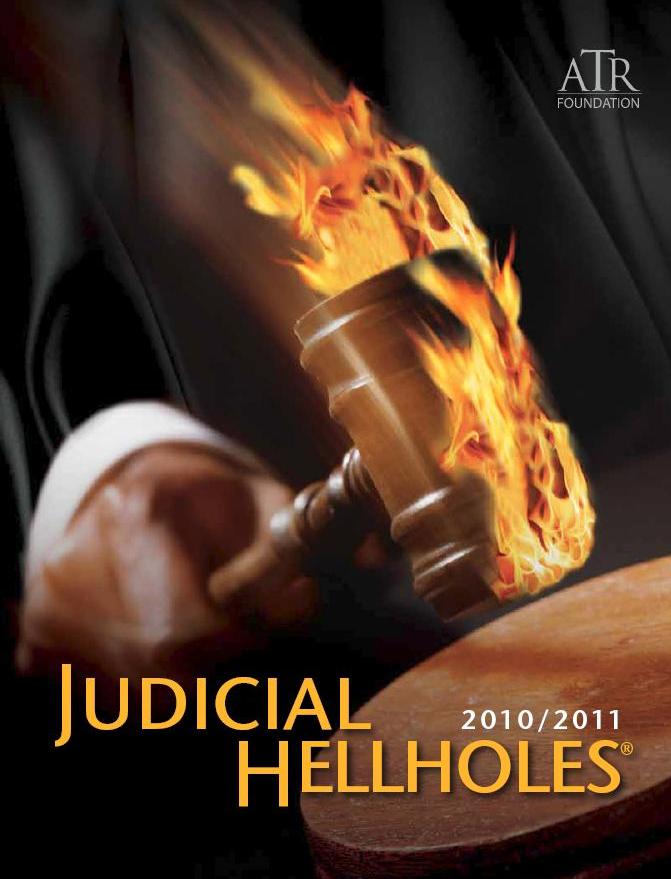
The American Tort Reform Association has released its annual list of Judicial Hellholes and, once again, Cook County is prominently featured.

The catchy name and scary graphics almost guarantee press coverage and strong reaction. The report hasn't made a big splash in the Chicago papers as of yet, but then again, the report was just released this week. The Daily Herald noted the pending release of the "Judicial Hellholes" report this week with a story, by Ted Cox, quoting Thomas Demetrio (speaking "only partially tongue in cheek") as saying that ATRA's poor ranking of our local courts should be viewed as a "badge of honor."

Actually, Cook County's rating slipped a little in the current report. In ATRA's 2009 ratings, Cook County was the third worst jurisdiction in the country. This year, we were no better, or worse, than fifth.

ATRA blames judges for making jurisdictions into "hellholes." According to this year's report (p. 26), "Judicial Hellhole judges... may favor local plaintiffs’ lawyers and their clients over defendant corporations. Some, in remarkable moments of candor, have admitted their biases. More often, judges may, with the best of intentions, make rulings for the sake of expediency or efficiency that have the effect of depriving a party of its right to a proper defense."

The report goes on to cite some "tricks of the trade" of "Judicial Hellhole" jurists (pp. 27-28), but the report makes no claims as to the extent to which these practices are inflicted on Cook County litigants. Instead, in its description of why Cook County again makes the list (we've been a "Judicial Hellhole, now, since 2005), ATRA cites the following (pp. 10-11):
  • Cook County has "consistently hosted nearly two thirds of the state’s litigation, while serving as home to just over 40% of its population – a proportion that has gradually grown more lopsided over the past 15 years"
The ATRA folks suggest an image of greedy tort lawyers are descending on Chicago from all over the country, plotting to take unfair advantage of our biased courts and generous juries. But the Cook County court system handles a lot of cases -- and most of them are decidedly not tort cases. Collection cases make up a huge percentage of the county docket -- at least a dozen collection cases are filed for each tort case (and medical malpractice and product liability claims make up only a small percentage of the tort cases filed in this or any other American jurisdiction). A lot of the collection cases filed here are tied to one of our larger industries, namely the commodities business. Cook County is often the venue of choice for commodity firms. Persons living from Maine or California routinely consent to be sued in Chicago if they fail to meet a margin call and a deficit remains when their trading accounts are liquidated. Readers are invited to supply other examples in the Comments. But it is neither surprising nor sinister that there would be disproportionately more litigation in a world class financial center, such as Chicago, relative to the rest of the state.
  • In February the Illinois Supreme Court affirmed "a Cook County judge’s ruling that struck down a 2005 law limiting subjective pain and suffering damages in medical liability cases."
The reference is to Lebron v. Gottlieb Memorial Hospital, 237 Ill.2d 217, 930 N.E.2d 895 (2010). In this case, the court struck down "caps" on medical malpractice verdicts. This was the third time that the Illinois Supreme Court has invalidated an effort to put "caps" on malpractice verdicts. In other words, the court followed its settled precedent. It's usually the failure to adhere to stare decisis that gets the business groups up in arms about the judiciary.

The report makes some additional claims about the likely effect of Lebron that will be addressed in a future post.
  • "Elsewhere in the county, the litigation engine rolled on as usual with numerous questionable claims and awards, as in previous years." Three examples are provided:
  1. Suit was filed against a Cook County McDonald’s in August 2010, alleging that her hot chocolate was too hot. But no award has been made. The new suit was still pending when the report went to press.
  2. A woman is suing an Ohio vacuum cleaner manufacturer for $200,000 because it sucked hair off the back of her hand. Again, however, the report does not suggest that the suit has succeeded, only that it has been filed.
  3. A factory worker received a $30.4 million verdict in a "popcorn lung" suit alleging "that exposure to an ingredient used in the making of butter-flavored microwave popcorn can cause injury to the lungs."
This last citation sent me into Westlaw, looking for newspaper coverage of the verdict. Sure enough, both the Tribune and the Sun-Times covered the trial of Gerardo Solis, a South Elgin factory worker. According to the September 5, 2010 Tribune article, by Brian Slodysko and Erika Slife, Solis had "worked for various popcorn and popcorn-flavoring plants in the Chicago area since 1987. Over time, Solis, a father of three, developed bronchiolitis obliterans, a rare respiratory disease that has destroyed 75 percent of his lungs, leaving him with the minimum lung capacity a person needs to live. Fireworks displays or second-hand smoke can send Solis into brutal coughing fits, which can cause him to pass out." The damage was allegedly caused by exposure to the chemical diacetyl. Eventually, according to his attorney, Solis will need a lung transplant. (Maureen O'Donnell's September 6 article in the Sun-Times said that Solis is "awaiting" a lung transplant.)

The articles make clear that Solis sued 15 companies and one trade organization and that every single defendant except BASF settled out before trial. The amounts of the settlements were not disclosed.

At trial, according to O'Donnell's article, Solis put on evidence that, back in 1993, BASF's German parent, did a "study on rats that showed diacetyl caused lung damage but did not disclose the findings."

According to the Tribune article, "diacetyl is a naturally occurring compound that gives [microwave popcorn] butter its flavor. Studies have shown that the heated vapors of the chemical diacetyl lead to a breakdown of the airway branches deep in the lungs. The lung scarring is irreversible and can be fatal. " California and the Federal Drug Administration are considering a ban on the chemical and OSHA is considering rules limiting worker exposure to the chemical, although no bans or rules have yet been promulgated.

The Sun-Times noted that BASF was planning an appeal from the verdict.

The ATRA report concludes its review of Cook County (p. 11) by charging that such "rampant abuse of the civil justice system" comes with costs, citing, as an example, that Cook County spent $54 million on litigation involving just the county and its various agencies an amount that "dwarfs counties of similar size in the state and beyond." Actually, there are no counties of 'similar size' in Illinois, and few in the nation -- but it may well be that there may be other reasons, such as pinstripe patronage, that explain the high price tag -- not necessarily (or not exclusively) "the county’s 'infamously plaintiff-friendly courts.'"

Nor is ATRA optimistic about the future of the Cook County court system (p. 11): "[A]mazingly enough, Cook County voters and taxpayers also seem content with the status quo. Though several neutral legal groups deemed four circuit court judges unqualified for the bench, all were narrowly retained by voters in November 2010 elections."

For more background about the American Tort Reform Association, please turn to page two.

Tuesday, November 16, 2010

Jean Prendergast appointed to Circuit Court

The Illinois Supreme Court has appointed Jean M. Prendergast to a Circuit Court vacancy that will open up with the forthcoming retirement of Judge Daniel E. Jordan.

Prendergast's appointment is effective December 3, 2010 and will terminate December 3, 2012.

Currently a shareholder with Schuyler, Roche & Chrisham, P.C., Prendergast is a 1994 graduate of the Loyola University School of Law. After graduation, Prendergast clerked for then-Appellate Court Justice (and now Supreme Court Justice) Mary Jane Theis and, later, for Supreme Court Justice Mary Ann McMorrow.

Prendergast currently serves as President of the Appellate Lawyers Association. Her predecessor in that position was Gary Feinerman, now a United States District Judge in Chicago.

Before appointing Prendergast to a judicial post, the Illinois Supreme Court had asked Prendergast to serve on the Court's Committee on Character and Fitness, becoming Chairperson of the Committee in the First District this year.

Friday, November 05, 2010

Ald. Thomas Allen appointed to Pucinski vacancy

The Illinois Supreme Court has appointed Chicago Alderman Thomas R. Allen (D-38) to the countywide vacancy that will be created next month by the elevation of Cook County Circuit Court Judge (and former Circuit Court Clerk) Aurelia Pucinski to the Illinois Appellate Court.

Allen's appointment is effective December 6 and will terminate December 3, 2012.

In addition to serving as Alderman of the Northwest Side 38th Ward, Allen has been a partner in the Chicago law firm of Chapekis, Marcus, Allen and Chapekis. An attorney since 1977, Allen, like newly-appointed jurist Tommy Brewer, was a candidate for Cook County State's attorney in 2008.

-------------------------------------------------------------------
The Chicago Tribune reports on this appointment.

Thursday, November 04, 2010

Tommy H. Brewer appointed to 7th Subcircuit vacancy

The Illinois Supreme Court has appointed Tommy H. Brewer to the vacancy in Cook County's Seventh Judicial Subcircuit created by the recent retirement of Judge Cheryl A. Starks.

Brewer's appointment was effective November 1 and will terminate on December 3, 2012.

Brewer had a law office in the Loop at the time of his appointment. Brewer ran for Cook County State's Attorney in 2008 and 2004; he also ran a number of times for the office of Cook County Sheriff.

Tuesday, November 02, 2010

Who's doing best in the retention races?

I mentioned earlier that all Cook County judges on the retention ballot appear to have kept their jobs this evening -- but, as I mentioned in a September post, no matter how highly regarded the judge, no matter how many endorsements or favorable bar association ratings, it is rare indeed for any sitting judge to receive more than an 80% favorable rate.

Put another way, it appears that two of every ten voters will "just say no" to each and every sitting judge.

The pattern appears to be holding tonight. Quickly scanning City and County returns, Judge Carol A. Kelly, who received favorable ratings from every bar association, has received just under an 80% "yes" vote (79.7%). Judge Sharon Marie Sullivan, who has also received favorable ratings from all the bar associations, has a 78.25% "yes" vote. These two jurists appear to be leading the pack among the retention candidates.

Bar ratings and endorsements do matter: Checking updated results, Judge Dorothy F. Jones has received 63.6% "yes" votes (and she has received "yes" votes from only 58.3% of the suburban voters). Another judge who was targeted by the Chicago Tribune and Sun-Times, Judge Jim Ryan has received "yes" votes from only 63.5% of the voters. (Judge Jones received unfavorable ratings from all the bar associations; Judge Ryan was not recommended by the Chicago Bar Association, the Illinois State Bar Association and the Chicago Council of Lawyers, although he did receive favorable ratings from the Asian American Bar Association, Black Women Lawyers' Association of Greater Chicago, Cook County Bar Association, Decalogue Society of Lawyers, Hispanic Lawyers of Illinois, Puerto Rican Bar Association, and Women's Bar Association of Illinois.)

The question that will be posed by critics of our current system of electing and retaining judges is whether bar association ratings and newspaper endorsements make enough of a difference. (No Cook County Circuit Court judge has been defeated for retention since 1990.)

Cook County judges holding on in retention elections

The votes aren't all in, but it looks like all Cook County Circuit Court judges seeking retention will be retained in office. I've used the Dorothy F. Jones retention race as a bellwether because every single bar association urged that she not be retained, as did the Tribune, the Sun-Times and the Judicial Performance Commission of Cook County.

If Judge Jones could hold on in the face of this united opposition, it follows (I believe) that all the retention judges will prevail.

As of this writing, Judge Jones is holding on with a 63.15% favorable vote, 381,744 "yes" votes to 222,788 "no" votes.

More to come as the evening goes on.