Monday, May 28, 2012

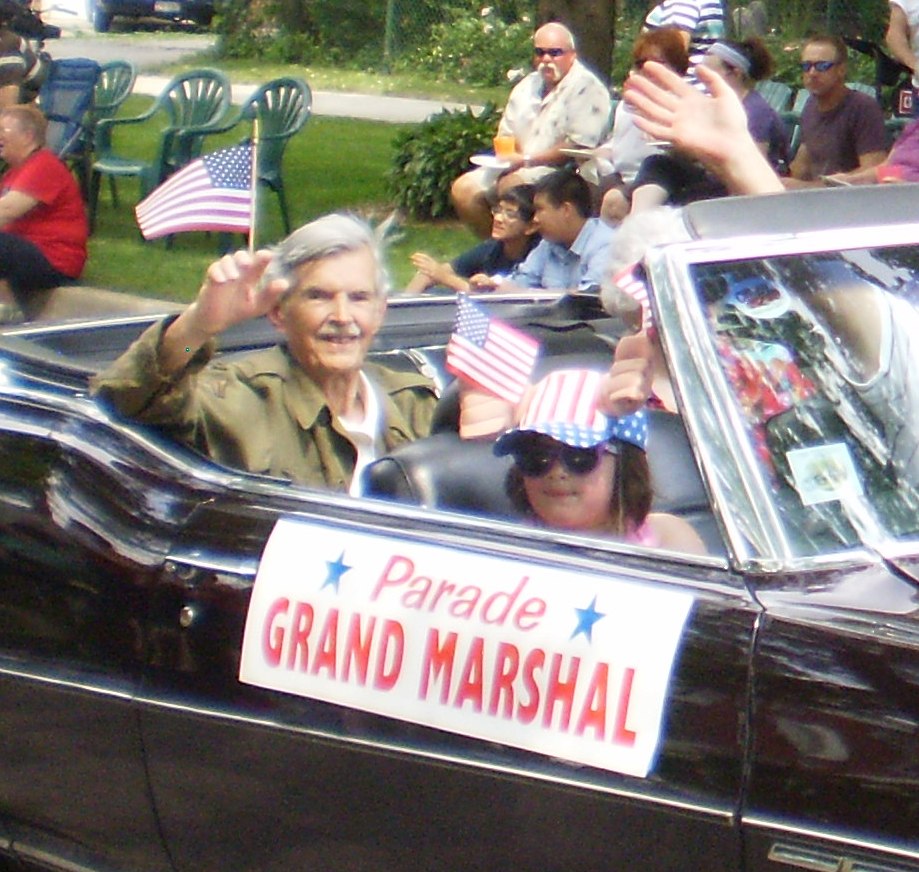
Pictures from today's Norwood Park Memorial Day Parade

The annual Norwood Park Memorial Day Parade wound its way through the neighborhood earlier today. The Edison Park American Legion and the American Flag Coalition led the way.


You can't have a parade in Chicago without politicians. Groups for State Senator John Mulroe (D-10) Ald. Mary O'Connor (D-41) represented the Democrats at the front of the parade; groups for County Commissioner Peter Silvestri (17th) and State Rep. Michael McAuliffe (R-20) represented the Republicans at the front of the parade.


Cook County Metropolitan Water Reclamation District Commissioner Frank Avila was further back in the parade, but we'll keep all the politicians together in this post.


But it wouldn't be much of a parade without a grand marshal, motorcycles, marching bands....


Want more? Turn to page two.

Tuesday, May 22, 2012

Judge Thomas J. Carroll appointed to Felton vacancy

The Illinois Supreme Court has appointed Judge Thomas J. Carroll to the countywide vacancy created by the recent death of Judge Donna Phelps Felton.

Judge Carroll's appointment became effective last Friday and will expire on December 1, 2014. At the time of this appointment, Judge Carroll was serving on the bench by appointment to the McSweeney Moore vacancy in Cook County's 3rd Subcircuit.

Judge Carroll was one of several candidates to file for the McSweeney Moore vacancy in the March primary, but Carroll and all the other hopefuls in that race withdrew in favor of Daniel R. Degnan, Executive Director of the Cook County Employee Pension Fund and the son of former state senator and one-time director of the mayor's Office of Intergovernmental Affairs, Timothy F. Degnan. Daniel R. Degnan was unopposed in March; he face no opposition in November.

Prior to his initial elevation to the bench, Judge Carroll was a criminal defense attorney. He has also worked as an Assistant Public Defender.

Tuesday, May 15, 2012

Sixty Cook County Judges file for November retention ballot

Sixty Cook County Circuit Court Judges elected or retained in 2006 have filed to appear on the retention ballot in the November 2012 general election, according to information furnished by the Illinois Secretary of State.

The last day for a judge to provide a declaration of candidacy was May 6, according to the Illinois State Board of Elections website.

If normal patterns hold, some of these jurists will withdraw their retention bids between now and the election. Three of the judges on this list are serving on the Appellate Court; two, Maureen Elizabeth Connors and P. Scott Neville, Jr., won their respective races in the March Democratic Primary and face no opposition in November. They are likely to withdraw their retention bids. On the other hand, Judge Stuart E. Palmer was assigned by the Illinois Supreme Court to serve on the Appellate Court. He would have to be retained in office as a Circuit Court Judge in order to continue in his assignment on the Appellate Court.

Also on the list of judges currently seeking retention is Cynthia Brim. Currently, Judge Brim has been removed from all judicial duties by order of the Executive Committee of the Circuit Court of Cook County. The suspension came after Judge Brim was arrested at the Daley Center, charged with allegedly shoving a Cook County Sheriff's deputy and tossing a set of keys at a security checkpoint.

One Justice of the Appellate Court, James Fitzgerald Smith, has filed for retention in the First Appellate District (Cook County). Several downstate Appellate Court justices have also filed for retention, Tom M. Lytton and Daniel L. Schmidt (3rd District), John Turner (4th District), and Melissa Ann Chapman (5th District). No Supreme Court Justice will be on the retention ballot in Cook County; Justice Rita B. Garman has filed for retention in the downstate 4th District.

A complete list of Cook County Circuit Court Judges who have filed for retention in November follows:
  • Martin S. Agran
  • Patricia Banks
  • Ronald F. Bartkowicz
  • Carole Kamin Bellows
  • Maura Slattery Boyle
  • Daniel Patrick Brennan
  • Cynthia Brim
  • Rodney Hughes Brooks
  • Mary Margaret Brosnahan
  • Robert Lopez Cepero
  • Gloria Chevere
  • Matthew E. Coghlan
  • Maureen Elizabeth Connors
  • Grace G. Dickler
  • Christopher Donnelly
  • Loretta Eadie-Daniels
  • James D. Egan
  • Kathy M. Flanagan
  • Ellen L. Flannigan
  • Peter Flynn
  • Raymond Funderburk
  • Joyce Marie Murphy Gorman
  • Catherine Marie Haberkorn
  • Orville E. Hambright
  • Pamela E. Hill Veal
  • Carol M. Howard
  • Garritt E. Howard
  • Michael J. Howlett, Jr.
  • Anthony A. Iosco
  • Moshe Jacobius
  • Edward R. Jordan
  • Paul A. Karkula
  • Joseph G. Kazmierski, Jr.
  • Stuart F. Lubin
  • Marvin P. Luckman
  • Marcia Maras
  • Jill C. Marisie
  • James Michael McGing
  • Mike McHale
  • James Patrick Murphy
  • Thomas W. Murphy
  • Lisa Ruble Murphy
  • Marya Nega
  • P. Scott Neville, Jr.
  • Patrick W. "Pat" O'Brien
  • Joan Margaret O'Brien
  • Ramon Ocasio III
  • Stuart E. Palmer
  • Lee Preston
  • Mary Colleen Roberts
  • Thomas David Roti
  • Drella C. Savage
  • Colleen F. Sheehan
  • Diane M. Shelley
  • Bill Taylor
  • James M. Varga
  • Carl Anthony Walker
  • Richard F. Walsh
  • Camille E. Willis
  • E. Kenneth Wright, Jr.

Saturday, May 12, 2012

FWIW among this year's Kogan Award winners

The Chicago Bar Association's 23rd Annual Herman Kogan Media Awards were handed out Wednesday, May 9 at a luncheon at Petterinos in Chicago's Loop. WLS-TV anchor Ron Magers served as the keynote speaker.

Tribune reporters David Jackson and Gary Marx were honored in the print category for their series "Fugitives from Justice," about criminals who have fled overseas to avoid prosecution. In addition to the Kogan award, "Fugitives from Justice" has received the Watchdog Award for Excellence in Public Interest Reporting from the Chicago Headline Club and a Medill Medal for Courage in Journalism. "Fugitives from Justice" was also a finalist for this year's Pulitzer Prize in the investigative reporting category.

Mark Suppelsa and Marsha Bartel of WGN-TV received a Kogan Award for their broadcast series "Pension Games," a multimedia series (in conjunction with the Chicago Tribune) that exposed waste and fraud in the state pension system. The "Pension Games" series has also won two Lisagor Awards from the Chicago Headline Club and the 2012 Richard H. Driehaus Foundation Award for Investigative Reporting from the Better Government Association.

The third Kogan Award winner, in the online category, was yours truly. Photographic evidence is supplied above for the understandably skeptical. The particular post singled out was "In defense of the Supreme Court's recent practice of recalling appointed judges who've lost in a primary election."

In addition to the three Kogan Awards, the CBA gave out three Meritorious Achievement Awards on Wednesday.

John Marshall Law School Professor and Chicago Daily Law Bulletin columnist Timothy P. O'Neill was given a Meritorious Achievement Award for his anti-death penalty column, "Some Advice: Let's Leave Well Enough Alone."

Angela Caputo of the Chicago Reporter received a Meritorious Achievement Award for "Out at First," about the Chicago Housing Authority's "one strike policy" of seeking the eviction of families when any person residing with that family is accused of any crime. "Out at First" won a Sigma Delta Chi Award from the Society of Professional Journalists in the category of Public Service in Magazine Journalism (Regional/Local Circulation) and a Lisagor Award from the Chicago Headline Club in the category of general-interest publication, circulation less than 20,000.

The third Meritorious Achievement Award went to Cate Cahan and Robert Wildeboer of WBEZ Radio for the series, "Whatever Happened to Marcus?" This series also received a Lisagor Award from the Chicago Headline Club in the radio category.

The Herman Kogan Media Awards are named for the late Chicago newsman Herman Kogan. A reporter, feature writer, columnist and editor at various times with the Chicago Tribune, Sun-Times, and the old Daily News, Kogan also won three Emmys during a mid-1960's stint as assistant general manager of news at WFLD. Along the way, Kogan also hosted two programs on WFMT radio, "Critics Choice" and "Writing and Writers."

Kogan was the author of several books on Chicago themes including Big Bill of Chicago, a biography of William Hale Thompson (with Lloyd Wendt); Lords of the Levee: the Story of Bathhouse John and Hinky Dink (also with Wendt -- also released under the title Bosses in Lusty Chicago: the Story of Bathhouse John and Hinky Dink) and The Great Fire, Chicago, 1871 (with Robert Cromie).

The First Century, the story of the Chicago Bar Association's first 100 years, was a solo effort.

Friday, May 11, 2012

Forgetfulness may not be a sign of aging, just the result of a change of venue

A colleague told me recently that while driving to work he'd thought of a long list of things to accomplish but -- just as soon as he set foot in his office -- he couldn't remember anything on his list. "I must be getting old," he complained.

A note by Marc Silver in the "Next" section of this month's National Geographic provides a happier explanation. He writes of research published by Notre Dame's Gabe Radvansky that suggests that people simply don't remember things as well when they cross through a doorway. Silver summarizes Professor Radvansky's conclusion: "Change of venue makes the brain 'push old stuff out and focus on what's going on now,' a good strategy for cavemen heading from forest to field."

Radvansky's paper, which was published in the Quarterly Journal of Experimental Psychology, may be accessed here. Another summary of Radvansky's work, by Susan Guibert, can be found on the Notre Dame website.

Tuesday, May 08, 2012

Is pulling down an opponent's campaign signs a crime?

The answer to this question (and all lawyers out there are invited to say it along with me) is: It depends. Let me explain.

The possible pilfering of campaign signs is in the news today because of an article by Jeremy Gorner in today's Chicago Tribune, about the arrest of Carl Boyd on the night before the March 20 primary.

Boyd was the winner of the Democratic Primary for Circuit Court Judge in Cook County's 2nd Judicial Subcircuit. He faces no opposition on the ballot in November.

Quoting from the linked Tribune article:
According to a police report, a Chicago police sergeant spotted Boyd removing [Chester] Slaughter campaign signs and placing them in the trunk of his 2000 BMW near 119th and Halsted streets early on March 19. [Slaughter was one of Boyd's three primary opponents.]

Police reported recovering 12 of Slaughter's campaign signs from Boyd's car.

Boyd was arrested on a misdemeanor theft charge, booked at the Calumet District police lockup and released later in the morning after posting $200 in cash for bail.
What's missing from this account is an essential element that might make Mr. Boyd's alleged conduct into a crime.

I have no opinion as to whether Mr. Boyd did or did not do something in violation of the law.

However, in 1984, in Members of the City Council of the City of Los Angeles v. Taxpayers for Vincent, 466 U.S. 789, 104 S.Ct. 2118, 80 L.Ed.2d 772, the United States Supreme Court upheld a city ordinance that prohibited the erection of campaign signs on public property. Most cities and villages in Cook County also have some sign ordinance prohibiting campaign signs on public property; some even have provisions that purportedly allow municipalities to bill campaigns whose signs are removed from streetlights or public parkways by public employees. In this sense, signs on lampposts or posted at intersections may be considered abandoned and might be removed by anyone.

On the other hand, uprooting and removing a campaign sign planted by a homeowner in his or her own front lawn might very well constitute misdemeanor theft.

In other words, if Candidate A is pulled over by the police and is found to have a whole bunch of Candidate B's signs in the back seat, it may look a tad unseemly -- but where those signs came from is the key factor in determining whether Candidate A has committed a crime.

Sunday, May 06, 2012

Judge's daughter in the running for Miss USA

Beauty contests are beyond the usual scope of this blog, but a Facebook message this evening got me looking into the upcoming Miss USA Pageant.

The next Miss USA will be crowned June 3 in a live NBC television broadcast. To boost interest in the contest, the pageant organizers are running an online election: Anyone can vote for their favorite Miss USA contestant; the winner is guaranteed a place among the pageant semifinalists.

The Illinois representative in the Miss USA contest (shown above) is Ashley Hooks; her proud father is Cook County Circuit Court Judge William H. Hooks. It was Judge Hooks who sent me the Facebook message this evening, looking to spread the word about his daughter's Miss USA bid. "People can vote on line up to 10 times per day, per email account," Judge Hooks wrote. Voting is underway now, and continues through June 2 at noon ET. Votes can be taken at this link or on Facebook or Twitter.

Wednesday, May 02, 2012

Too much enthusiasm over Osama's anniversary?

There were an awful lot of Westerns on TV when I was a kid (and I watched nearly as much television as the Bill Murray character in Scrooged) -- Maverick, Have Gun Will Travel, Gunsmoke, The Rifleman, Bonanza.... There were a lot of old Western movies on TV, too -- with John Wayne, of course, but also Alan Ladd or Randolph Scott; Gene Autry and Roy Rogers were always singing on one channel or another.

So I imbibed a heady draught of what I'll call the Western Ethos. Among these principles is that, sometimes, a man is so evil or so corrupt, and the law is so weak or unavailable, the bad guy simply can't be arrested and brought to justice. The hero is forced to take the law into his own hands, and he does what needs doin'.

The important thing is that the hero is not happy about it. It's the grizzled prospector or the comely schoolmarm who tries to offer comfort, if not absolution, just before the end credits roll: "If ever a man needed killin', that one did."

Maybe the hero can stay on as Sheriff, or become Sheriff -- but not to start his own reign of terror, but rather to bring law and order and schools and churches and marriageable ladies into town, to bring the blessings of civilization and the Rule of Law to the hitherto untamed frontier. Maybe, like Gary Cooper in High Noon, he's so disgusted, not just by what his alleged friends and neighbors didn't do, but by what he himself had to do, that he takes off the badge forever and goes off to start a ranch someplace.

Everyone thinks that Jimmy Stewart's character, in The Man Who Shot Liberty Valance, is the man who rid Shinbone of its most feared outlaw. The naive lawyer rises rapidly in politics after the showdown, eventually becoming senator from the new state that he helped to hew from the wilderness.

Only he's not the man everyone thinks he is. He knew what really happened, and so did his wife (played by Vera Miles), and so (of course) did John Wayne. Towards the end of Stewart's career, the Stewart and Miles characters come back to Shinbone for Wayne's funeral, and Stewart tries to set the record straight. But, as the newspaperman tells him at the end, "This is the West, sir. When the legend becomes fact, print the legend." The point is that Stewart neither wanted nor deserved the accolades heaped on him as a result of the death of Liberty Valance; he took no satisfaction from it.

This brings us to Osama bin Laden. It is an article of faith for me, as an American lawyer, that "justice" can not be meted out with helicopters and Navy SEALs and firefights. Yet, as an American realist, steeped in the cultural values I absorbed through a small-screen black and white TV, I can't help but agree that, "If ever a man needed killin', that one did."

It's just not a cause for celebration. And the man who did what needed doin' should never, ever be perceived as gloating about it. For that reason, surely, President Obama is ill-served by some supporters who recently 'questioned' whether Gov. Romney would have given the order to 'take out' Osama.

In one clip I heard, Gov. Romney was 'accused' of expressing concern (back in 2007) about violating Pakistani sovereignty in pursuit of bin Laden, and that he should be made to 'explain' himself. Well, no explanation is required.

In 2007 most of us thought bin Laden might be hiding in caves on the Pakistani side of the Afghan border; we had no idea that he had built himself a compound for himself in the shadow of a Pakistani military academy in Abbottabad, a city of about 500,000 just 60 miles or so away from the Pakistani capital of Islamabad. Jane Perlez, in an article posted on the New York Times website one year ago today, reported that, "In an ironic twist, the academy [next door to the bin Laden compound] was visited just last month by the Pakistani military chief, Gen. Ashfaq Parvez Kayani, where he proclaimed that Pakistan had 'cracked' the forces of terrorism, an assessment that was greeted with skepticism in Washington."

Until we knew that the Pakistani government was either deliberately covering up bin Laden's presence or so incompetent that it could not find him in plain sight, everyone was right to be concerned about possibly violating an ally's sovereign territory. Once we knew bin Laden's whereabouts, however, we also knew that we could not inform our gallant Pakistani ally in advance of any raid. Prior notice would almost guarantee bin Laden's successful escape. Nevertheless, sending troops across a national border without permission is called an invasion; it is an act of war. There was, accordingly, even at that late stage, extremely good reason to be concerned about sending in SEAL Team Six. Fortunately, it was in the best interests of both the United States and Pakistan to make nice with each other after the fact -- President Obama, according to an AP account by Kimberly Dozier and David Espo, was careful to stress that he called Pakistani President Asif Ali Zardari after the raid to brief him on what had already happened. Pakistan accepted the President's explanation, at least to the extent that we are not now in a state of war with that nation.

In the western movies, the good guy who is forced to take out the bad guy is scarred by his act, not enthused. He knows he's done something to prevent greater wrongs in the future, but only by committing a wrong himself. The townspeople may be grateful, but the hero can not fully accept their cheers. He must live with what he has done. So too must President Obama. I am certain that the President must have agonized about authorizing the mission. He did what he did with resolve, yes, but also with regret -- and any man or woman worthy of the title of President of the United States would have been similarly stressed in those same circumstances. The President's more bloodthirsty supporters need to be reined in; their misguided enthusiasm diminishes all of us.

Sunday, April 29, 2012

On the exceptional importance of Law Day

Law Day is Tuesday, May 1.

Law Day was invented as a Cold War-era response to May Day. It was first observed in 1958; the date was recognized by statute in 1961.

Area lawyers have received a special issue of the Chicago Daily Law Bulletin every year just in time for Law Day, but other than that I can't think of too many ways in which Law Day has been celebrated in this country.

I think that's a mistake.

Forget about the Cold War origins of the day, or that Law Day was set up to compete with May Day for the hearts and minds of future American workers. Law Day has been set aside to commemorate the importance of law in America, and there's nothing more important than the law in the development and history of our nation.

To talk about the singular import of law in America is to acknowledge American exceptionalism. The so-called doctrine of American exceptionalism has more or less been hijacked by some on the political right in this country, to justify all sorts of behaviors, interventions, or attitudes. (For example, the attitude that 'we need not join with other nations in international agreements because we are different from – better than – other nations.')

But, if that's what you think of when you think of American exceptionalism, you're just wrong, wrong, wrong.

What makes America the exceptional nation is the way the law binds us together as a people.

All countries have laws, of course. But every other nation on the earth has been defined in terms of a particular people in a particular place. A motherland. A fatherland. And the people there? All one tribe. All one ethnicity. No outsiders need apply. So after the fall or Rome, we find all sorts of Franks gathered in former province of Gaul, and voilà, we have the Frankish kingdom. And, 1,500 years later, we have France -- and North Africans segregated in French ghettos unable to meaningfully assimilate into the French nation, unable to hope for full participation in the life of their adopted homeland.

A westerner can live in Japan. He can learn Japanese. He can eat Japanese foods. If he can hit a curve ball he may even become a hero to Japanese baseball fans. But he can not become Japanese. He will always be a gaijin. In the current issue of the Wilson Quarterly, in an article entitled "Japan Shrinks," Nicholas Eberstadt observes that, in 2009, Japan naturalized only one-third as many new citizens as Switzerland. And Switzerland has "a population only six percent the size of Japan's and a reputation of its own for standoffishness."

America is different; we can not be pigeonholed as a particular people living in a particular place. America itself has been a dynamic nation, growing by leaps and bounds from the original 13 Colonies, and a citizen from Massachusetts is no more an American than any citizen from Alaska, Hawaii or California.

Of course, George Washington, in his Farewell Address, wrote that his fellow Americans "have the same religion, manners, habits, and political principles," with only "slight shades of difference."

Washington had his reasons for stressing unity -- in his time he would not have seen any reason to 'celebrate diversity' -- but what he said about all Americans having only 'slight shades of difference' wasn't all that true in 1796 and it certainly has gotten less and less true in the centuries since.

Except in the area of political principles.

As Jefferson wrote in the Declaration of Independence, "We hold these truths to be self-evident, that all men are created equal, that they are endowed by their Creator with certain unalienable Rights, that among these are Life, Liberty and the pursuit of Happiness. — That to secure these rights, Governments are instituted among Men, deriving their just powers from the consent of the governed." Or, as Lincoln paraphrased the Declaration of Independence at Gettysburg: "Four score and seven years ago, our fathers brought forth on this continent a new nation, conceived in liberty, and dedicated to the proposition that all men are created equal."

As John Adams wrote in the Massachusetts Constitution, in America, our Founding Fathers formed "a government of laws and not of men."

One's original tribe, or nation, or people -– none of that is important to becoming an American. A person can come to America and -- if he or she embraces these foundational principles -- he or she can realize their greatest individual potential. The only limitation we put on the foreign-born is that they can not be President of the United States. But the son of a man from Kenya can become President.

Just before his death in 1919, Theodore Roosevelt wrote, "we should insist that if the immigrant who comes here in good faith becomes an American and assimilates himself to us, he shall be treated on an exact equality with everyone else, for it is an outrage to discriminate against any such man because of creed, or birthplace, or origin."

I realize that America has not always treated immigrants fairly -- and that not all immigrants have at all times and all places been fully welcomed into the American mainstream. Nevertheless, these are our ideals. Even if we have not always -- even if we have not often -- been perfect in our observation of and adherence to these principles, is that an intelligent basis upon which to reject our ideals altogether?

I get tired of cultural relativism, the idea that we're 'just as bad' as everyone else. In the summer of 2010, for example, you may recall the media circus over the proposed construction of the so-called 'Ground Zero Mosque.' Yes, there were loud, emotional protests. Bigots bellowed, but it wasn't just know-nothings and right-wingers. Some relatives of persons killed in the September 2001 attacks thought that the proposal was a provocation or, at best, insensitive.

But no house of worship, of any denomination, gets built anywhere in this country without some controversy. Any property on which a church is built comes off the local tax rolls, and somebody always has a question about parking or traffic. And there's often whispers about what might happen after the church is built. What happens later on if Fr. Murphy decides to open a soup kitchen or the Rev. Jones decides to make her sanctuary a sanctuary for the homeless, too?

You can tsk-tsk all you want about how opposition to church or synagogue or mosque-building is narrow-minded, selfish, even bigoted. But, please, tell me -- how do I find the Roman Catholic Cathedral in Riyadh?

Oh, wait, open Christian worship is illegal in the Saudi kingdom. In 2008 there were some 800,000 Catholics in Saudi Arabia, mostly Indian and Filipino guest workers, and not a single Catholic church to minister to their spiritual needs. A Saudi who converts to Christianity is courting death as an apostate. (And, remember, these are our gallant Saudi allies, not the Taliban.) Meanwhile, Wikipedia says that a 4,000 square foot Islamic community center opened at the 'Ground Zero Mosque' site in September 2011, and that the developer still hopes to go forward with plans for the 13 story building originally proposed.

Our "intolerance," though real enough, is a pretty weak strain, compared with the varieties found elsewhere in the world. Just today, according to this Reuters report, carried on the Huffington Post, gunmen opened up on Christians worshiping in a university lecture hall in the northern Nigerian city of Kano, killing 15 and wounding many more. According to the article, "Radical Islamist sect Boko Haram, which wants to carve out an Islamic state in northern Nigeria, has killed hundreds in bomb and gun attacks this year." No group has yet claimed responsibility for this attack, however, the article reports.

Christians worshiping in the Kenyan capital of Nairobi were attacked during a service by a grenade throwing man who had disguised himself as a congregant, according to another Reuters article posted today by the Chicago Tribune. The article says one man was killed; 16 other persons were injured. Again, no group has claimed responsibility, but the article reports that al-Shabaab, a Somali group that has ties to al-Queda, is angered by Kenyan intervention in support of the Somali government, which al-Shabaab is trying to overthrow.

No one can deny that we have our problems, but America really is an exceptional country.

Where else in the world can the mere embrace of certain 'self-evident truths' even potentially make you a fully integrated member of society except in America?

What makes America unique –- exceptional -– is that we are bound by our shared embrace of principles, not by kinship or religion or blood.

In other words, we are bound by law. By laws.

Thus, Law Day, whatever its artificial origins, should be -- and is -- a big deal.

And Law Day is a particularly appropriate time for us to remember and reflect upon the dangers confronting American belief in the rule of law –- which, as I’ve tried to show, ultimately, is our common, unifying thread as a people.

When we say we believe in the rule of law, we mean that we should be obedient to the law. We should respect and obey the law.

That has not always happened. Prohibition, for example, was a great American tragedy on many levels, and we here in Chicago suffer particularly from the legacy of Prohibition. But the Volstead Act was unevenly enforced (or not enforced at all) in American cities generally. It was not just thirsty urban working people and the bootleggers who supplied them that defied the law. Many in the upper classes thought the law was meant to apply to their workmen –- but never to them. As a law that could not be enforced, and was not enforced evenly –- as a law that a significant portion of the American people routinely ignored -– Prohibition undermined Americans' respect for the law generally.

There are a number of other, subsequent examples of this, perhaps not all as uncontroversial as the Volstead Act. But I suggest that, whenever we pass a law that we do not mean to enforce, or that we can not enforce evenly and fairly, we undermine respect for all laws –- and thereby jeopardize our national unity and, ultimately, our freedom.

Law Day is a good time to remember that we should encourage the passage only of laws that can be uniformly and fairly applied and enforced.

But although we say we want people to respect our laws, we also know that unthinking blind obedience to the law can itself be a great evil.

We have just finished our national observation of the Days of Remembrance, the days set aside by Congress each year to reflect upon the Holocaust.

One thing that has often struck me about the Nazis is how the Hitler regime papered over every outrage with a figleaf of legality. Hitler came to power in a legally constituted coalition government. There was a law passed to grant Hitler absolute power as dictator. The dissolution of the Reichstag was "legal." The persecution of Jews was all done under color of German law. Even the death camps were "legal" under German law. How many Nazis stood in the dock at Nuremberg claiming apparently genuine confusion that they should be prosecuted for following orders –- for simply following the law?

But those laws were evil. They violated basic norms of human civilization. They were certainly not worthy of anyone's respect.

That may be the most extreme illustration possible but perhaps it serves as a useful reminder of how blessed we are to live in a country with a constitution, a constitution that is deliberately difficult to amend.

And our Constitution provides a means of keeping a runaway legislature in check. At least since Marbury v. Madison in 1803, our Supreme Court has had the power to declare laws "unconstitutional," even ones that are passed by a "strong majority." My fellow Chicago attorney -- I won't name him, so as not to embarrass him -- was thus flat out wrong when he said recently:
Ultimately, I’m confident that the Supreme Court will not take what would be an unprecedented, extraordinary step of overturning a law that was passed by a strong majority of a democratically elected Congress. And I'd just remind conservative commentators that for years what we’ve heard is, the biggest problem on the bench was judicial activism or a lack of judicial restraint -- that an unelected group of people would somehow overturn a duly constituted and passed law. Well, this is a good example. And I'm pretty confident that this Court will recognize that and not take that step.
My fellow Chicago attorney feels quite strongly about the passage of a law that may become emblematic of the success or failure of his administration for generations to come. I express no opinion about that law here, and certainly no prediction about how the Supreme Court will assess that law. But it is important to remember that, in this country, no law, no matter how popular, or passed by how large a majority, can survive if it violates our Constitution. While we may disagree in good faith on particular cases, the principle itself is a wonderful thing, and part of what makes America exceptional.

Law Day is a good time to remind ourselves that the mere fact that a law has been passed by Congress or the General Assembly does not itself make that law either constitutional or worthy of respect. When we ask people to respect the law, we must always remember, in return, to make only laws that we, in good faith, believe to be constitutional -- and worthy of respect.

And one thing more -– in order to follow the law, in order to maintain our national respect for the law, our laws must be reasonably simple and understandable.

Americans who joined wagon trains heading west could carry with them only a few cherished possessions with which to start building their new life. If settlers brought with them only one book, it was probably a Bible. But if they brought two books, the other was probably a statute book -– all the laws of their state or territory compiled in a single volume.

There's no such thing as a statute book (book, singular) these days.

We've only just passed the end of this year’s tax season, so let's use tax law as an example. It appears to be a fact that the Internal Revenue Code now amounts to some 3.8 million words, more than four times the roughly 900,000 words that Shakespeare needed for every one of his known works –- all the comedies, all the tragedies, all the histories – even the sonnets.

We who are interested in politics and policy talk about taxation and who should pay what, and how the burden of taxation should be distributed but, sad to say, for the most part, we're all speaking from ignorance. I would go so far as to say that there is no one CPA or tax lawyer who has mastered each and every detail of the tax code -- and, even if such a triumph were possible, it would be of fleeting duration. The tax code will change next year. It changes every year.

I’m not picking on tax laws for anything other than seasonal reasons. The point is that our laws generally have become so cumbersome, so unwieldy, so specialized, so picayune, that it is impossible to claim knowledge of them all. We used to say that ignorance of the law is no excuse. But why isn't it? Lawyers don't always know the law; judges don't always know the law.

We lawyers laugh it off by saying 'that's why we call it practice -– because we never quite get all of it' – but it’s not really a laughing matter.

For a society where law, not blood, is the sinew that binds us together, the growing opacity, complexity and prolixity of our law is a real problem. How can we maintain our national unity through law, when the law which binds us together as a people becomes a more impenetrable mystery in each passing year? There is an increasingly urgent need to simplify and streamline our law so that it can continue to be worthy of the people's respect. That which can not be understood can surely not be applied fairly or evenly.

So Law Day really is a big deal for all of us. Don’t let it slip by unnoticed! We all have a part to play in helping insure that the United States will remain a nation of laws -- for ourselves and for our posterity. What will you do?

Saturday, April 21, 2012

Dr. Klumpp replies to Mr. Strom

For those who came in late: Today's guest post, by Albert J. Klumpp, PhD, is the third in a series that began with Dr. Klumpp reviews judicial countywide results. Next followed Mr. Strom responds to Dr. Klumpp, a guest post from reader Michael A. Strom. I am grateful to both contributors. I think their discussion has been stimulating and enlightening and I hope readers may agree.

Having performed both qualitative and quantitative research on judicial elections, I can attest that both approaches have their strengths and produce useful insights. So I'm always sorry to hear of anyone shunning one or the other. But many people do, and I respect Mr. Strom's being honest and upfront about his views on the matter. With regard to his comments about my work and my conclusions, I'll gladly address them.

One general comment first. Mr. Strom correctly points out that every primary has unique characteristics. Unquestionably, those characteristics do affect the importance of some variables from one primary to another. For instance, a summary of my analyses for the 2008 and 2010 primaries was posted in this blog two years ago and is still accessible; it shows the substantial difference in the pro-female vote that led to the different success rates for female candidates that Mr. Strom mentions. The same can be said for the values of slating in 2010 and 2012, and in many other situations. As I wrote in the DePaul Law Review last year,* "evidence scattered throughout the thirteen elections [that I analyzed] supports the notion that the idiosyncrasies of both the electorate and the top-of-ballot contests in each individual election can affect the results of judicial contests."

The longer-term measurements in the table that Mr. Leyhane posted last week (for 1986-2010 and 2000-2010) are simply for bigger-picture comparison to the 2012 results and aren't intended to compare one specific year to another specific year. I suppose a good idea in the future is to put a footnote to that effect below those kinds of tables. The alternative is to turn the table into a long string of individual-year measurements, which solves that problem but creates others. In any event, my intention was definitely not to suggest that all primaries are identical.

On the specific topics Mr. Strom addresses:

Dilution: Dilution occurs regardless of whether or not a given candidate is a "ringer." A second legitimate female candidate in a contest will divide the pro-female vote just as a ringer female will. The fact that more female candidates won in 2008 than in 2010 was due to a larger pro-female vote in 2008, as noted above, and was not because any of the females in either year were or were not ringers.

As for ringers specifically, at least in countywide contests, I haven't seen solid evidence of their use since the year 2000. There may have been a few scattered throughout the subcircuits, but again, this is beside the point. The subdividing of advantages like gender or ethnicity is clearly established in our electoral history. It predates the use of ringer candidates and is why ringer candidates were employed in the first place.

Faithful committeemen: With regard to Epstein and Patti in 2010, Epstein had advantages that Patti did not. Namely, the Tribune's endorsement and his half-million-dollar campaign that ran TV ads. And so Epstein got more votes than Patti. Remember, all of the variables present in each contest have their own effects, so all must be considered together.

It's true that slating did not do a lot for Judge Hill-Veal in 2010. It didn’t do a lot for any slated countywide candidate. Again, looking at my posted analysis for that year, the low value of the slating variable stands out. Actually, though, Hill-Veal's 2010 contest is not a good choice for any sort of comparison because it was overwhelmingly decided by one very unusual factor: name recognition. This was the contest that put Aurelia Pucinski on the Appellate Court and was the third contest that she had won strictly based on a large name-recognition boost that drew many votes away from her opponents. A politically well-known name in a judicial contest is an uncommon event, but when it happens, it usually overwhelms the other variables. (Unless a Mary Jane Theis comes along with a seven-figure campaign.)

Educated voters: I was puzzled by the comments pertaining to voter education. Possibly my use of the word "unless" in the original post was a bad choice, since it may have suggested that I advocate educational programs or a greater use of one source or another of voter information. Whatever the reason, I can assure Mr. Strom that nothing could be further from the truth. I do not seek and have never sought to perpetuate the views of "good government types" or anyone else in the judicial selection debate. I have never "lauded" any group of voters and have always been scrupulously neutral about comparing voting strategies or, for that matter, judicial selection systems. I present the evidence and let it speak for itself. To whatever extent certain individual findings support one viewpoint over another, so be it. But I approach the topic with complete neutrality.

On the size of the informed-voter group: Yes, the better-informed judicial voters are more regular voters than others, but even in small-turnout years, it's simply not a large group. It never has reached more than around twenty percent or so in any primary or general election since 1980—turnout level notwithstanding. (The statement that I have "entirely ignored the salutary effect of an exceptionally low vote total" is incorrect; see my published material.) The larger implications of those small numbers can and should be debated; that they are in fact small numbers is well-established.

Ballot position: Other published studies have demonstrated that the first ballot position has positive value and can affect the outcome of electoral contests. The finding in my own research is hardly groundbreaking. Nor is it news to the many political candidates who line up outside of elections offices as soon as a filing period begins simply for a chance at the first position.

With regard to the two contests I cited: Karen O'Malley, who held the first position, defeated Stanley Hill by 1.4% of the vote. If Hill had won the ballot lottery instead of O'Malley, his vote percentage would have been higher and hers would have been lower. Very simple. Same with Jesse Reyes; his margin of victory was small enough that if the first-position advantage had shifted to Boyd or Flannigan, his percentage would have decreased, and his opponent's would have increased, by enough that he would have lost.

The fact that some first-position candidates are defeated doesn’t mean that ballot position is worthless; it merely means that their first-position advantages were trumped by other variables. Pamela Hill-Veal, listed first, was edged out by Mat Delort, who was slated, endorsed by the Tribune, and had top bar ratings. Patrick Sherlock, listed first, ceded other advantages to his two opponents -- gender, bar ratings, Tribune endorsement, slating, even had to share his Irish-name advantage with one opponent -- and so he lost to both of them. Without the first position, he would have lost by a greater margin. To reiterate, all variables must be considered together and not simply in isolation.

As far as why the first position draws extra votes, theories have been offered but the question is still unanswered. It's a fascinating question, no doubt about it. But whether or not the underlying mechanism is understood yet, the evidence clearly shows that the first position is an advantage for the candidates who possess it. And as such, it must be accounted for.

One final comment. I’m very grateful for all of the work that Mr. Leyhane does to cast light on judicial elections and for his interest in my research. And I always appreciate people like Mr. Strom who take enough of an interest in the subject to look for potential problems with my work. Public review and critical evaluation is what makes research better in the long run. But claiming that I "hate" the votes cast by some voters, and implying that I have some sort of anti-democracy desire to see certain people not vote at all... that’s going a little overboard, to put it kindly. My respect for the electorate is part of the reason that I dedicated myself to the judicial-selection topic in the first place; otherwise it isn’t the issue at all and it shouldn’t have been questioned. Let’s keep things civil and stick to the matters at hand.

Now, on to retention season!

------------------------------------------------------------------------------
* Klumpp, "Judicial primary elections in Cook County, Illinois: fear the Irish women!" DePaul Law Review 60:3 (Spring 2011), pp. 821-847.

Friday, April 20, 2012

Nine new Associate Judges named today

The Administrative Office of the Illinois Courts has released the names of the nine men and women elected by the Cook County Circuit Court judges to serve as Associate Judges.

All three current Circuit Court judges on the short list were chosen, namely Mary S. Trew, Stanley L. Hill, and Nicholas Geanopolous. These judges had been serving pursuant to Supreme Court appointment but were unsuccessful in their recent primary election bids.

The other six new Associate Judges include Assistant State's Attorney Joseph M. Cataldo, Assistant Public Defender Lana C. Johnson, and Assistant Attorney General Richard D. Schwind. (Schwind had been a finalist for Associate Judge in 2009.)

Greene and Letts partner Allen P. Walker was chosen, as were solo practitioners Steven Mark Wagner and Michael J. Kane.

The concept of speed limits does not lend itself to enforcement by camera

Fran Spielman writes that the city plans to "go slow" on speed cameras in an article posted on the Chicago Sun-Times website. She quotes Transportation Commissioner Gabe Klein as saying, "We may do some pilots earlier in the fall, but I don't think you’ll actually see cameras out there on the streets issuing ticketing for bad behavior until the end of the year at the earliest."

It doesn't matter, in my opinion: Any is too many.

I know, I know, these cameras are supposed to make our streets safer for pedestrians, and children especially. The City resolutely insists that these cameras are about safety, not revenue. I don't buy it.

I'm willing to revise my opinion, of course -- just as soon as a speed camera leaps down from its pole (or jumps up from the pavement -- speed cameras can be put there, too) and snatches a child to safety from the path of a speeding car.

But I respectfully submit that there is is a more fundamental objection to the entire concept of speed cameras.

Back in 2009 (when speed cameras were rejected by the legislature), I contended that determining who is a speeder is fundamentally different from determining whether someone has, or has not, blown a red light.
Running a red light is an either/or proposition. An unthinking, unblinking camera can reasonably make that call. But can it really decide when someone is really "speeding"?
"Speed limits," at least as commonly understood, are not really "limits" at all. A limit is an absolute: Try buying three items when the store says "limit two." Watch what happens when you exceed your credit limit. A "speed limit," on the other hand, is more like a target or an average. At rush hour on most Chicago arterial streets, achieving the posted "speed limit" is an impossible goal; at non-peak hours, though, on those same streets, a speed limit may be more of a posted minimum. The one thing "speed limits" are not -- generally -- are scientifically demonstrable maximums beyond which no vehicle may safely travel.

Even the new City ordinance recognizes that "speed limits" are more flexible than "limits" used in other contexts: That's why fines don't kick in (for now, anyway) until a car is observed going six miles per hour above the posted limit. But one-size-fits-all discretion is a poor substitute for the real thing.

A police officer observing traffic may see that traffic is moving safely and smoothly at 37... 38... maybe even 39... 40 mph... and choose not to enforce a 30 mph limit. A police officer observing traffic on that same street on an icy Winter's day may see that it is unsafe to drive at even 20 mph -- and pull over a motorist who tries. A driver can be ticketed under §11-601(a) of the Motor Vehicle Code for "driving too fast for conditions." ("The fact that the speed of a vehicle does not exceed the applicable maximum speed limit does not relieve the driver from the duty to decrease speed... when special hazard exists with respect to pedestrians or other traffic or by reason of weather or highway conditions.")

A police officer has training, judgment and discretion. The most advanced unthinking, unblinking eye has none of these. Programming is not discretion.

Nor, thank you, are the "three levels of review" (promised by Commissioner Klein) any substitute for the discretion of a police officer on the scene. According to the linked Sun-Times article, Klein says that any picture obtained by a speed camera would be subject to review by its operator; "by IBM, which has a contract with the city’s Department of Revenue and Finance and by the city’s Department of Transportation," all before a ticket is issued.

Cynics will claim that this merely creates multiple opportunities for the city to weed out potential tickets against cars registered to Politician A, while allowing tickets to be spit out for Non-Clouted Citizens B through Z, all of whom were "keeping up with traffic."

When a police officer pulls over a 'pace car' it has a remarkable effect on the traffic that had been "keeping up": It slows down. Even if the stopped driver gets a "pass" from the officer (whether because of clout, a fetching smile, or a plausible sob story), the purpose of slowing traffic -- the safety purpose -- has been achieved. But when the flash goes off 20 times and only 19 tickets are issued? I would expect that City will want to be particularly vigilant against this possible abuse -- but I don't know how the City can ever hope to protect itself against this possibility.

And there's one thing more. While a police officer can issue a ticket as well as any camera, he or she would not have to be a mute, impotent witness to a child being run down: A police officer could pull a child to safety from the path of a speeding car.

I suppose nothing can deter the City of Chicago from proceeding with the installation of cameras. But I have to admit to just a hint of amusement at a suggestion made by Edward McClelland on the NBC5 Ward Room blog. He suggests:
[I]ndex parking, speeding and red-light camera tickets to income. If you earn less than $20,000 a year, you pay $20. If you earn between $20,000 and $50,000, you pay $40. If you earn between $50,000 and $100,000 a year, you pay $80. And if, like an alderman, you earn more than $100,000 a year, you pay $200. That will ensure the fines hit everyone equally hard. Since the tickets are supposed to a deterrent to speeding, we have to make sure the wealthy feel it just as much as the indigent.

It’ll be like a graduated income tax. All 50 members of the City Council are Democrats, and if there's one thing Democrats believe, it's that the rich should pay more than the poor. So I’m sure they’ll embrace this idea.
Because, remember, it's all about safety, not revenue, right?

--------------------------------------------------------------------------
Also related: Getting a clearer picture of speed cameras and other surveillance devices

Thursday, April 19, 2012

Mr. Strom responds to Dr. Klumpp

Today I present a guest post from Michael Strom,a frequent commenter on this blog. Strom writes in response to a post I put up on April 13 ("Dr. Klumpp reviews countywide judicial results"), prepared from emails exchanged with Albert J. Klumpp, PhD, a research analyst with McDermott Will & Emery LLP -- also a frequent and generous contributor to this blog. In an email, Strom explained that he started this post as a comment to last Friday's post, but it became too long.

Strom practices with the firm of Strom & Associates in Chicago. He currently serves as first vice president of the Decalogue Society of Lawyers.


During my undergraduate days at the University of Illinois, like many of my compatriots, I wound up majoring in Political Science awaiting admission to law school. I quickly learned to my horror that many of the professors were serious about the word "science" in their department. Many of them spun sparse material into endless graphs and charts that allegedly proved things. Those efforts uniformly fell far short of spinning straw into gold. I did not stay around long enough to find out exactly what it was they thought those charts were proving, since I dropped any course where a political science instructor demonstrated a belief that science (in chart or graph form) was actually part of the analysis. My disciplinary training on analysis of numbers and statistics is limited to a misspent youth poring over baseball statistics.

Your opening comments concerning generals preparing to fight the last war and poking through the March 2012 judicial primary ashes seeking patterns helpful in 2014 are spot on. Each primary election season around here is so different from the one before, we must despair for anyone aggregating data over a 35 year period on the purpose of drawing conclusions significant to future contests.

When Avy Meyers started asking me to analyze judicial elections in 2008, since my personal experience in the field consisted of finishing fifth of six candidates in a 2004 primary, I was reduced to mining data for a statistical analysis. I started with all the usual "decisive" criteria: first ballot line, party slating, Tribune endorsement, etc. -- but when the analysis was carried to the next step, it became exceptionally clear that in 2008 gender trumped everything else on the table. For example, considering the fact that the candidate with the top line on a judicial ballot won 12 of 25 contested races, it would be easy enough to cite that as advantageous. However, it gets difficult to make that argument in a year like 2008 where male candidates holding the top line of the ballot only won two of 11 contested races where both male and female candidates were in the race. Since female top line judicial candidates won 10 of 14, it is difficult to take the ballot order as seriously as we often hear. In other words, in a year where one of the cited factors is clearly subordinate to other more decisive factors, aggregating data becomes more misleading than enlightening. Since female judicial candidates had a surprisingly bad year in 2010, that business about looking to the past to prepare for the next war really hits home.

So, I will turn to a few comments relating to Dr. Klumpp's analysis. I am certain that his methodology is exceptionally sound and rigorous in all aspects susceptible to scientific deduction. However, I do question some of the conclusions drawn from his review of what is always a limited pool of data in any given year.

“DILUTION”: One of the common insider strategies deployed where there is fear of a single candidate with a characteristic deemed favorable –- such as gender or an Irish name -– is to put up faux opponents to dilute the advantage. Dr. Klumpp agrees: "If more than one candidate in a race shares one of these advantages -- such as more than one woman or Irish-surnamed candidate in a contest, the statistical advantage is diluted." The only problem with that theory is that I have seen it wrong in two consecutive election cycles. Eight of the 18 female primary winners in 2008 were in races with multiple females. In 2010, there were nine judicial primaries with one female candidate against one or more male candidates (seven races had one female against multiple male candidates). The female candidates won only one of those nine races that year. Just to make things more confusing, in the 10 races with multiple female and multiple male candidates, five winners were male, five female. Go figure. If the point of such analyses is to draw statistical conclusions that will be more frequently accurate than not, we might do better with a Magic 8-ball.

FAITHFUL COMMITTEEMEN: This was the part that got my head spinning.
Klumpp acknowledged "there are instances in which a ward or township organization will deviate from a party slate, but I haven't seen evidence that it's widespread enough to justify adding into a big-picture model like mine." * * * [Klumpp] preferred to state "the slating measure is strictly a countywide value."
Down in the trenches, the candidates know the difference between "slated candidates” and "really slated candidates.” But let's take a limited peek at the variable advantages of slating.

In 2010, there were three contested Illinois Appellate Court races in Cook County. Here is a list of slated candidates, percentage of vote (countywide) and order finished:

EPSTEIN26.88%[1st]
HILL-VEAL19.95%[3d]
PATTI15.91%[3d]

Through some statistically convenient fluke, all three Appellate Court races had five candidates, neutralizing any data-skewing effect of comparing three candidate races against five candidate races. If "slating is slating," how come Judge Epstein received almost twice as many votes as Judge Patti? Say, wouldn't it be great if we could gauge the effect of slating when the same person runs in two consecutive elections, once with slating and once without? No problem, since Judge Hill-Veal was slated in 2010, but ran without slating in 2012 –- both in races for the Illinois Appellate Court. Here are Judge Hill-Veal’s results, targeting three wards where the Democratic Party tends to be more successful, plus the 50th Ward as sort of a control factor -- Avy Meyers would be curious about his home ward anyway. The vote totals are lower across the board since the overall city vote in 2012 was about 24% less than 2010, so the percentages are more significant:

Pamela E. Hill-Veal/2010Pamela E. Hill-Veal/2012
Ward
VotesPercentVotesPercent
113966.45%2896.47%
135887.89%5777.36%
191,72712.19%1,69516.91%
5074815.89%28010.58%

2010 City Total 291,015
2012 City Total 221,038 [-69,977 from '10 = 24%]


Looking at these numbers, it seems pretty apparent that slating did nothing for Judge Hill-Veal. Oddly enough, she did markedly better in the 19th Ward (arguably the best Democratic Party ward in the City) without slating (16.9%, rather than 12.2%). In the final analysis, she finished third in the City both times, improving her City total of 23.29% in 2010 to 25.85% in a six-person race in 2012.

Lest we stir up troubling concerns on party slating for African-American candidates, in 2010 the first countywide race after the appellate contests featured a slated African-American candidate, Judge William Hooks. Judge Hooks carried about 52% citywide. For comparison (albeit in a three-person race), here are Judge Hooks’ totals in the same wards reviewed above:

WardTotal Votes CastVotes for William H. HooksPercentage of Vote
115,7373,50661.11%
137,1244,36261.23%
1912,5777,05256.07%
504,3502,26252.00%


EDUCATED VOTERS: Dr. Klumpp perpetuates the "good government types'" wistful hopes of educating the voters to do a better job on the judicial ballot: "[T]here are civic-minded, responsible voters out there who diligently study judicial elections, there just aren't very many of them. At least not enough to remove poorly rated retention candidates, for instance." He added, "Unless we start doing a better job to educate young people and new voters about the judicial part of the ballot, it's not going to change." Oh the irony of it – the chances of getting the good people of Cook County to scour ratings, endorsements and qualifications for perhaps 90 judicial candidates in 25 or so races per year are so remote that he has entirely ignored the salutary effect of an exceptionally low vote total. Those civic-minded, responsible voters lauded by Dr. Klumpp always vote. In an election like 2012, the people who did not vote are those much more likely to choose on the basis of lyrical Irish names, gender preference, and all the other stuff he hates. So really, the ideal scenario for judicial elections is to alienate as many casual voters as possible so the civic-minded folks can decide the election. If only there was a way to square that with democracy.

FIRST BALLOT POSITION: Dr. Klumpp fears that top ballot position is such a big deal that: "Ballot position was determinative in two of last month's contests. Jesse Reyes would have lost if William Boyd or Ellen Flannigan had been first on the ballot, and Stanley Hill would have defeated Karen O'Malley if Hill had been listed first instead of O'Malley." We have been encouraged to consider a rotating ballot position to neutralize this decisive edge. To which I posit the following query: Huh?

There were three contested Illinois Appellate Court races on the 2012 ballot. In the first one listed, Judge Hill-Veal had top ballot position and lost. In the second one listed, Judge Patrick Sherlock had top ballot position and lost. If we are aggregating Irish names and first ballot position, Judge Sherlock should have won. If we are aggregating gender and first ballot position, Judge Hill-Veal should have won. I am puzzled on Dr. Klumpp's theory of how it is that first ballot position became so compelling for Judge Reyes. Is it a theory of ballot fatigue, where thinking through the Supreme Court race and the first two Appellate Court races led to mental fatigue alleviated only by poking the first name seen in the third race? Is there an emerging theory under which first ballot position is especially advantageous to an Hispanic candidate, notwithstanding the fact that the second ballot position was also held by an Hispanic candidate? Was the certainty of Judge Flannigan's victory (if provided first ballot position) determined by some sort of transitive mathematical property under which we can extrapolate the victory of Karen O'Malley into a similar victory by other female Irish names candidates holding first ballot position? Is this theory contradicted by the victory of Jessica O'Brien from the second ballot position, or would civic-minded, responsible voters have known she was ethnically Asian, thereby neutralizing the aggregated advantages of first ballot position plus her politically golden married name?

Wednesday, April 18, 2012

George Washington honored (?) as Britain's greatest foe

Listen my children and you shall hear
Of the midnight ride of Paul Revere,
On the eighteenth of April, in Seventy-five;
Hardly a man is now alive
Who remembers that famous day and year....

-- Henry Wadsworth Longfellow
The Midnight Ride of Paul Revere

Patriots' Day was celebrated in Massachusetts this week. Although no one seems to remember, Patriots' Day is more than just the day on which the Boston Marathon is run. Actually, the day commemorates the anniversary of what Ralph Waldo Emerson called the "shot heard round the world," the April 19, 1775 Battles of Lexington and Concord, the start of the American Revolution.

Paul Revere's Ride was meant to warn the local militia of the British march from Boston (the Redcoats were seeking to capture a cache of arms and ammunition stored by patriots at Concord):

["]One if by land, and two if by sea;
And I on the opposite shore will be,
Ready to ride and spread the alarm
Through every Middlesex village and farm,
For the country folk to be up and to arm."

Real life was not as glorious for Mr. Revere as Longfellow's poem suggested: Revere never made it to Concord; he was captured by the British in Lexington and his horse confiscated. But the alarm got through.

This brings us to the present, where, in a contest sponsored by Britain's National Army Museum, George Washington was named "Britain's Greatest Enemy Commander."

According to this Reuters account, by Angus MacSwan, posted on Yahoo! News, Washington was chosen ahead of Napoleon, Erwin Rommel, Mustafa Kemal Atatürk, and Ireland's Michael Collins.
Making the case for Washington, historian Stephen Brumwell said the American War of Independence (1775-83) was "the worst defeat for the British Empire ever."

"His personal leadership was crucial," he said.

Washington was a courageous and inspirational battlefield commander who led from the front but also had the skills to deal with his political counterparts in Congress and with his French allies, Brumwell said. Above all, he never gave up even when the war was going against him.

"His army was always under strength, hungry, badly supplied. He shared the dangers of his men. Anyone other than Washington would have given up the fight. He came to personify the cause, and the scale of his victory was immense."
The British have been smarting over the outcome of the American Revolution ever since.

After the Revolution, in fact, it was remembered how a jewel had dropped from George III's crown on his coronation day, in 1760. In the revealing glare of 20/20 hindsight, that mishap was interpreted as a foreshadowing of the loss of the American colonies.

While it may still be necessary, therefore, even now, to make allowances for British sensitivities about the success of the American Revolution, this gratuitous slap in Mr. MacSwan's article must nevertheless be called out:
"None of the five [finalists] is particularly pleasant ideologically," [said Matthew Hughes of London's Brunel University, adding] that even Washington was a slave owner whose newly forged country then went on to try to destroy its native population.
What kind of history professor is this?

Yes, Washington was a slave owner. Slavery was a vital component of British trade and a pillar of the British economy in Washington's lifetime.

Of all the slave-holding Founding Fathers, only Washington freed his slaves. (Washington's will made arrangements for the emancipation of his slaves.) Washington's relationship with slaves and slavery is indefensible by modern standards, but by any fair measure he was far ahead of his time.

William Wilberforce, the great British abolitionist, was not converted to the cause until 1787 -- after American independence -- and his great Parliamentary triumph, the Slave Trade Act of 1807 (years after Washington's death), did not end slavery in British colonies, but merely the importation of slaves. This was at about the same time that the importation of slavery was officially banned in the United States.

Nor can Washington be blamed for how his "newly forged country then went on to try to destroy its native population." Many indigenous nations sided with the British in the Revolution; they hoped that a victorious Britain might halt, or at least slow, America's westward expansion. But Washington did not adopt a punitive approach in his administration's relations with indigenous tribes and the historic injustices of later American governments toward indigenous inhabitants can not be attributed to Washington.

No less than King George III said of Washington (upon hearing that Washington was to voluntarily retire as head of the Continental Army in 1783), "If he does that, he will be the greatest man in the world."

Washington could have been an American Caesar -- but Washington modeled himself after another consular called to be Dictator of Rome. About four hundred years before Julius Caesar's assassination, Lucius Quinctius Cincinnatus was twice called from retirement to become Dictator. Legend has it that, on the first of these occasions, Cincinnatus left his plow in the field when the Senate came to ask his aid in rescuing the Republic. He attended to the threat and promptly gave up his office -- returning to his plow still waiting in the field where he had left it.

Like Cincinnatus, Washington voluntarily relinquished power not once, but twice. He insisted on retiring after his second term as President of the United States to prevent setting a precedent of American leaders clinging to power for life.

If that's an "unpleasant ideology," I'll have a double, please.

Friday, April 13, 2012

Dr. Klumpp reviews countywide judicial results

In peacetime, the old saying goes, generals spend all their time preparing to fight the last war. I suppose we might be accused of doing something similar here, poking amongst the ashes of the March 2012 judicial primary, looking for patterns in the dust that will be helpful in 2014.

But Albert J. Klumpp, PhD, a Research Analyst with the Chicago firm of McDermott Will & Emery LLP, has made a scientific study of results in judicial races, applying statistical principles with academic rigor to produce patterns that can really be used to help predict future outcomes.

Dr. Klumpp recently provided this illustrative table to FWIW to explain his findings. This table looks at countywide contests in 2012, and in the aggregate from 1986 to 2010 (long term) and 2002-2010 (near term).

1986-20102002-20102012
Female Name14.612.012.2
Irish Name11.411.19.6
Black Name7.18.06.8
Top Ballot Line4.46.78.5
Slating10.39.213.0
Recommendations10.814.18.4
Spending (per $10k above avg.)0.20.20.03


Klumpp writes that the numbers in this table are "all percentage-point numbers, as in, percent of the vote." The spending variable is per units of $10,000 above the average spending level within each contest; the person with $100,000 more to spend than the average candidate in his or her race would have 10 times the number shown in the table -- and it would still be a small number.

"Recommendations," Klumpp says, is a composite "that refers to the combined impact of the Chicago Tribune, Chicago Sun-Times, Chicago Bar Association and Chicago Council of Lawyers." If more than one candidate in a race shares one of these advantages -- such as more than one woman or Irish-surnamed candidate in a contest, the statistical advantage is diluted ("divided among them," Klumpp says).

With regard to the 2012-specific numbers, Klumpp worries that the 2012 figures may be based on too small a data set (43 candidates). "But," Klumpp writes, within this limitation, "I think there are three important things in the 2012 numbers. First, the high value for slating -- more than twice as high as in 2010, and one of the highest values in many years. An exceptionally large number of people supported the slated candidates this time." And, Klumpp adds, assuming that all the committeemen remain faithful to the slate, "one of the big perks of being slated is that" the slated candidate ordinarily gets the full advantage of this percentage boost.

But what about those instances -- some of which we've been able to document here in post-election posts -- where individual committeemen 'dumped' slated candidates for someone else? We've been able to document instances where, in a given ward, the inclusion of a non-slated candidate on an ward palm card in lieu of a slated candidate has provided a big boost for that candidate vis a vis that candidate's performance in other wards.

Klumpp acknowledged "there are instances in which a ward or township organization will deviate from a party slate, but I haven't seen evidence that it's widespread enough to justify adding into a big-picture model like mine." Does this mean that the occasional deviation from the slate is factored into the overall slating number? Klumpp would not go that far; he preferred to state "the slating measure is strictly a countywide value."

On the other hand, Klumpp stated, "If you can give me evidence that a significant number of local organizations dumped a slated candidate and pushed someone else in a particular contest, then there would have to be an adjustment to the slating variable for that contest -- provided that we can answer the question about what proportion of the voters presented with conflicting slates would use one versus the other." That would be a big and presumably difficult question to answer because, even in wards where committeeman back one or more unslated candidates, voters do receive party mailings that include the orthodox county judicial slate.

Klumpp also sees the large statistical boost for slated candidates as "further evidence of Mayor Emanuel's popularity, beyond the Theis victory."

"I can't prove that directly without a survey," Klumpp conceded, "but, indirectly, the voting patterns in the Supreme Court primary strongly suggest it. So does that big 13.0 number I got for the other countywide contests." Although Emanuel is not the chairman of the county Democratic Party, or even a committeeman, people "tie the mayor to the party in their minds, and that will affect the value of party slating. That also helps explain the poor slating number from two years ago although," Klumpp added, "the ugly contests at the top of the ballot was probably the main reason."

Moreover, Klumpp said, "to be fair, I have to think that [Cook County Board President and 4th Ward Committeeman] Toni Preckwinkle deserves some credit too. Her personally endorsed candidates didn't do nearly as well as Emanuel's, but I think some voters just feel a little more comfortable with the local party in 2012 from seeing how the two of them have been conducting their business, and at least to that extent, it boosted that slating number."

Also important, Klumpp said, was that "the overall value of recommendations fell by roughly 40 percent. The drop was caused by the Sun-Times' decision not to endorse political candidates and to instead print a giant table containing nearly 1,300 individual bar association ratings. It's exactly what happened between 1996 and 2004 when they didn't endorse judicial candidates and printed giant bar tables -- a 40 percent reduction in the overall value of recommendations. You could see this coming a mile away. This is something that I've found without exception in all of the judicial voting I've looked at, both contests and retention, in whatever jurisdiction."

Klumpp had some bad news for this blog, too: "Voters will not use voluminous or complicated forms of information on judicial candidates." That bodes ill for both the famous Alliance 'grids' and the Organizing the Data posts here. On the other hand, Klumpp stated, "If a trusted source like a newspaper reduces it all down to a simple endorsement, they'll respond. But they simply will not do 'homework' for low-visibility contests that are of little or no direct relevance to them."

Although, Klumpp said, "there are civic-minded, responsible voters out there who diligently study judicial elections, there just aren't very many of them. At least not enough to remove poorly rated retention candidates, for instance." He added, "Unless we start doing a better job to educate young people and new voters about the judicial part of the ballot, it's not going to change."

The third key factor in analyzing this year's judicial primary results, Klumpp said, is "the continuing importance of the first ballot position. The 8.5 figure may be a slight overestimate, but the first-position advantage has been growing over the years, particularly since the county's switch from punch-card voting to the touch-screen and optical-scan ballots." Klumpp said he is not quite sure why this it, but this phenomenon "should be triggering some serious debate over whether or not the county should implement ballot rotation and do away with the first-position lottery. In fact," Klumpp stated, "ballot position was determinative in two of last month's contests. Jesse Reyes would have lost if William Boyd or Ellen Flannigan had been first on the ballot, and Stanley Hill would have defeated Karen O'Malley if Hill had been listed first instead of O'Malley."

As for the seeming minimal impact of campaign spending, Klumpp admitted "0.03 may be a little low." However, he said, "even the historical value of 0.2 is trivial. It's very difficult to get any kind of impact from campaign spending in these lower-court contests." These numbers would seem to undermine the argument of those who fret about the corrosive influence of money in judicial elections. Money may be decisive in high-level judicial races, such as Supreme Court contests, but it seems almost immaterial in races for the Circuit Court.