Showing posts with label 2022 Retention Election. Show all posts

Monday, February 13, 2023

Guest Post: Dr. Klumpp makes deeper dive into 2022 retention returns

FWIW is pleased to present this Guest Post by Albert J. Klumpp, a generous and frequent contributor to FWIW over the years, a research analyst with a public policy PhD, and the author of several scholarly works analyzing judicial elections.

by Albert J. Klumpp

Before the 2022 election cycle gets too far in the rearview mirror, I wanted to provide FWIW with two pieces of follow-up analysis that were promised in previous posts. Family health issues pushed back anything election-related for several weeks but I finally am catching up. First up is a deeper dive into the results of the November voting on retention judges.

Overall the final numbers confirm what I reported in November using preliminary numbers:
  • Roughly 1.1 million Cook County voters completed the retention part of the November 8 ballot. This number is on the surface very ordinary for Cook retentions, but in fact was produced from two extremes: the lowest voter turnout (45.7%) for any November election since the introduction of retention voting in 1964; and the highest participation rate ever (75.7%) with the smallest proportion of the electorate skipping the retention judges.

  • The baseline level of support for the judges was 75.1 percent, a historically typical level for Cook retentions. Rates for the higher-court judges were roughly one point higher, in part because of the small proportion of voters who start but don’t finish the retention section of the ballot and who almost always vote to retain.
Among the 80 wards and townships, these are the ones with the highest and lowest baseline levels:
  • Name cues, which are highly influential in primaries, are of little value in retention voting and were of little value this time. Female candidates got a boost of just under two percentage points, and none of the major name categories (Irish, Black, Hispanic) were statistically detectable. Within certain wards and townships, though, there was detectable support for each of the categories. The highest estimates:
  • For every election going back to 1976 I’ve been able to estimate the combined influence of bar associations and newspapers. The 2022 estimate, 15.0 percent, is historically typical in magnitude but singularly remarkable because it includes nothing from newspapers. As I pointed out in November, for the first time in many years neither of the major Chicago newspapers provided any sort of guidance to retention voters, either in their own recommendations or by reporting the ratings of bar associations. The suburban Daily Herald likewise provided no guidance.
Nine of the 80 wards and townships produced estimates that exceeded 30%:
With no information provided by newspapers or their websites, many voters apparently turned to other sites, either those of the bar associations or else summary sites like VoteForJudges or Injustice Watch. But the evidence suggests that a major factor was the use of smartphones in the voting booth. This is implied by the predominance of Illinois State Bar Association ratings, which accounted for roughly 60 percent of the total use of bar ratings and which were statistically detectable in 39 wards and 27 townships. Google searches of “Cook County judicial retention” and similar terms on or before election day on mobile devices returned the ISBA’s ratings first among those of the bar groups. In addition, the ratings were presented in a mobile-friendly scroll that, while not the optimal presentation, was an improvement over the paper-formatted guides and cumbersome grids available elsewhere.
  • Two social-media sources of ratings on retention judges that emerged in the two previous retention cycles together influenced just over 7 percent of the electorate. The “Girl I Guess” progressive voter guide produced a 5.3 percent estimate, up from 3.4 percent in 2018 and 4.2 percent in 2020. It was detectable in 43 of the 50 wards and 23 of the 30 townships, and had a double-digit influence in 14 wards. Interestingly, while most of those 14 wards were North and Northwest Side wards between the DePaul and Loyola campuses, they also included several Hispanic-majority wards.
In contrast, the Chicago voter “Cheat Sheet” guide prepared by city political activists saw a decline in its influence. Debuting in 2020 as a simple one-page list, it influenced an estimated 2.6 percent of the electorate and was detectable in many Black wards where none of the mainstream sources of information had ever seen success. This year it apparently was retargeted as part of a broader “Young Voters Guide,” and in so doing it influenced only 1.8 percent of a smaller electorate and lost most of its influence with Black voters.
  • One final point concerns the partial set of ratings issued by the local Fraternal Order of Police. Typically I don’t examine ratings from unions or special interests because they aren’t detectable in the countywide results. This time, though, one of the judges on the retention ballot alerted me to what looked like unusual results from the 19th and 41st wards. So I added the FOP ratings to the ward and township analyses…and the judge is correct. While not detectable at the county or city-only level, roughly seven percent of the vote in the19th and 41st Wards can be linked to the FOP ratings, as well as between 2 and 3 percent in the 11th, 13th, 23rd, 38th and 45th and Lemont Township.
Overall, the biggest takeaway from this election is the lessening influence of candidate ratings from traditional, established sources and the continued increasing influence of smartphones and social media. As a result of this shift, for the first time ever city voters were more likely than suburban voters to complete the retention part of the ballot (75.7% to 75.6%) and more likely to distinguish among judges with mixed yes and no votes rather than voting unanimously all-yes or all-no. The absence of newspaper guidance clearly was felt more strongly in the suburbs, while voters in the city (where the median age is more than five years younger than in the suburbs) were more receptive to both the content and distribution of social media guides aimed at a younger and more progressive audience.

Finally, the usual qualifier: all of the estimates cited here are just that, estimates, and have margins of error. But all are considered statistically significant and nearly all are highly so.

Next up is a review of campaign spending by 2022 judicial candidates, including a new all-time record set for spending on a circuit court campaign.

Tuesday, November 15, 2022

Guest Post: Approaching a new retention normal?

Today FWIW is again honored to present a Guest Post by Albert J. Klumpp, a generous and frequent contributor to FWIW over the years, a research analyst with a public policy PhD, and the author of several scholarly works analyzing judicial elections.

by Albert J. Klumpp

Despite the current level of political turmoil throughout our country, last Tuesday’s election concluded one of the quietest judicial retention cycles on record. Nationally there were 692 state court judges seeking noncompetitive retention in eighteen different states. Pending some unreported results in Kansas and Indiana, 689 of the judges appear to have been retained. The lone exceptions were in Maricopa County, Arizona, where three trial court judges with less-than-perfect marks from the state’s judicial performance commission were on the verge of defeat, albeit with many thousands of ballots still to count.

Here in Cook County, the voting indicated that the surge in interest in the retention part of the ballot that began in 2018 and grew in 2020 is starting to fade. This is not at all unexpected. The same happened during the Operation Greylord elections of the 1980s, and has happened in other jurisdictions as well. But while the post-Greylord voting was largely the same as the pre-Greylord voting, in this instance future retention elections are likely to settle into a somewhat different normal compared to the past.

Ballots are still being counted in both city and suburbs, but the retention numbers are complete enough to allow for a sufficient examination of the results:
  • The reported voter turnout of 41% is the lowest for any November election since the adoption of judicial retention in 1964. Conversely, the median participation rate for the retention judges on the ballot was 76%, the highest level ever. Since it typically is the most regular and dedicated voters who complete the retention part of the ballot, the two figures in combination is not a surprise.
  • The baseline approval rate for the 61 judges on the retention ballot, controlling for all positive and negative variables, was a historically typical 75.3 percent. This is exactly the same figure as in 2020 and just below the 75.4 percent level in 2018. (There in fact were 62 judges listed on the ballot, but unfortunately both the city and county election agencies did not report vote totals for the retiring Daniel Pierce.)
  • Among the bar association ratings, the Illinois State Bar Association’s were by far the most influential at roughly eight percent of the vote, compared to roughly five percent for all of the other bars combined. In recent years the ISBA ratings have been reported more frequently by suburban media, so their growing influence is to be expected, and in fact was measured as growing in 2018 and 2020. However, in this election they were predominant among the bar groups even in the city. The eight percent figure may be a bit of an overstatement, due to the small overall number of negative ratings by the bars and the consequent difficulty in estimating their impact, but the trend is undeniable.

  • The two social media guides from progressive activists that were detectable in the 2018 and 2020 voting were once again detectable here. The “Girl I Guess” guide was used by roughly 4.8 percent of the voters, while the “Cheat Sheet” guide circulated by the Chicago Votes group was used by roughly 1.6 percent. As expected, both were much more influential in the city than in the suburbs.

  • Unlike the primaries, where name cues are highly influential and often determinative, name cues are of little significance in retention voting and were not a major influence here. Female judges did 1.8 percent better than males, and among the three most important race/ethnicity categories (Irish, Black, Hispanic), none was worth more than 1 percent.

  • Overall roughly 200,000 voters made use of information from one of the above-named information sources to cast a mixture of yes and no votes. This is double the historically typical figure of 100,000, but only a fraction of the 400,000 in 2018 and the 520,000 in 2020. However, while the number is smaller than in the two previous elections, it occurred with no help whatsoever from either of the major metropolitan newspapers, The Sun-Times and Tribune both not only declined to offer any retention recommendations of their own, but did not even report any of the bar association ratings for informational purposes.
One final point, something that drew surprisingly little pre-election attention but cannot be ignored:
This was the county Democratic party’s mailer for the election, showing a full retreat from the aggressive position taken by the party in 2018 and 2020 regarding retention candidates. There is no mention on the party’s website of having done the sort of investigating that it claimed to have done in 2018 and 2020, so this appears to be simply a reversion to the party’s previous long-running practice of simply recommending yes votes on the full retention class. And while this may have surprised many observers, history teaches us that it should have surprised no one.

In 1887, 1921, 1953, 1984 and again in 2020 the local political powers-that-be suffered headline-generating embarrassments in judicial elections, because they forgot the lessons of the past and were repudiated by the electorate for trying to overly influence the process of judicial selection. It’s a remarkably cyclical pattern that repeats every thirty-something years, and proves the old adage of those who forget history being doomed to repeat it. This mailer may well be evidence of another cycle coming to a close.

Looking forward, if the Sun-Times and Tribune, which were significant drivers of retention votes in the past, continue to shun the retention candidates in the future, then future elections will continue to see the combination of the internet, social media and smartphones play the primary role in retention voting as they apparently did here. The mixture of information-based votes will be more political and less profession-oriented — especially considering that the bar community shows no interest in strategies to increase the use of its ratings, and seems oddly accepting of its lessening influence. This will likely occur regardless of the choices made by the county Democratic party.

When the results are official the ward and township numbers are final, I’ll share some detail from the analysis at that level. For now I’ll just add the usual fine print about how the figures cited above are statistical estimates with margins of error, but that on the whole they “fit” the retention results very well and describe the voting patterns accurately.

Wednesday, November 09, 2022

Something to consider for those who think the 60% + 1 judicial retention bar too low

Would anyone seriously call Pritzker's margin over Bailey a squeaker? A close call? A cliffhanger?

Maybe "landslide" would be used only by those with a rooting interest -- but it does not seem at all hyperbolic to say that Gov. Pritzker enjoyed a "comfortable" or "double-digit" margin over State Sen. Bailey, at 54.2% to 43.1%. The election had been called by every major news outlet before the election judges had a chance to get home.

But if J.B. Pritzker were a Cook County judge seeking retention, he would have been kicked out of office with "only" a 54.2% favorable vote.

It was a Democratic sweep last night in Illinois, but outside of races for Cook County offices where the Republicans cobbled together a ticket only after the primary, very few winners got 60% of the vote. If 60% + 1 were the standard, every lopsided Democratic statewide winner, not just Pritzker, would have gone down to defeat.

But, just as sure as sunrise, there will be those who lament that the judicial retention standard is too lenient, a virtual guarantee of lifetime employment for those fortunate enough to serve in the judiciary.

But, in reality, it's darned hard for a candidate to get the approval of more than six out of every 10 voters. It's an achievement. Just look at the numbers.

Was there ever really a doubt? All Cook County judges seeking retention were retained

The headline says it all: Every Cook County judge seeking retention, from newly-installed Illinois Supreme Court Chief Justice Mary Jane Theis on down, received more than the necessary 60% + 1 "yes" votes, granting each of the retention candidates new terms in office (10-year terms for the Supreme and Appellate Courts, 6-year terms for Circuit Court judges).

Some judges had a harder time than others: Unlike most of his colleagues, Cook County Chief Judge Timothy C. Evans did not break the 70% approval barrier in either the City (68.7%) or suburbs (69.91%).

Ann Finley Collins, who received negative evaluations from every bar association because she did not submit to evaluation, fared worse than nearly all of her colleagues, getting a 63.53% yes vote in the City and only a 61% yes vote in the suburbs.

Charles Patrick Burns, who received positive reviews from all bar associations, but was called out by Injustice Watch for a high reversal rate, received a 67.95% yes vote in the City and a 69.9% yes vote in the suburbs.

Rossana P. Fernandez and William H. Hooks received negative evaluations from the Illinois State Bar Association. The Girl I Guess Progressive Voter Guide also recommended a 'no' vote on Fernandez. (That guide also recommended a 'no' vote on Hooks initially -- but subsequently flipped.) But voters returned both, giving Fernandez a 63.39% 'yes' vote in the suburbs and a 62.02 'yes' vote in the City, while Hooks received favorable votes of 64.21% in the suburbs and 68.39% in the City.

In general, City voters were more generous with their 'yes' votes than suburban voters: No retention judge appears to have received an 80% approval rating among suburban voters, while City voters gave Chief Justice Theis an 81.54% approval rating; Appellate Court Justices Maureen E. Connors and Jesse G. Reyes 80.13% and 81.09%, respectively; and 80% or better 'yes' votes to Circuit Court Judges Sophia H. Hall, Clare Elizabeth McWilliams, Linzey D. Jones, Susan Kennedy Sullivan, Eulalia "Evie" De La Rosa, Carolyn J. Gallagher, D. Renee Jackson, Daryl Jones, and Catherin Ann Schneider (82.14%, 80.20%, 80.03%, 80.46%, 80.49%, 80.73%, 81.21%, 80.49%, and 80.15%).

Saturday, November 05, 2022

Welcome judicial retention voters: The it's too late to really be early edition

The actual election is finally (almost) upon us. This is the last weekend for early voting for both Chicago residents and residents of suburban Cook County.

If you've landed here via a web search, you are probably seeking information about the lengthy Cook County judicial retention ballot. What follows are a number of links to recent FWIW posts that should help satisfy your curiousity.

Feel free to share this post (or any of the posts linked herein) with your friends and neighbors by clicking on one of those little buttons at the bottom of the post you wish to share (or in whatever other way you share on social media).

The good news is that the November elections are almost over.... the bad news is that the Chicago mayoral and aldermanic races have already begun.... *Sigh*

But without further adieu, then, links:

Friday, October 28, 2022

Welcome early voters! Everything you need to know about the Cook County judicial retention ballot

Updated October 28 and bumped up for greater visibility
Updated October 14 and bumped up for greater visibility

Early voting is now well underway for both Chicago residents and residents of suburban Cook County.

If you've landed here via a web search, you are probably seeking information about the lengthy Cook County judicial retention ballot. What follows are a number of links to recent FWIW posts that should help satisfy your curiousity.

Feel free to share this post (or any of the posts linked herein) with your friends and neighbors by clicking on one of those little buttons at the bottom of the post you wish to share (or in whatever other way you share on social media).

And, for those of you who are voting early, you do know it won't stop the commercials on your TV, right? (If only...........)

Without further adieu, then, links:

Wednesday, October 26, 2022

Former alderperson and Democratic Party committeeperson recommends "no" vote on Chief Judge Evans

No, not Bob Fioretti. (Although he presumably does, too.)

I refer instead to recently-retired 43rd Ward Ald. Michele Smith. While she has not held both titles for several years, Smith was at one time both alderperson and 43rd Ward Democratic Party Committeeperson.

And Smith has long had a lively interest in the quality of the Cook County judiciary. FWIW has frequently reported her recommendations in judicial races.

Though now out of office, Smith has again released her recommendations for voters in her former constituency, a list which includes her choices on the judicial retention ballot. (A complete list is available here.)

Perhaps the most notable of Smith's choices on the retention ballot is her recommendation that voters vote NO on the question of Cook County Chief Judge Timothy C. Evans "despite his other accomplishments."

Smith's argument against Evans is laid out in an email. The starting point, for her, is Circuit Court General Order No. 18.8A which "[changed] the way pre-trial bond is determined in Cook County" (links as in original):
We are all aware of the controversy over pre-trial detention. However, underlying all of this controversy is a lack of transparent and accurate data.

In Chicago, the city’s data portal has a record of every crime reported to the police since 2001. It can be searched by ward, date and type of crime. While not perfect, it provides an ability to understand reported crime in our neighborhood.

Cook County has no easily publicly accessible, searchable database for its criminal justice system. It’s almost impossible for the media (much less the public) to actually track the progress of criminal cases through the system.

The decision to NOT have this data for criminal cases falls squarely on the Chief Judge and the [Clerk of the Circuit Court]. Good government organizations such as the Civic Federation and reform groups like Chicago Appleseed have been calling for more transparency in the data processes of the criminal courts since at least 2017.

The impact of this lack of data is significant because the Court’s data has been found unreliable. In May 2019 the Circuit Court published a study of the first 18 months of implementation of the new bail bond rules. The county claimed that rates of re-offending (meaning an arrest) were the same 18 months after implementation of the new rules. No underlying data was made available.

The Chicago Tribune published a report in 2020 after a hand analysis of case files of all murders committed after the report was issued. That analysis found that instead of three murders committed by offenders who were out on bail there were twenty-one.

The Court's analysis of its data is also misleading. In its report, the court stated that after being released on bond, the same percentage of people were not rearrested, 82.2% before and 83.1% after - and claimed that crime by people out on bond had not increased.

However, straightforward math shows that the number of crimes increased after the bail bond rules changed. In the first 18 months of the new system, 4164 new crimes were committed by felony defendants out on bond compared to 3712 in the 18 months before the new system, a total of 452 new crimes – 8 more a week of the most violent crimes in our city.

More shocking is that the court’s calculations on violent crimes committed by released defendants do NOT include crimes such as domestic battery, assault, assault with a deadly weapon, battery, armed violence and reckless homicide.

As of June 30, 2022 the Court states that 83,206 adult felony defendants have been released under the new order, and at least 15,060 of those arrested and released on bond under the new system were arrested for new crimes.

No comparative analysis is available to calculate how many of those would have been released under the old system. The Court continues to release quarterly or monthly dashboards with the same unsubstantiated data.

There are many more questions about this data, such as the impact on the dramatic increase in the number of defendants on electronic monitoring, the re-arrest records of misdemeanor defendants and the large number of crimes committed for which there are no arrests. There is no analysis at all about juvenile defendants, only adults.

The person responsible for the issuance of Order 18.8 and the person responsible for the courts, Chief Judge Evans, has not made the data available for unbiased study.

I therefore recommend a NO vote to retain Chief Judge Evans (#218) despite his other accomplishments over his long career.
Smith also recommends a "no" vote on four other Circuit Court judges, only three of whom are seeking retention. Quoting again from Smith's email:
  • 242 Daniel James Pierce - would not participate in the evaluation process
  • 255 Ann Finley Collins - would not participate in the evaluation process
  • 257 Daniel J. Gallagher - Judge Gallagher, while a compassionate judge, has made it difficult to achieve justice in our misdemeanor cases. With frequent "do overs" for defendants, delays and continuances, even our own attempts to get defendants treatment for drug or mental health issues in lieu of incarceration took tremendous effort by our citizens, victims and our office.
  • 282 Rossana P. Fernandez - Several bar associations recommend she leave the bench for poor disposition.

Another day, another voters' guide....

This one is from an outfit called Chicago Votes, but it's not pitched at all Chicagoans apparently... only the "young people":
The reader may wonder what is meant by the above and foregoing. I can offer no clarification.

But I can tell you how this particular guide was made, because the makers offer this explanation: "We asked candidates questions about issues that young people give a sh*t about."

But, you say, never mind the generalities: What does the Chicago Votes Voters' Guide have to say about the retention judges?

Well, the Guide comes in hot, to begin with (punctuation, CAPS and bold as in original):
AMERICA HAS A PROBLEM, and that is our courts! Use our judicial cheat sheet to disrupt judges that have been flagged as not recommended or not qualified! They too COZY!
But... it is a little unclear at whom the Chicago Votes disruptors have been aimed.

Here are the instructions for reading the Chicago Votes judicial guide:
Note the use of red letters. Practically anyone who drew any sort of notice, good or bad, in the Injustice Watch Judicial Guide gets branded with red letters by Chicago Votes:
It is safe to say that Injustice Watch has singled out one of the members of the retention class for having what it deems an unusually high reversal rate and also that Injustice Watch has highlighted two members of the retention class (only one of whom is actually seeking retention) who chose to forego the bar associations' judicial evaluation process. But the 'judicial cheat sheet' from Chicago Votes seems to be suggesting a sort of equivalence between "0% qualified" and a "flag" from Injustice Watch.

Chicago Votes bills itself as "a non-partisan, non-profit organization building a more inclusive democracy by putting power in the hands of young Chicagoans. We’re engaging a new generation of leaders, changing laws to make Chicago and Illinois a better place to be young, and in the process, we’re making democracy FUN."

Tuesday, October 18, 2022

CWBChicago offers guidance in some Cook County retention races

Not endorsements.

CWBChicago wants to make it clear that it neither makes endorsements nor recommendations in judicial elections (or in any others).

But, yesterday, CWBChicago published two posts offering information about certain retention races. The posts are:
Both posts provide extensive links to prior CWBChicago coverage about the judges identified (Chief Judge Evans and Judges Susana Ortiz, Charles Patrick Burns, Aleksandra Gillespie, William H. Hooks, and John Fitzgerald Lyke, Jr.).

And, before someone takes me to task for not saying it, I will say that CWBChicago, like Injustice Watch, has a point of view. Well, not a point of view like IJW... but a distinct voice, shall we say, just as IJW has its own distinctive voice....

Both publications are particularly interested in the criminal courts. Both will agree that most of the Circuit Court judges on the retention ballot are assigned elsewhere. And while CWB and IJW will have vastly different takes on whether Bond Court judges are too lenient or too restrictive, both would agree that, contrary to the insinuations of some politicians, almost all of the judges up for retention this year are not Bond Court judges. As this Tweet from IJW's Maya Dukmasova makes clear: CWBChicago and IJW may draw different conclusions from mostly the same data -- but they share their data along with the conclusions. Which permits voters to draw their own conclusions.

Monday, October 17, 2022

Some resources for Downstate voters in judicial races

While the primary focus of this site is on Cook County judicial races, I get inquiries from time to time from persons looking for information about judicial elections outside Cook County -- or "Downstate" as the term is sometimes (and imprecisely) used. For those who may have landed here looking for information about judicial elections outside Cook County, I can offer the following:

While the Illinois State Bar Association is but one of many bar groups in Cook County that evaluate judicial candidates (although, since it has started publishing evaluation narratives, an increasingly important one), outside of Cook County it is the go-to source.

This page of the ISBA website will take the reader to a hyperlinked list of Illinois counties; each county link will take the reader to a list of all judges on the ballot in that county.

Outside of Cook County, the ISBA reviews candidates by polling practitioners -- it requires a certain minimum response before making a recommendation, so not every candidate may be evaluated... but, in the smaller counties there is a good chance that the lawyers really do know each other and deeply concerned about who may preside when they attempt to earn some portion of their living in court.

In this election cycle the ISBA also has had its Judicial Evaluation Committee evaluate Downstate (outside Cook County) candidates for Supreme and Appellate Court vacancies or retention. So the reader reviewing the county list will sometimes find two ISBA evaluations for some Appellate or Supreme Court vacancies.

But, while the ISBA is the traditional, go-to source for judicial evaluations outside Cook County, there are evaluations published by the DuPage County Bar Association specifically for the November election. The Lake County Bar Association and the Kane County Bar Association published ratings for the June primary on their respective websites (but the KCBA rating was only for the 16th Circuit, 1st Subcircuit vacancy) (as regular FWIW readers know, a great many Illinois counties have their own subcircuits these days). Voters in these counties may find these of interest as well.

Readers are invited to advise of any additional resources I have overlooked; I will update as necessary.

Thursday, October 13, 2022

Just in time for the November elections, the Illinois Judges Association makes a plea for judicial independence

From the text of the "Judicial Independence Declaration" on the Illinois Judges Association website:
A basic principle that defines the United States of America is that we are all entitled to equal treatment under the law. The judiciary’s primary function is to protect the rights of all people.

The court system can only function if it is viewed as impartial, that means making decisions based solely upon the facts and the law.

There are headline grabbing incidents of judges being threatened at all levels of the judiciary. The incidents are happening more frequently. These assaults are not solely limited to a disgruntled litigant, or non-prevailing party. Many are based upon a political agenda.

Judges are called upon to make decisions on controversial and hotly contested matters. We make these decisions because we have been given a position of trust in our communities. The voters should be able to determine whether we retain that position of trust based upon whether our rulings are fair and well grounded in the law, not whether we adhere to anyone’s political idealogy.

Our democracy encourages discussion, debate and scrutiny. The scrutiny that a judge receives is appellate review, and further Supreme Court review. The right to appeal an adverse ruling subjects those rulings to further scrutiny to determine if that decision comports with the facts and the law.

In November, judges on each level of court system will be on the ballot. Members of the state supreme court, the state appellate court, and the circuit court will be seeking retention. Voters should evaluate judges based on their integrity, professionalism, temperament, fairness and impartiality.
Of course partisans on OUR SIDE (whatever side is yours) can point to all sorts of instances where partisans on THE OTHER SIDE are guilty of terrific attacks on judicial independence but never see any problem in their campaign rhetoric or tactics. This always reminds me of the quote from the Gospel of Matthew (in the exquisite language of the King James Bible), "Thou hypocrite, first cast out the beam out of thine own eye; and then shalt thou see clearly to cast out the mote out of thy brother's eye."

Which is yet another reason why I never made it in politics....

But the principle of judicial independence is of vital import to the continued vitality of our system and the reminder is timely and appropriate.

On the judicial retention ballot, the default vote should be "yes"

In most elections, supporters of a candidate who wins 59% of the vote will use words like "landslide" to describe their favorite's splendid victory.

In Illinois judicial retention elections, a judge who receives a 59% favorable vote has to look for a new job come the first Monday in December.

To remain in office, a judge must receive a better-than-60% "yes" vote (often expressed as 60% + 1). Historically, most Cook County judges have little trouble surpassing this minimum requirement, high as it may seem.

For several consecutive elections (from 1992 until 2018) all Cook County judges won retention. In 2018 one judge was targeted for defeat by the Cook County Democratic Party (which historically had always supported all retention judges, even those first elected as *gasp* Republicans) -- and the targeted candidate lost. In 2020, the Party targeted a veteran judge and two judges in "judges' jail." One of the judges in judges' jail quit before the election; the other lost. The targeted veteran judge survived.

So even the occasional judge who has incurred the wrath of powerful politicians can survive on the retention ballot. And most judges do their necessary work unnoticed, safely out the politicians' reach.

But this rosy prospectus is darkened by the fact that, in any given retention election, 15 to 20% of the Cook County electorate reaching the retention ballot will vote "no" on every single judge. Every single judge -- no matter how universally praised by the bar associations -- no matter how highly praised by the press, dead tree or online -- no matter how mellifluous their surnames -- will get a "no" vote from 15 or 20 of every 100 voters.

In the 2020 retention election, for example, only five judges (all female) secured more than an 80% "yes" vote -- and none of them got 81%.

Some people (me, for one) believe that the influence of consistent "no" voters increases in inverse proportion to the turnout: The number of always-"no" voters is roughly consistent from election to election, so if turnout is lower, the indigestible lump of "no" votes may climb higher than 20%.

And turnouts for gubernatorial elections, like this one, are typically lower than the turnouts in presidential election years.

And that's before the selective "no" votes are counted. Lawyers will vote against judges who did not (in the lawyers' subjective view) treat them, or their clients, with the respect they considered due. Some may vote on the basis of 'sour grapes' -- that judge ruled against me, so I will vote 'no' on that judge. And ordinary people, too: "No" on the judge who dinged them on the speeding ticket, "no" on the judge who handled the divorce, "no" on the judge who put the voter's relative in jail, "no" on the judge who didn't jail that trouble-making kid down the street. Any time a judge makes a decision, someone is likely to be upset. And a judge's job is to make decisions.

So judges on the retention ballot (and their friends and family) may be forgiven if they get a little squirrelly around this time.

We have many very good, hard-working, scholarly judges in Cook County. With two exceptions, one of whom has already retired, all of the judges on the 2022 retention ballot are recommended by most of the bar associations that screen judicial candidates; the overwhelming majority have been recommended by each each and every one of the bar groups.

Therefore, while I mean to express no opinion about whether any particular judge should or should not be retained, I submit that the default vote on the judicial retention ballot, in the absence of a good reason to vote otherwise, should be "yes."

Tuesday, October 11, 2022

Injustice Watch out with its "Check Your Judges" Guide

I've spent some time today reviewing Injustice Watch's "Check Your Judges" Guide.

The key feature of the Guide is this info button; information (including the ratings offered by every bar association, both the CBA and every Alliance member) is available for every retention candidate and for the two candidates in the one contested judicial election, in the far northwest suburban 13th Subcircuit. Some retention candidates provided questionnaire responses for Injustice Watch; others did not. Where a response was provided, an excerpt is included in the information summary, along with a link to the full candidate questionnaire.

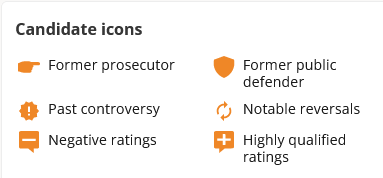
For those who don't want to read all the details about each candidate, Injustice Watch provides these handy symbols. Former public defenders get nice, robust shields; former ASAs get pointed fingers. I'm guessing these are supposed to be accusatory fingers, consistent with a prosecutor's statutory function. Given the editorial bias of the publication, I wonder if a different pointed-finger-symbol might not have been considered.

Of course, I realize that might sound a tad mean-spirited. And I don't mean it that way. It might make me sound a little envious, too, and I suppose I might be: But I also recognize and appreciate what an involved and substantial undertaking this Guide represents.

If you've been following this year's retention election at all, you know that nearly all the members of the retention class have 100% favorable ratings. There are a number of instances where, for a given candidate, Injustice Watch has gone back and documented where a candidate, who now is favorably reviewed, was initially elected with negative or even strongly negative ratings. It has always been the perception that most (not all) judges elected despite bad ratings wind up with good ratings come retention time; Injustice Watch has collected the actual data that backs up this perception.

The little rotation symbol has generated its share of controversy among the retention judges.

Last week, Injustice Watch's Maya Dukmasova tweeted that some judges were "livid" about possible links to old news stories about their decisions. A couple of days before that she had tweeted a question: "Who's a good expert to ask about the meaning of appellate court reversals?"

The problem with considering a trial judge's reversal rate is the implicit assumption that the trial judge who is reversed was wrong... and the Appellate Court was necessarily right.

But if ever the lawyer's clichéd fallback response to almost any question (it depends) applies, it is on the question of whether a judge should be subject to criticism in any given case because a higher court reversed that judge's decision.

The Illinois Supreme Court sits atop the Appellate Court of Illinois in the judicial pyramid, but in any given term it agrees to hear roughly 1% of the cases in which review of an Appellate Court decision is sought. And that dismal figure does not, and can not, take into account the number of disappointed litigants who are dissuaded from even seeking Supreme Court review because of the daunting odds against being accepted for further review.

Thus, our Appellate Court is effectively the court of last resort for Illinois litigants. But just because that court disagrees with a Circuit Court judge in a given case does not mean that the Circuit Court judge really erred. The Appellate Court is not final because it is always right; rather it is only "right" because it is (almost always) final. And a Circuit Court judge who makes decisions with a view toward avoiding reversal in a higher court probably is unworthy of the robe.

Anyone who has handled any significant number of appeals can point to instances where the trial court erred and the Appellate Court failed to correct the error -- at least in the practitioner's opinion. (Funnily enough, I can't recall a single instance where the trial court erred in a way that redounded to my client's benefit and where that judgment was affirmed....) But the bottom line is that Appellate Court panels can err, too, and do.

Also, there really is often no one 'right' answer in any given set of facts. If there were, we could just turn the justice system over to some all-powerful computer (and anyone who has ever watched Star Trek or Dr. Who knows what a bad idea that would be). In many cases, the way the issues are framed determines the outcome -- and reasonable judges can disagree on how the issues should be framed in a given case. It may be that the dispositions of both the trial court and the Appellate Court are reasonable -- but the Appellate Court has the last word.

True story: Some years ago I got involved in a case at the Petition for Leave to Appeal (to the Supreme Court) stage. The trial court had dismissed the case. The Appellate Court had unanimously affirmed in an unpublished Rule 23 Order (the Appellate Court's equivalent of 'nothing to see here, citizens, move along'). But, against all the odds, the Supreme Court took the case and reversed the Appellate Court in a 4-3 decision. (This was certainly not solely due to my efforts; the late William J. Harte handled the argument and signed the brief -- but I did get to drive the car to Springfield and whole paragraphs of my drafts were included in the final product.)

Anyway, in due course, the case made its way back to the Circuit Court of Cook County, and, when the defendant brought another motion to dismiss, I wound up appearing before the judge who'd originally dismissed it. The trial court made a point of telling me that six out of 10 reviewing court judges had viewed the case as she had -- and she was not wrong.

Earlier today, in promoting the release of the Guide, Dukmasova tweeted that the Guide "takes thousands of hours of our team's time to research." I believe it. And I believe it shows, too.

But I can't imagine how many more hours would be necessary to fairly evaluate whether a given judge really should be criticized because of the number of times that judge was reversed -- even if that judge was (as Dukmasova also tweets) reversed more than twice as often as that judge's next-most-reversed peers. Reversals alone do not make a judge unworthy of retention. Even if those reversals are occasionally accompanied by a 'bench slap' that gets picked up by a reporter.

With that caveat, the Injustice Watch "Check Your Judges" Guide is a valuable tool and well worth the consideration of the voter looking for help in navigating the retention ballot.

Friday, October 07, 2022

Chicago Bar Association says vote "yes" on all retention judges, with two exceptions

The Chicago Bar Association has announced that it is recommending that voters give a "yes" vote for all Cook County retention judges on the November ballot -- with two exceptions. As will come as no surprise to FWIW readers, the two exceptions are Daniel James Pierce and Ann Finley Collins.

Both told bar screeners that they would not participate in either screening by either the Alliance of Bar Associations for Judicial Screening or the CBA because they were planning to retire. While both filed for retention, Pierce ultimately went through with his retirement plans; Collins changed her mind about retiring this year.

Both Pierce and Collins will appear on the retention ballot. But votes for or against Pierce will not count because he has in fact retired. Votes for or against Collins will count.

Tuesday, October 04, 2022

"Girl I Guess Progressive Voter Guide" recommends "no" votes on six -- no, check that -- five Cook County retention judges

The "Girl I Guess" voter guides are the brainchild of @Stephanie_Skora who describes herself as a "Genderqueer Trans woman, Femme Lesbian, Jewish Mom Virgo, organizer, [and] speaker."

Ms. Skora has also become, in a very short time, quite influential in Cook County judicial races. In his post-primary analysis for FWIW, Dr. Albert J. Klumpp wrote:
One other relevant factor was the “Girl I Guess” progressive voter guide that has been a detectable presence in the two most recent November retention elections. It influenced roughly six percent of the vote. This is an impressive achievement for a single individual, but it was not part of any larger grassroots movement that was the primary cause of anyone’s victory or defeat.
Skora's opinions on Cook County judicial retention candidates are therefore newsworthy.

These may be found in the Guide itself, a Google doc, linked herein.

To find Ms. Skora's pungent commentaries on those candidates she deems unworthy of retention, one must scroll down the 46-page document quite a bit. The reader with time may find it illuminating to first read Ms. Skora's explanations of herself, her methods, methodologies, metrics, and priorities (pp. 3-7), but most FWIW will want to 'cut to the chase' and see who Ms. Skora rejects.

Those singled out are Anna Loftus, Alison C. Conlon, Daniel James Pierce, Ann Finley Collins, and Rossana Patricia Fernandez. Judge William H. Hooks was also initially targeted for a "no" vote, but Skora changed her mind.

Skora explains her choices in detail at pp. 39-41 of her Guide but, to summarize, Pierce and Collins are singled out on account of their failure to participate in the bar associations' review process. Pierce has since resigned; FWIW has not yet determined whether his name will appear on the ballot but, even if it does, and even if Pierce attracts sufficient "yes" votes, he can not "un-resign." Collins recently contacted FWIW to explain that she, too, had been planning to retire, which was why she did not submit to bar screening, but changed her mind at the last moment when she realized that personal financial considerations made retirement in 2022 inadviseable. Skora's current version of her Guide contains this "update" in regard to Collins:
Several people have reached out to me to express that Judge Collins is hardworking and should be retained. I’m including that in this update here because it’s important that folks are vouching for her as a Judge, including one individual who I’ve endorsed in a Judicial race before. But with little other information to work off of, I’m not able to change my endorsement based on her lack of participation in the Bar Association ratings. If anyone is able to tell me why she chose not to participate, that might sway things, but barring that information, I don’t have enough to change my mind.
Skora recommends that Anna Loftus be turned out of office because Loftus hired a law clerk with Trumpian views. FWIW has tracked down the apparent Facebook page of the person in question; if the screen grabs Skora includes with her "dish" were public posts, they have (unsurprisingly) been scrubbed. All of which begs the question of whether a public agency can, or should, be permitted to vet a job applicant's political leanings in making a hiring decision. Obviously, this was once permitted: For many years in Cook County, no one could get a public job without a letter from one's committeeman attesting to the applicant's bona fides generally and party loyalty specifically. This was called "patronage" -- and progressives used to hate it. But, I guess, times change.

Skora calls Rossana Patricia Fernandez a "complicated case." She writes:
According to all accounts, she’s a capable judge who knows the law, can do the work, and has held a number of impressive leadership positions throughout her career... and also according to the Illinois State Bar Association, the Chicago Council of Lawyers, and an anonymous website where litigants and attorneys can review judges, she’s got some serious problems with her temperament, and has been reported as condescending and disrespectful to attorneys and litigants alike. Bar Associations are split on Fernandez because of her impressive qualifications, but I’m not inclined to give a break to a Judge who should treat people better from the bench. Vote NO.
For the record, the "anonymous website" referred to in Skora's "dish" regarding Fernandez is The Robing Room -- where, indeed, Fernandez comes in for a very poor rating... on the basis of three evaluations.


While it may seem otherwise from Skora's remarks, the Chicago Council of Lawyers did rate Fernandez "Qualified," although it did consider her case a "close call." Here is the complete text of the CCL's evaluation of Fernandez:
The Hon. Rossana P. Fernandez was admitted to the Illinois bar in 1997. She is currently assigned to the Domestic Relations Division in the Third Municipal District. She was appointed to the bench by the Illinois Supreme Court in 2015 and elected as a Circuit Court Judge in 2016. Previously, she had been a Partner at Sanchez and Daniels, where she handled personal injury litigation. She had also worked at Eannace Lowery & Meade as an Associate Attorney.

Judge Fernandez has extensive legal knowledge and ability. She is praised for her opinion writing skills. However, there are mixed reviews on the issue of temperament and court management. Many lawyers praised her ability to control a courtroom while being respectful. Others criticize her for being inflexible and rigid in managing her courtroom and applying courtroom procedures in Domestic Relations and Domestic Violence cases, which, they say sometimes leads to questionable outcomes. Many lawyers praise her temperament and how she addresses person in her courtroom. But many other respondents say she is sometimes rude to litigants and lawyers. Because of the wide disparity of views, Judge Fernandez’s evaluation presents a very close call. The reports of problems with Judge Fernandez’s handling of her call are credible and concerning. Ultimately, however, the Council credits reports that Judge Fernandez is a hardworking and caring judge who is capable of improvement. On balance, the Council finds her Qualified for retention.
Of the four Alliance bar groups that recommend "no" votes on Fernandez, the Decalogue Society, the Hellenic Bar Association, the Illinois State Bar Association, and Chicago’s LGBTQ+ Bar Association (LAGBAC), only the ISBA publishes a narrative explaining its rating. That explanation may be found in this prior FWIW post.

That leaves Alison C. Conlon and William H. Hooks. Skora recommends voting against Judge Conlon because of an alleged relationship between the judge and a Sergeant in the Cook County's Sheriff's Office and what her apparent single "source in the Daley Center" says are the consequences that follow therefrom. I won't repeat the "dish" here, but commend the reader to p. 39 of the guide instead.

As to Hooks, Skora initially called him a misogynist, among other things. While noting the Chicago Council of Lawyer's praise for Judge Hooks for "calling out cops who lie on the stand," she initially opposed Hooks' retention because he was required to attend anger management training (which he was, in October 2018, though he was reinstated in January 2019).

Skora announced her change of heart about Hooks in this update:
A trusted source reached out to me with more context on Hooks’s anger management stint, and it very much changed my mind on this endorsement. Evidently, what went down is that Hooks called out a shitty, ex-cop judge for throwing out the cases against the cops who covered up the murder of Laquan McDonald in 2014. He called her a bitch and a bunch of other things, and she reported him to the presiding justice at the time, so he got sent to anger management classes! Holy shit! Throwing out cases against cops who covered up a murder for a disgraced former Mayor absolutely qualifies someone as a bitch, and Hooks has been on the side of victims of police violence for years internally to the courthouse.

Wednesday, September 28, 2022

Judge Ann Finley Collins comes forward

In connection with ratings issued by the Alliance of Bar Associations for Judicial Screening and various members thereof, FWIW has reported that two Circuit Court candidates were not recommended for retention on account of their failure to participate in the Alliance's screening process.

One of these two judges has recently advised the Illinois State Board of Elections that he is withdrawing his candidacy as a retention candidate; he has in fact submitted his resignation.

The other is Judge Ann Finley Collins.

Judge Collins contacted FWIW recently to advise that she, too, was seriously considering retirement as the current retention cycle got underway. When contacted about participation in the Alliance screening process, Collins advised that she would not participate since she was planning to retire.

But, Collins explained in a telephone interview Monday, as the deadline for filing for retention drew near, she realized that personal financial considerations made retirement in 2022 inadvisable. So, at the last moment, on May 5, 2022, Collins changed her mind and filed for retention.

The records of the Illinois Secretary of State (with whom declarations of intent to seek retention must be filed) confirm that Collins was one of the last Cook County judges to file for retention.

In this unusual election cycle, the Alliance made a decision early on to evaluate retention candidates first, before conducting evaluations of candidates running in the June primary. The Alliance acknowledged that it would be under unusual time pressures because of the late primary; the subsequent announcement of a new associate judge selection process only heightened those time pressures.

Sources in the Alliance have confirmed that screening questionnaires went out to retention judges in November 2021 and candidate interviews began in January.

Collins told FWIW that, by the time she decided to seek retention, she had missed the Alliance deadline for screening. She subsequently reached out to the Alliance, she said, asking if she could be screened late, but the Alliance declined.

Sources within the Alliance confirm that Collins did reach out in August and that the Alliance did reject Collins' request for a late screening. Other judges who were wavering on the question of retirement, including some who did retire, participated in the early screening process anyway, an Alliance spokesperson said.

Collins was elected to an 11th Subcircuit vacancy in 2010. For what it's worth, Collins had very favorable bar ratings at that time, including a Highly Qualified rating from the Chicago Bar Association and a Well Qualified rating from the Chicago Council of Lawyers. Collins was retained by the voters in 2016. She participated in both the CBA and Alliance screening processes in 2016 and received no negative evaluations.

Collins also told FWIW that she did not participate in the CBA screening process for the forthcoming retention election. She expects to be found Not Recommended by the CBA as a result.

The CBA ratings for retention candidates have not yet been released and FWIW has so far been unable to obtain any statement from the CBA JEC about Collins' situation.

Friday, September 23, 2022

Alliance of Bar Associations for Judicial Screening retention judges "grids" published

The lengthy retention ballot is straightforward enough. For each of the many jurists listed, voters are asked to answer a simple "yes" or "no" question: Shall Judge X be retained in office as a judge?

Judges receiving "yes" votes from more than 60% of the voters answering the question (60% + 1) are retained; any judges falling below that mark would have to look for work elsewhere.

What follows are the "grids" published by the Alliance of Bar Associations for Judicial Screening, showing side-by-side comparisons of ratings issued by each of the 12 Alliance members for each of the many retention candidates.

As readers will note, when looking at these grids, nearly all the Alliance bar groups agree that nearly all the judges on the ballot deserve to remain in office. (Click on the images below to enlarge or clarify.)

As we know from the CCL and ISBA narratives, the two obvious exceptions, Ann Finley Collins and Daniel James Pierce, received negative ratings because they did not participate in the Alliance screening process.

FWIW is aware of a number of judges who were up for retention but who declined to be screened because they were planning to retire. Pierce has retired, but apparently his announcement did not come soon enough to prevent the publication of the negative ratings. (Pierce has also withdrawn from the ballot.)

Insofar as FWIW can determine, Collins remains on the November retention ballot.

Only three other judges received negative ratings from any Alliance members at all. Judge William H. Hooks received "Yes" recommendations from every bar group except the ISBA. Judge Leonard Murray received "Yes" recommendations from every Alliance member except Chicago’s LGBTQ+ Bar Association (LAGBAC). Judge Rossana Patricia Fernandez received "Yes" recommendations from eight of the 12 Alliance groups, but the not the ISBA, Decalogue Society, Hellenic Bar Association, or LAGBAC.

The Alliance of Bar Associations for Judicial Screening consists of the Arab American Bar Association (AABAR), the Asian American Bar Association of the Greater Chicago Area (AABA), the Black Women Lawyers’ Association of Greater Chicago (BWLA), the Chicago Council of Lawyers (CCL), the Cook County Bar Association (CCBA), the Decalogue Society of Lawyers (DSL), the Hellenic Bar Association of Illinois (HBA), the Hispanic Lawyers Association of Illinois (HLAI), the Illinois State Bar Association (ISBA), Chicago’s LGBTQ+ Bar Association (LAGBAC), the Puerto Rican Bar Association (PRBA), and the Women’s Bar Association of Illinois (WBAI), all working collaboratively to improve the process of screening judicial candidates in Cook County, Illinois.

The Chicago Bar Association conducts a separate evaluation process for retention candidates. FWIW will have those ratings, too, when they are available.

Illinois State Bar Association recommends "No" vote on four Cook County judges seeking retention

The Illinois State Bar Association has published narrative explanations of Cook County jurists seeking retention this November. The complete narratives may be found at the link in the preceding sentence.

Unlike the Chicago Council of Lawyers, which distinguishes some retention candidates as "Highly Qualified" or "Well Qualified," the ISBA's ratings for retention candidates are simply "Yes" or "No."

For the November election the ISBA recommends a "Yes" vote for Supreme Court Justice Mary Jane Theis and each of the six elected Appellate Court justices seeking retention. It also recommends a "Yes" vote for every Circuit Court judge, with four exceptions.

The ISBA recommends a "No" vote on the retention bids of Judges Ann Finley Collins, Daniel James Pierce, William H. Hooks, and Rossana P. Fernandez.

Collins and Pierce declined to participate in the Alliance screening process and were automatically found not recommended on that basis. (The ISBA, like the Chicago Council of Lawyers, is a member of the Alliance of Bar Associations for Judicial Screening.)

But Pierce, who was serving on the Illinois Appellate Court pursuant to Supreme Court Order, has announced his retirement, effective one week from today. The Supreme Court has already appointed his replacement. Pierce's withdrawal from the retention ballot was not online when I checked on September 14; the Illinois State Board of Elections confirms his withdrawal as of September 15.

Insofar as I have been able to determine, Collins remains on the November retention ballot.

This is the ISBA's explanation of its negative rating on Judge Fernandez:
Hon. Rosanna Fernandez has been licensed since 1997. She was appointed to the Circuit Court in 2015 and elected in 2016. She has been assigned to Domestic Relations in the Third District (Rolling Meadows) since August 2018; her prior assignments include Domestic Violence and Traffic Court. She is the president of the Illinois Latino Judges Association and has been a Board member of the Hispanic Lawyers Association and the Illinois Association of Defense Trial Lawyers, and a committee member with the Illinois State Bar Association and the Women’s Bar Association. She has spoken on legal topics and served on Supreme Court committees. While attorneys agreed that she knows the law, writes well thought out opinions and is hard-working, substantial concerns were raised about her judicial temperament and demeanor. It was reported that at times she could be condescending and disrespectful to both attorneys and litigants, and that there are times she speaks Spanish directly to litigants without properly employing the official court interpreter.

The ISBA finds Judge Rossana P. Fernandez not recommended for retention to the Cook County Circuit Court.
As to Judge Hooks, the ISBA provided this explanation of its negative rating:
Hon. William Hooks has been licensed since 1981. He was appointed to the Circuit Court in 2008, elected in 2010, and retained in 2016. He has been assigned to the Criminal Division at the Leighton Courthouse since 2009, and to the Veterans Treatment Court since 2018. From October 2018 until January 2019, he was temporarily assigned to administrative duties in the Sixth District (Markham) by the Executive Committee of the Circuit Court. In January 2019 he returned to the Criminal Division. He is a past president of the Cook County Bar Association, a past Section chair with the Illinois State Bar Association, a committee member with the Illinois Judges Association, and has served on Illinois Supreme Court committees and the Illinois Courts Commission. He is also a United States Marine Corps veteran and received the Hon. Mary Ann McMorrow Service to the Profession Award in 2012 from the Phi Alpha Delta law fraternity. He is a board member of the Illinois Judicial Council.

Many attorneys praised his legal knowledge and ability, stating that he understands the issues in complex matters and has a good sense of justice. A few felt he was unimpressive and did not always follow the rules. He was praised for his work in Veterans Court and his diligence and impartiality. Concerns were raised, by some attorneys, about his demeanor and temperament, and some instances of insensitivity towards women. As noted, and as was reported in the press at the time, Judge Hooks was referred to anger management counseling by the Executive Committee when he was reassigned temporarily to administrative duties in 2018 upon being accused by another judge of creating a hostile work environment outside of the courtroom. Attorneys were split in their assessment of his courtroom demeanor - some stated that he runs his courtroom well, while others referenced his brusque manner, and felt that he could be disrespectful and arrogant at times, especially towards women attorneys.

The ISBA finds Judge William H. Hooks not recommended for retention to the Cook County Circuit Court.

Chicago Council of Lawyers recommends "Yes" votes for all but two Cook County Circuit Court judges seeking retention, finds Evans "Highly Qualified"

The Chicago Council of Lawyers has released its evaluation report for Cook County judicial candidates seeking retention this November. The link in the preceding sentence will take the reader to the complete CCL report, which also explains the methodology used by the Council in formulating its evaluations.

Only two Circuit Court judges were singled out for "No" votes by the CCL, Daniel James Pierce and Ann Finley Collins. Neither participated in the Alliance evaluation process (the CCL is a member of the Alliance of Bar Associations for Judicial Screening) and were Not Recommended on this basis.

But Pierce, who was serving on the Illinois Appellate Court pursuant to Supreme Court Order, has announced his retirement, effective one week from today. The Supreme Court has already appointed his replacement. Pierce's withdrawal from the retention ballot was not online when I checked on September 14; the Illinois State Board of Elections confirms his withdrawal as of September 15.

Insofar as I have been able to determine, Collins remains on the November retention ballot.

While the Council recommends "Yes" votes for each of the other Circuit Court judges seeking retention, one, Cook County Chief Judge Timothy C. Evans, was singled out by the CCL as "Highly Qualified," the highest rating the Council bestows.

Of Evans, the Council states:
The Hon. Timothy C. Evans was admitted to the Illinois bar in 1969. He currently serves as the Chief Judge of the Circuit Court of Cook County and has previously served as the Presiding Judge of the Domestic Relations Division. He was first elected to the bench in 1992 and was elected to the position of Chief Judge in 2001. Before taking the bench, he was a sole practitioner. Judge Evans was also an assistant corporation counsel for the City of Chicago and had served as a floor leader for Mayor Harold Washington and as an Alderman for the 4th Ward.

As Chief Judge, he does not hear cases, but sees to the administration of the courts. Chief Judge Evans created a domestic violence division of the Cook County Circuit Court, and recently convened a Task Force to identify needed reforms for that division. He re-instituted a pretrial services program and changed procedures so that bond hearings since 2008 are conducted in person, rather than via teleconferencing. This resulted in better due process protections. He has overseen the creation of several community courts which employ principals of restorative justice. In 2017 he issued an administrative order restricting the amount of money bond which could be imposed – resulting in a significant reduction in the Cook County jail population while 2017-2019 statistics showed no significant increase in Cook County crime.

Advocates say he is cooperating fully in preparing the Court for the end of money bond which is mandated by Illinois legislation to begin in January 2023, He has also issued an administrative order stopping Cook County judges from denying a public defender to a defendant without first conducting an indigence hearing.

Chief Judge Evans has also overseen the implementation of a court recording system in eviction courts and worked to ensure that judges recorded their eviction proceedings conducted by Zoom. Some say that he was too slow in moving the Circuit Court to a virtual operation during the pandemic, but others say that after delays at the outset, the Cook County Circuit Court made the necessary changes. The Council finds him Highly Qualified for retention.
The Council also rated five Circuit Court judges as "Well Qualified" for retention. These are Judges Jerry A. Esrig, John P. Kirby, Geary W. Kull, Freddrenna M. Lyle, and (as mentioned earlier) Mary Lane Mikva.

Of Esrig, the Council stated:
The Hon. Jerry A. Esrig was admitted to the Illinois bar in 1978. He was first appointed to the Circuit Court by the Illinois Supreme Court in 2013. He lost a Primary election in 2014. He was appointed to the Circuit Court by the Illinois Supreme Court for another interim term in 2014 and was elected to the bench in 2016. He is currently assigned to the Law Division, Calendar S, Commercial Calendar Section. Prior to becoming a judge, he was a Partner with a small firm, focusing on sophisticated personal injury and commercial litigation matters.

Respondents spoke exceptionally highly of Judge Esrig’s legal knowledge and ability. He is praised for his preparation and willingness to do the research necessary to acquire the necessary knowledge of the issues being litigated before him. He is also praised for his integrity and his judicial temperament was generally described as very good. He is considered punctual and diligent on the bench and respondents generally stated that Judge Esrig’s orders were thorough, well-done, and issues in a timely manner. The Council finds him Well Qualified for retention to the Circuit Court.
The CCL had this to say about Kirby:
The Hon. John P. Kirby was admitted to the Illinois bar in 1983. He was elected to the bench in 1998. He has served in the Criminal Division and is currently assigned to the Law Division. Prior to becoming a judge, he was an Assistant Cook County State’s Attorney. Judge Kirby is a lecturer at DePaul University in Trial Advocacy I as well as a substitute lecturer in other courses.

Judge Kirby is considered to be knowledgeable and to have good legal ability. He has done well presiding over both criminal and civil cases. He is praised for his temperament and for his courtroom management skills. He is also praised for his punctuality and for his diligence. He is generally considered to be an excellent judge. In his past criminal division assignments, he received praise for his dedication to using alternative sentencing and for helping develop a cyber high school as an alternative sentence for youthful offenders. The Council finds him Well Qualified for retention to the Circuit Court.
As to Kull, the CCL's narrative report states:
The Hon. Geary W. Kull was admitted to the Illinois bar in 1974. He was appointed to the bench by the Illinois Supreme Court in 2009 and was elected in 2010. Before becoming a judge he served as an Assistant Cook County Public Defender and was in private practice focusing on criminal defense work. He is currently assigned to the Fourth Municipal District, where he hears felony cases.

Judge Kull is considered to have very good legal ability. He is reported to be exceptionally knowledgeable and is respectful to all parties. He has a very good judicial temperament – patient but controls his courtroom. He is well-respected as a jurist. The Council finds him Well Qualified for retention to the Circuit Court.
The Council stated this about Lyle:
The Hon. Freddrenna M. Lyle was admitted to the Illinois bar in 1980. She was appointed to the Circuit Court by the Illinois Supreme Court in 2012 .She unsuccessfully ran for election to the Illinois First District Appellate Court in 2014; later that year, her Circuit Court term expired. She was elected to the bench in 2016 and is currently assigned to the Mortgage Foreclosure Mechanics Lien Section in the Chancery Division. Before becoming a judge, she worked in small firms and as a solo practitioner, where she had substantial experience handling complex litigation matters. She also served for 13 years in the Chicago City Council.

Judge Lyle is praised for her knowledge of the law and for her courtroom management. She has a high volume call and is adept at getting through the cases while giving each of the parties the ability to make their case. She is praised for being “one of the judges who doesn’t automatically assume the bank is right.” Her rulings are well reasoned and are issued in a timely fashion. She is considered to have good legal ability. She is reported to have good legal ability. She is courteous and respectful to all litigants, including self-represented litigants. The Council finds her Well Qualified for retention to the Circuit Court.
These were the Council's comments about Mikva:
The Hon. Mary Lane Mikva was admitted to the Illinois bar in 1980. She currently serves as a Justice on the Illinois Appellate Court, where she was appointed in 2016. She was elected to the bench in 2004 and had been assigned to the Chancery Division and the Child Protection Division. Previously she had served as a clerk to Judge Prentice H. Marshall and later to U.S. Supreme Court Justice William J. Brennan, Jr. Judge Mikva also was an appellate attorney for the City of Chicago Law Department, as well as in private practice.

Justice Mikva is a highly respected jurist who is considered to have very good legal ability. She is praised for her ability to analyze and understand complex legal issues. She is respectful to those appearing before her and her written opinions are considered thoughtful and well- reasoned. The Council finds her Well Qualified for retention.