Wednesday, October 26, 2022

Another day, another voters' guide....

This one is from an outfit called Chicago Votes, but it's not pitched at all Chicagoans apparently... only the "young people":
The reader may wonder what is meant by the above and foregoing. I can offer no clarification.

But I can tell you how this particular guide was made, because the makers offer this explanation: "We asked candidates questions about issues that young people give a sh*t about."

But, you say, never mind the generalities: What does the Chicago Votes Voters' Guide have to say about the retention judges?

Well, the Guide comes in hot, to begin with (punctuation, CAPS and bold as in original):
AMERICA HAS A PROBLEM, and that is our courts! Use our judicial cheat sheet to disrupt judges that have been flagged as not recommended or not qualified! They too COZY!
But... it is a little unclear at whom the Chicago Votes disruptors have been aimed.

Here are the instructions for reading the Chicago Votes judicial guide:
Note the use of red letters. Practically anyone who drew any sort of notice, good or bad, in the Injustice Watch Judicial Guide gets branded with red letters by Chicago Votes:
It is safe to say that Injustice Watch has singled out one of the members of the retention class for having what it deems an unusually high reversal rate and also that Injustice Watch has highlighted two members of the retention class (only one of whom is actually seeking retention) who chose to forego the bar associations' judicial evaluation process. But the 'judicial cheat sheet' from Chicago Votes seems to be suggesting a sort of equivalence between "0% qualified" and a "flag" from Injustice Watch.

Chicago Votes bills itself as "a non-partisan, non-profit organization building a more inclusive democracy by putting power in the hands of young Chicagoans. We’re engaging a new generation of leaders, changing laws to make Chicago and Illinois a better place to be young, and in the process, we’re making democracy FUN."

A Tweet about CTA safety from the Chief Judge's Director of Communications

Presented without comment (except to note, for the reading-comprehension-impaired, that this is obviously a statement of personal opinion and not any sort of attempt at communication on behalf of the court system). Here's the link to the original Tweet, which should be embedded below:
But, just in case, here's a screenshot:

Thursday, October 20, 2022

Next week: CBA, CBF host Annual Pro Bono Week

The old joke is that pro bono is Latin for 'you're not getting paid for your services.' But that's not true. I've had clients say that to me many times during the years (actually, they seldom said anything; they merely ignored my bills). Either way, I can tell you for a fact that getting stiffed by non-paying clients does not constitute pro bono work. I've asked.

Rather, pro bono is short for "pro bono publico," literally 'for the public good,' and some very good lawyers have made their living doing this kind of work.

But their efforts frequently need supplementation from persons who know -- in advance -- that they will not get paid for their public-spirited efforts. It is to these volunteers and potential volunteers that the activities of the forthcoming Pro Bono Week are directed.

Pro Bono Week began in 2005 when the Chicago Bar Association and Chicago Bar Foundation realized the increasing need for pro bono services during harsh economic times. In 2009, the American Bar Association took up the cause and created a National Celebration of Pro Bono to draw attention to the need for pro bono participation, and to thank those who give their time year-round.

In a press release calling attention to this year's observance, the CBA says Pro Bono Week 2022 will focus on efforts to provide access to justice to empower people and communities. The week’s events will highlight the vitally important legal work lawyers do in their communities to improve the lives of their friends and neighbors while ensuring the access to justice that people deserve, not just what they can afford.

"Equal access to justice is core to the CBA’s mission. Serving our community members in need and fighting for justice and equality for all, is our profession’s highest calling," said CBA President Timothy Tomasik. "We are proud to join with lawyers across our nation to celebrate National Pro Bono Week 2022 and to recognize the important contributions that have been made as well as the work that still needs our support."

Here are some of the scheduled Pro Bono Week events:
Monday, October 24:
  • Pro Bono in Communities - Registrants will hear from the Center for Disability & Elder Law, the Legal Aid Society Communities Partnering 4 Peace Program, the CBA’s Lawyers in the Classroom program, and the CBA’s Young Lawyers Section about how volunteer lawyers can give back in their communities. Panelists will describe the work their organizations are doing, discuss how persons can get involved as a pro bono volunteer, and provide details about volunteer opportunities at all levels of engagement. This is a hybrid event from 12:00 p.m. to 1:15 p.m. at The Chicago Bar Association, 321 S. Plymouth Court or via webinar.

  • Justice: An Evening of Stories and Community - The CBA describes this as a "fan favorite celebration" to kick off Pro Bono Week with an evening of justice-themed stories told by audience volunteers. Persons interested in telling their own story may sign up and come prepared with a five-minute story to share. Storytellers and listeners alike are encouraged to attend. This is an in-person event from 6:00 p.m. to 8:00 p.m. at Revolution Brewpub at 2323 N. Milwaukee Ave., Chicago, IL 60647.
Tuesday, October 25:
  • Voting Rights and Election Protection - Attorneys from the Chicago Lawyers’ Committee for Civil Rights and Kirkland & Ellis LLP (who together operate the Election Protection Hotline - 866-OUR-VOTE) will present on the history of voting rights and the current state of the law in Illinois and Indiana. Registrants will learn about what challenges and opportunities they expect in the upcoming November election and hear about opportunities to support the hotline as a call center volunteer or serve as an in-person field volunteer (poll-watcher). This is a hybrid event from 12:00 p.m. to 1:15 p.m. at The Chicago Bar Association, 321 S. Plymouth Court or via webinar.
Thursday, October 27:
  • Annual Pro Bono and Community Service Fair - Over 40 of Chicago’s legal aid, pro bono, community service, and mentoring organizations will gather at tables to meet with members of the legal community. Hear directly from legal aid and pro bono attorneys about how you can make a difference. Co-sponsored with the CBA Young Lawyers Section and Kirkland & Ellis LLP. This is an in-person event from 4:30 p.m. to 6:30 p.m. at Kirkland & Ellis LLP at 300 N. LaSalle Street Chicago, IL 60654.
To register for any of the events listed or for more information about Pro Bono Week, click here.

Wednesday, October 19, 2022

Reminder: Deadline for Bill of Rights Day Student Contest is October 30

The United States Courts of Appeals along with the United States District Courts in the Seventh and Eighth Circuits are hosting the third annual Bill of Rights Day Contest and students in Grades 5-12 are encouraged to enter before the 5:00 p.m., October 30 deadline.

I don't suppose that FWIW draws many readers from middle school or high school (although this might explain some of the comments received here and duly flushed away) -- but I would wager that a great many regular FWIW readers know teachers of students in the aforementioned grades or, perhaps, have students in these very grades consuming comesitbles under their very roofs. Get creative, people. If we can draw any lesson from the miserable political climate in our home state and country, it is that proper civic education, in generous doses, is sorely needed.

Detailed contest prompts, guidelines, and online submission form can be found at this link.

More information (summarizing the contest) may be found at this prior FWIW post.

Tuesday, October 18, 2022

CWBChicago offers guidance in some Cook County retention races

Not endorsements.

CWBChicago wants to make it clear that it neither makes endorsements nor recommendations in judicial elections (or in any others).

But, yesterday, CWBChicago published two posts offering information about certain retention races. The posts are:
Both posts provide extensive links to prior CWBChicago coverage about the judges identified (Chief Judge Evans and Judges Susana Ortiz, Charles Patrick Burns, Aleksandra Gillespie, William H. Hooks, and John Fitzgerald Lyke, Jr.).

And, before someone takes me to task for not saying it, I will say that CWBChicago, like Injustice Watch, has a point of view. Well, not a point of view like IJW... but a distinct voice, shall we say, just as IJW has its own distinctive voice....

Both publications are particularly interested in the criminal courts. Both will agree that most of the Circuit Court judges on the retention ballot are assigned elsewhere. And while CWB and IJW will have vastly different takes on whether Bond Court judges are too lenient or too restrictive, both would agree that, contrary to the insinuations of some politicians, almost all of the judges up for retention this year are not Bond Court judges. As this Tweet from IJW's Maya Dukmasova makes clear: CWBChicago and IJW may draw different conclusions from mostly the same data -- but they share their data along with the conclusions. Which permits voters to draw their own conclusions.

You mean there might be even more commercials?

The following item, from today's Chicago Public Square, caught my attention:
■ A federal judge has at least temporarily blocked Illinois laws limiting political contributions to judicial races—potentially unleashing what the Tribune calls “a deluge of cash into two hotly contested races for … the state’s highest court.”
The linked article discusses, but does not link to, the October 14, 2022 Memorandum Opinion and Order of U.S. District Judge John J. Tharp, Jr. in Chancey v. Illinois State Board of Elections, 22 CV 04043. Here's the link.

Just what we need: More outrageous nonsense about the State Supreme Court candidates in the newly-reconstituted Second and Third Judicial Districts.

I didn't think it was possible to buy any more airtime... but I fear I may be proved wrong.

Monday, October 17, 2022

Some resources for Downstate voters in judicial races

While the primary focus of this site is on Cook County judicial races, I get inquiries from time to time from persons looking for information about judicial elections outside Cook County -- or "Downstate" as the term is sometimes (and imprecisely) used. For those who may have landed here looking for information about judicial elections outside Cook County, I can offer the following:

While the Illinois State Bar Association is but one of many bar groups in Cook County that evaluate judicial candidates (although, since it has started publishing evaluation narratives, an increasingly important one), outside of Cook County it is the go-to source.

This page of the ISBA website will take the reader to a hyperlinked list of Illinois counties; each county link will take the reader to a list of all judges on the ballot in that county.

Outside of Cook County, the ISBA reviews candidates by polling practitioners -- it requires a certain minimum response before making a recommendation, so not every candidate may be evaluated... but, in the smaller counties there is a good chance that the lawyers really do know each other and deeply concerned about who may preside when they attempt to earn some portion of their living in court.

In this election cycle the ISBA also has had its Judicial Evaluation Committee evaluate Downstate (outside Cook County) candidates for Supreme and Appellate Court vacancies or retention. So the reader reviewing the county list will sometimes find two ISBA evaluations for some Appellate or Supreme Court vacancies.

But, while the ISBA is the traditional, go-to source for judicial evaluations outside Cook County, there are evaluations published by the DuPage County Bar Association specifically for the November election. The Lake County Bar Association and the Kane County Bar Association published ratings for the June primary on their respective websites (but the KCBA rating was only for the 16th Circuit, 1st Subcircuit vacancy) (as regular FWIW readers know, a great many Illinois counties have their own subcircuits these days). Voters in these counties may find these of interest as well.

Readers are invited to advise of any additional resources I have overlooked; I will update as necessary.

Friday, October 14, 2022

Illinois Latino Judges Association plans Holiday Fiesta on December 8

Here's the festive Save the Date poster:

And I know these events have to be planned well ahead of time... and well I know how quickly dates fill up as the end of the year sneaks up on us... but I can't help myself:

I've seen this one in several places online in recent days... and I've been itching for a chance to use it....

Thursday, October 13, 2022

Just in time for the November elections, the Illinois Judges Association makes a plea for judicial independence

From the text of the "Judicial Independence Declaration" on the Illinois Judges Association website:
A basic principle that defines the United States of America is that we are all entitled to equal treatment under the law. The judiciary’s primary function is to protect the rights of all people.

The court system can only function if it is viewed as impartial, that means making decisions based solely upon the facts and the law.

There are headline grabbing incidents of judges being threatened at all levels of the judiciary. The incidents are happening more frequently. These assaults are not solely limited to a disgruntled litigant, or non-prevailing party. Many are based upon a political agenda.

Judges are called upon to make decisions on controversial and hotly contested matters. We make these decisions because we have been given a position of trust in our communities. The voters should be able to determine whether we retain that position of trust based upon whether our rulings are fair and well grounded in the law, not whether we adhere to anyone’s political idealogy.

Our democracy encourages discussion, debate and scrutiny. The scrutiny that a judge receives is appellate review, and further Supreme Court review. The right to appeal an adverse ruling subjects those rulings to further scrutiny to determine if that decision comports with the facts and the law.

In November, judges on each level of court system will be on the ballot. Members of the state supreme court, the state appellate court, and the circuit court will be seeking retention. Voters should evaluate judges based on their integrity, professionalism, temperament, fairness and impartiality.
Of course partisans on OUR SIDE (whatever side is yours) can point to all sorts of instances where partisans on THE OTHER SIDE are guilty of terrific attacks on judicial independence but never see any problem in their campaign rhetoric or tactics. This always reminds me of the quote from the Gospel of Matthew (in the exquisite language of the King James Bible), "Thou hypocrite, first cast out the beam out of thine own eye; and then shalt thou see clearly to cast out the mote out of thy brother's eye."

Which is yet another reason why I never made it in politics....

But the principle of judicial independence is of vital import to the continued vitality of our system and the reminder is timely and appropriate.

On the judicial retention ballot, the default vote should be "yes"

In most elections, supporters of a candidate who wins 59% of the vote will use words like "landslide" to describe their favorite's splendid victory.

In Illinois judicial retention elections, a judge who receives a 59% favorable vote has to look for a new job come the first Monday in December.

To remain in office, a judge must receive a better-than-60% "yes" vote (often expressed as 60% + 1). Historically, most Cook County judges have little trouble surpassing this minimum requirement, high as it may seem.

For several consecutive elections (from 1992 until 2018) all Cook County judges won retention. In 2018 one judge was targeted for defeat by the Cook County Democratic Party (which historically had always supported all retention judges, even those first elected as *gasp* Republicans) -- and the targeted candidate lost. In 2020, the Party targeted a veteran judge and two judges in "judges' jail." One of the judges in judges' jail quit before the election; the other lost. The targeted veteran judge survived.

So even the occasional judge who has incurred the wrath of powerful politicians can survive on the retention ballot. And most judges do their necessary work unnoticed, safely out the politicians' reach.

But this rosy prospectus is darkened by the fact that, in any given retention election, 15 to 20% of the Cook County electorate reaching the retention ballot will vote "no" on every single judge. Every single judge -- no matter how universally praised by the bar associations -- no matter how highly praised by the press, dead tree or online -- no matter how mellifluous their surnames -- will get a "no" vote from 15 or 20 of every 100 voters.

In the 2020 retention election, for example, only five judges (all female) secured more than an 80% "yes" vote -- and none of them got 81%.

Some people (me, for one) believe that the influence of consistent "no" voters increases in inverse proportion to the turnout: The number of always-"no" voters is roughly consistent from election to election, so if turnout is lower, the indigestible lump of "no" votes may climb higher than 20%.

And turnouts for gubernatorial elections, like this one, are typically lower than the turnouts in presidential election years.

And that's before the selective "no" votes are counted. Lawyers will vote against judges who did not (in the lawyers' subjective view) treat them, or their clients, with the respect they considered due. Some may vote on the basis of 'sour grapes' -- that judge ruled against me, so I will vote 'no' on that judge. And ordinary people, too: "No" on the judge who dinged them on the speeding ticket, "no" on the judge who handled the divorce, "no" on the judge who put the voter's relative in jail, "no" on the judge who didn't jail that trouble-making kid down the street. Any time a judge makes a decision, someone is likely to be upset. And a judge's job is to make decisions.

So judges on the retention ballot (and their friends and family) may be forgiven if they get a little squirrelly around this time.

We have many very good, hard-working, scholarly judges in Cook County. With two exceptions, one of whom has already retired, all of the judges on the 2022 retention ballot are recommended by most of the bar associations that screen judicial candidates; the overwhelming majority have been recommended by each each and every one of the bar groups.

Therefore, while I mean to express no opinion about whether any particular judge should or should not be retained, I submit that the default vote on the judicial retention ballot, in the absence of a good reason to vote otherwise, should be "yes."

Tuesday, October 11, 2022

Injustice Watch out with its "Check Your Judges" Guide

I've spent some time today reviewing Injustice Watch's "Check Your Judges" Guide.

The key feature of the Guide is this info button; information (including the ratings offered by every bar association, both the CBA and every Alliance member) is available for every retention candidate and for the two candidates in the one contested judicial election, in the far northwest suburban 13th Subcircuit. Some retention candidates provided questionnaire responses for Injustice Watch; others did not. Where a response was provided, an excerpt is included in the information summary, along with a link to the full candidate questionnaire.

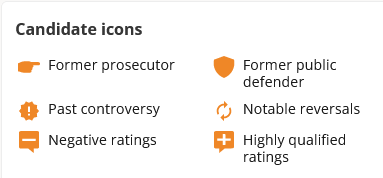
For those who don't want to read all the details about each candidate, Injustice Watch provides these handy symbols. Former public defenders get nice, robust shields; former ASAs get pointed fingers. I'm guessing these are supposed to be accusatory fingers, consistent with a prosecutor's statutory function. Given the editorial bias of the publication, I wonder if a different pointed-finger-symbol might not have been considered.

Of course, I realize that might sound a tad mean-spirited. And I don't mean it that way. It might make me sound a little envious, too, and I suppose I might be: But I also recognize and appreciate what an involved and substantial undertaking this Guide represents.

If you've been following this year's retention election at all, you know that nearly all the members of the retention class have 100% favorable ratings. There are a number of instances where, for a given candidate, Injustice Watch has gone back and documented where a candidate, who now is favorably reviewed, was initially elected with negative or even strongly negative ratings. It has always been the perception that most (not all) judges elected despite bad ratings wind up with good ratings come retention time; Injustice Watch has collected the actual data that backs up this perception.

The little rotation symbol has generated its share of controversy among the retention judges.

Last week, Injustice Watch's Maya Dukmasova tweeted that some judges were "livid" about possible links to old news stories about their decisions. A couple of days before that she had tweeted a question: "Who's a good expert to ask about the meaning of appellate court reversals?"

The problem with considering a trial judge's reversal rate is the implicit assumption that the trial judge who is reversed was wrong... and the Appellate Court was necessarily right.

But if ever the lawyer's clichéd fallback response to almost any question (it depends) applies, it is on the question of whether a judge should be subject to criticism in any given case because a higher court reversed that judge's decision.

The Illinois Supreme Court sits atop the Appellate Court of Illinois in the judicial pyramid, but in any given term it agrees to hear roughly 1% of the cases in which review of an Appellate Court decision is sought. And that dismal figure does not, and can not, take into account the number of disappointed litigants who are dissuaded from even seeking Supreme Court review because of the daunting odds against being accepted for further review.

Thus, our Appellate Court is effectively the court of last resort for Illinois litigants. But just because that court disagrees with a Circuit Court judge in a given case does not mean that the Circuit Court judge really erred. The Appellate Court is not final because it is always right; rather it is only "right" because it is (almost always) final. And a Circuit Court judge who makes decisions with a view toward avoiding reversal in a higher court probably is unworthy of the robe.

Anyone who has handled any significant number of appeals can point to instances where the trial court erred and the Appellate Court failed to correct the error -- at least in the practitioner's opinion. (Funnily enough, I can't recall a single instance where the trial court erred in a way that redounded to my client's benefit and where that judgment was affirmed....) But the bottom line is that Appellate Court panels can err, too, and do.

Also, there really is often no one 'right' answer in any given set of facts. If there were, we could just turn the justice system over to some all-powerful computer (and anyone who has ever watched Star Trek or Dr. Who knows what a bad idea that would be). In many cases, the way the issues are framed determines the outcome -- and reasonable judges can disagree on how the issues should be framed in a given case. It may be that the dispositions of both the trial court and the Appellate Court are reasonable -- but the Appellate Court has the last word.

True story: Some years ago I got involved in a case at the Petition for Leave to Appeal (to the Supreme Court) stage. The trial court had dismissed the case. The Appellate Court had unanimously affirmed in an unpublished Rule 23 Order (the Appellate Court's equivalent of 'nothing to see here, citizens, move along'). But, against all the odds, the Supreme Court took the case and reversed the Appellate Court in a 4-3 decision. (This was certainly not solely due to my efforts; the late William J. Harte handled the argument and signed the brief -- but I did get to drive the car to Springfield and whole paragraphs of my drafts were included in the final product.)

Anyway, in due course, the case made its way back to the Circuit Court of Cook County, and, when the defendant brought another motion to dismiss, I wound up appearing before the judge who'd originally dismissed it. The trial court made a point of telling me that six out of 10 reviewing court judges had viewed the case as she had -- and she was not wrong.

Earlier today, in promoting the release of the Guide, Dukmasova tweeted that the Guide "takes thousands of hours of our team's time to research." I believe it. And I believe it shows, too.

But I can't imagine how many more hours would be necessary to fairly evaluate whether a given judge really should be criticized because of the number of times that judge was reversed -- even if that judge was (as Dukmasova also tweets) reversed more than twice as often as that judge's next-most-reversed peers. Reversals alone do not make a judge unworthy of retention. Even if those reversals are occasionally accompanied by a 'bench slap' that gets picked up by a reporter.

With that caveat, the Injustice Watch "Check Your Judges" Guide is a valuable tool and well worth the consideration of the voter looking for help in navigating the retention ballot.

Friday, October 07, 2022

Chicago Bar Association says vote "yes" on all retention judges, with two exceptions

The Chicago Bar Association has announced that it is recommending that voters give a "yes" vote for all Cook County retention judges on the November ballot -- with two exceptions. As will come as no surprise to FWIW readers, the two exceptions are Daniel James Pierce and Ann Finley Collins.

Both told bar screeners that they would not participate in either screening by either the Alliance of Bar Associations for Judicial Screening or the CBA because they were planning to retire. While both filed for retention, Pierce ultimately went through with his retirement plans; Collins changed her mind about retiring this year.

Both Pierce and Collins will appear on the retention ballot. But votes for or against Pierce will not count because he has in fact retired. Votes for or against Collins will count.
Diversity Scholarship Fund Unity Award Dinner set for December 6

The Diversity Scholarship Foundation has announced that its annual Unity Award Dinner will take place this year on December 6. It has also announced that it is looking for additional sponsors for the event: Email dsfchicago@gmail.com for more information.

Tuesday, October 04, 2022

Rena Marie Van Tine named Acting Presiding Judge of County Division

Press release issued yesterday by the Chief Judge's Office:
The Hon. Rena Marie Van Tine has been named Acting Presiding Judge of the County Division of the Circuit Court of Cook County, Chief Judge Timothy C. Evans said.

Judge Van Tine was the first female Indian American in the nation to serve as a judge on a state court on June 12, 2001, when she was appointed Associate Judge of the Circuit Court of Cook County. She was the first female Indian American judge to be appointed to a countywide vacancy by the Illinois Supreme Court in February 2021, and the first to win a county-wide election. With this new appointment, she is the first female Asian American Acting Presiding Judge in Illinois.

Judge Van Tine has been assigned to the Law Division since February 2017, and handled complex litigation. She was previously assigned to the Child Protection Division.

“Judge Van Tine has had many years of experience as a judge and a practicing attorney, handling hundreds of complex cases,” said Judge Evans. “She also has built a reputation as a leader and an educator in the legal field. I am confident that the County Division will benefit from her leadership.”

Prior to her appointment to the bench, Judge Van Tine served as Special Counsel to Illinois State Comptroller Daniel W. Hynes, where she assisted in managing about $1 billion in trust funds.

Before joining the Comptroller’s Office, Judge Van Tine was a Cook County Assistant State’s Attorney for 12 years, serving both in the Criminal and Civil Divisions. Prior to becoming an Assistant State’s Attorney, she was an attorney in private practice.

Judge Van Tine also has served as an adjunct professor of trial advocacy at the Chicago-Kent College of Law, and is often called on to give legal education presentations to her fellow judges, lawyers, and the public. She is a founding member of the Chicago chapter of the Indian American Bar Association (renamed the South Asian American Bar Association of Chicago in 2016), and served on its first board of directors. She is past president of the Asian American Bar Association, and is currently Vice President of the Asian American Judges Association of Illinois.

Judge Van Tine graduated from New York Law School in 1986, and received a B.A. from Oakland University in Michigan in 1982 and was a graduate student at Michigan State University in intercultural communications.

“It's been my honor to serve as a judge in Cook County for over twenty-one years,” Judge Van Tine said. “I am grateful for the opportunity to segue into this new endeavor, and I look forward to assisting Chief Judge Evans in carrying forward his vision for the County Division and our court system.”

Judge Van Tine replaces the Hon. Sanjay T. Tailor, who has been elevated to the First District Appellate Court. Judge Tailor, who was first appointed to the bench as an Associate Judge in 2003, was the state’s first Asian American presiding judge.
-------------------------------------
Actually, although this is just a formality, Judge Van Tine will not actually win election to the Circuit Court until next month. She won the Democratic Party's nomination for the countywide Leeming vacancy in the June primary and is unopposed on the November ballot.

"Girl I Guess Progressive Voter Guide" recommends "no" votes on six -- no, check that -- five Cook County retention judges

The "Girl I Guess" voter guides are the brainchild of @Stephanie_Skora who describes herself as a "Genderqueer Trans woman, Femme Lesbian, Jewish Mom Virgo, organizer, [and] speaker."

Ms. Skora has also become, in a very short time, quite influential in Cook County judicial races. In his post-primary analysis for FWIW, Dr. Albert J. Klumpp wrote:
One other relevant factor was the “Girl I Guess” progressive voter guide that has been a detectable presence in the two most recent November retention elections. It influenced roughly six percent of the vote. This is an impressive achievement for a single individual, but it was not part of any larger grassroots movement that was the primary cause of anyone’s victory or defeat.
Skora's opinions on Cook County judicial retention candidates are therefore newsworthy.

These may be found in the Guide itself, a Google doc, linked herein.

To find Ms. Skora's pungent commentaries on those candidates she deems unworthy of retention, one must scroll down the 46-page document quite a bit. The reader with time may find it illuminating to first read Ms. Skora's explanations of herself, her methods, methodologies, metrics, and priorities (pp. 3-7), but most FWIW will want to 'cut to the chase' and see who Ms. Skora rejects.

Those singled out are Anna Loftus, Alison C. Conlon, Daniel James Pierce, Ann Finley Collins, and Rossana Patricia Fernandez. Judge William H. Hooks was also initially targeted for a "no" vote, but Skora changed her mind.

Skora explains her choices in detail at pp. 39-41 of her Guide but, to summarize, Pierce and Collins are singled out on account of their failure to participate in the bar associations' review process. Pierce has since resigned; FWIW has not yet determined whether his name will appear on the ballot but, even if it does, and even if Pierce attracts sufficient "yes" votes, he can not "un-resign." Collins recently contacted FWIW to explain that she, too, had been planning to retire, which was why she did not submit to bar screening, but changed her mind at the last moment when she realized that personal financial considerations made retirement in 2022 inadviseable. Skora's current version of her Guide contains this "update" in regard to Collins:
Several people have reached out to me to express that Judge Collins is hardworking and should be retained. I’m including that in this update here because it’s important that folks are vouching for her as a Judge, including one individual who I’ve endorsed in a Judicial race before. But with little other information to work off of, I’m not able to change my endorsement based on her lack of participation in the Bar Association ratings. If anyone is able to tell me why she chose not to participate, that might sway things, but barring that information, I don’t have enough to change my mind.
Skora recommends that Anna Loftus be turned out of office because Loftus hired a law clerk with Trumpian views. FWIW has tracked down the apparent Facebook page of the person in question; if the screen grabs Skora includes with her "dish" were public posts, they have (unsurprisingly) been scrubbed. All of which begs the question of whether a public agency can, or should, be permitted to vet a job applicant's political leanings in making a hiring decision. Obviously, this was once permitted: For many years in Cook County, no one could get a public job without a letter from one's committeeman attesting to the applicant's bona fides generally and party loyalty specifically. This was called "patronage" -- and progressives used to hate it. But, I guess, times change.

Skora calls Rossana Patricia Fernandez a "complicated case." She writes:
According to all accounts, she’s a capable judge who knows the law, can do the work, and has held a number of impressive leadership positions throughout her career... and also according to the Illinois State Bar Association, the Chicago Council of Lawyers, and an anonymous website where litigants and attorneys can review judges, she’s got some serious problems with her temperament, and has been reported as condescending and disrespectful to attorneys and litigants alike. Bar Associations are split on Fernandez because of her impressive qualifications, but I’m not inclined to give a break to a Judge who should treat people better from the bench. Vote NO.
For the record, the "anonymous website" referred to in Skora's "dish" regarding Fernandez is The Robing Room -- where, indeed, Fernandez comes in for a very poor rating... on the basis of three evaluations.


While it may seem otherwise from Skora's remarks, the Chicago Council of Lawyers did rate Fernandez "Qualified," although it did consider her case a "close call." Here is the complete text of the CCL's evaluation of Fernandez:
The Hon. Rossana P. Fernandez was admitted to the Illinois bar in 1997. She is currently assigned to the Domestic Relations Division in the Third Municipal District. She was appointed to the bench by the Illinois Supreme Court in 2015 and elected as a Circuit Court Judge in 2016. Previously, she had been a Partner at Sanchez and Daniels, where she handled personal injury litigation. She had also worked at Eannace Lowery & Meade as an Associate Attorney.

Judge Fernandez has extensive legal knowledge and ability. She is praised for her opinion writing skills. However, there are mixed reviews on the issue of temperament and court management. Many lawyers praised her ability to control a courtroom while being respectful. Others criticize her for being inflexible and rigid in managing her courtroom and applying courtroom procedures in Domestic Relations and Domestic Violence cases, which, they say sometimes leads to questionable outcomes. Many lawyers praise her temperament and how she addresses person in her courtroom. But many other respondents say she is sometimes rude to litigants and lawyers. Because of the wide disparity of views, Judge Fernandez’s evaluation presents a very close call. The reports of problems with Judge Fernandez’s handling of her call are credible and concerning. Ultimately, however, the Council credits reports that Judge Fernandez is a hardworking and caring judge who is capable of improvement. On balance, the Council finds her Qualified for retention.
Of the four Alliance bar groups that recommend "no" votes on Fernandez, the Decalogue Society, the Hellenic Bar Association, the Illinois State Bar Association, and Chicago’s LGBTQ+ Bar Association (LAGBAC), only the ISBA publishes a narrative explaining its rating. That explanation may be found in this prior FWIW post.

That leaves Alison C. Conlon and William H. Hooks. Skora recommends voting against Judge Conlon because of an alleged relationship between the judge and a Sergeant in the Cook County's Sheriff's Office and what her apparent single "source in the Daley Center" says are the consequences that follow therefrom. I won't repeat the "dish" here, but commend the reader to p. 39 of the guide instead.

As to Hooks, Skora initially called him a misogynist, among other things. While noting the Chicago Council of Lawyer's praise for Judge Hooks for "calling out cops who lie on the stand," she initially opposed Hooks' retention because he was required to attend anger management training (which he was, in October 2018, though he was reinstated in January 2019).

Skora announced her change of heart about Hooks in this update:
A trusted source reached out to me with more context on Hooks’s anger management stint, and it very much changed my mind on this endorsement. Evidently, what went down is that Hooks called out a shitty, ex-cop judge for throwing out the cases against the cops who covered up the murder of Laquan McDonald in 2014. He called her a bitch and a bunch of other things, and she reported him to the presiding justice at the time, so he got sent to anger management classes! Holy shit! Throwing out cases against cops who covered up a murder for a disgraced former Mayor absolutely qualifies someone as a bitch, and Hooks has been on the side of victims of police violence for years internally to the courthouse.

Friday, September 30, 2022

Puerto Rican Bar Association seeks Spanish-speaking volunteers to help newly arrived immigrants and asylum seekers

The Puerto Rican Bar Association is asking that this information be shared:
The National Immigrant Justice Center is in need of immediate help from volunteer attorneys in helping newly arrived immigrants and asylum seekers who continue to arrive from Texas.

NIJC is looking for Spanish Speaking pro-bono attorneys for in-person shifts at the reception center on the north side of Chicago starting immediately. Volunteer spots are open for the first two weeks of October. The NJIC is asking potential volunteers to begin by completing this jotform.

The PRBA stresses that potential volunteers should realize that "this is a rapid response, this is an evolving project and volunteers with patience and flexibility are appreciated."

The PRBA's alert advises, "Due to space constraints at this time, Spanish fluency is required. It is also important to know that given the circumstances social distancing has not been possible. More logistical details will be provided at training sessions."

Wednesday, September 28, 2022

Judge Ann Finley Collins comes forward

In connection with ratings issued by the Alliance of Bar Associations for Judicial Screening and various members thereof, FWIW has reported that two Circuit Court candidates were not recommended for retention on account of their failure to participate in the Alliance's screening process.

One of these two judges has recently advised the Illinois State Board of Elections that he is withdrawing his candidacy as a retention candidate; he has in fact submitted his resignation.

The other is Judge Ann Finley Collins.

Judge Collins contacted FWIW recently to advise that she, too, was seriously considering retirement as the current retention cycle got underway. When contacted about participation in the Alliance screening process, Collins advised that she would not participate since she was planning to retire.

But, Collins explained in a telephone interview Monday, as the deadline for filing for retention drew near, she realized that personal financial considerations made retirement in 2022 inadvisable. So, at the last moment, on May 5, 2022, Collins changed her mind and filed for retention.

The records of the Illinois Secretary of State (with whom declarations of intent to seek retention must be filed) confirm that Collins was one of the last Cook County judges to file for retention.

In this unusual election cycle, the Alliance made a decision early on to evaluate retention candidates first, before conducting evaluations of candidates running in the June primary. The Alliance acknowledged that it would be under unusual time pressures because of the late primary; the subsequent announcement of a new associate judge selection process only heightened those time pressures.

Sources in the Alliance have confirmed that screening questionnaires went out to retention judges in November 2021 and candidate interviews began in January.

Collins told FWIW that, by the time she decided to seek retention, she had missed the Alliance deadline for screening. She subsequently reached out to the Alliance, she said, asking if she could be screened late, but the Alliance declined.

Sources within the Alliance confirm that Collins did reach out in August and that the Alliance did reject Collins' request for a late screening. Other judges who were wavering on the question of retirement, including some who did retire, participated in the early screening process anyway, an Alliance spokesperson said.

Collins was elected to an 11th Subcircuit vacancy in 2010. For what it's worth, Collins had very favorable bar ratings at that time, including a Highly Qualified rating from the Chicago Bar Association and a Well Qualified rating from the Chicago Council of Lawyers. Collins was retained by the voters in 2016. She participated in both the CBA and Alliance screening processes in 2016 and received no negative evaluations.

Collins also told FWIW that she did not participate in the CBA screening process for the forthcoming retention election. She expects to be found Not Recommended by the CBA as a result.

The CBA ratings for retention candidates have not yet been released and FWIW has so far been unable to obtain any statement from the CBA JEC about Collins' situation.

Upcoming political fundraisers that may be of interest to Cook County Judicial hopefuls

Getting to be a regular feature here....

FWIW readers with disposable income and judicial ambitions may be interested in one or more of the following House Democratic fundraisers.

Not, of course, because attendance will give you some sort of clear, inside track to Democratic Party political support for your eventual judicial campaign -- no matter how much disposable income you may have, you almost certainly don't have enough for that -- but your appearance at various functions may, over time, give you a sort of familiarity that might serve you well when slating rolls around. If you make a favorable impression.

Just knowing about these events, and showing up, may confer some benefit. Some little benefit.

FWIW readers are all too familiar with the politicans' mantra, we don't want nobody nobody sent. That made sense in the long-ago days of Daley I, and for decades prior thereto, when precinct captains with patronage jobs could turn out sufficient votes to elect almost anyone that the Party chose for greater things. Why mess up the system with strangers?

But -- in case you haven't noticed -- Daley I has been gone since 1976. There is no viable "Machine." There are 80 warlords vying for influence in a continual Game of Thrones, with the throne being of less and less value every day. But you -- the judicial wannabe -- don't need a Boss. You need a temporary coalition of local committeepersons, particularly in this dawning era of smaller subcircuits and few, if any, countywide opportunities.

And just as well, too: Even the Shakman case is (apparently) running out of steam, after a half-century of attacking the patronage system in favor of... something else... less predictable, more opaque... that must be inherently political anyway, since human beings are inherently political.

While reformers and political scientists may fret that that our one-party monopoly is a rotten system, and doomed and due to fall, it hasn't yet. For now, for the would-be Cook County judge, winning the Democratic Primary is the only thing that matters. So it may help to meet some Democrats on their turf. Or not. No warranties of any kind are intended, nor should they be inferred by you, in the dissemination of this list.

So, with these caveats firmly in mind, herewith some local Democratic Party fundraisers:
Democratic Party of Illinois Reception with Gov. Pritzker, Senate President Harmon, Speaker Welch, and Rep. Hernandez
Wednesday, September 28 | 5:00 p.m.
Fulton Market Kitchen | 311 N. Sangamon St, Chicago
VIP Reception: 5:00 p.m.
Write/raise individual: $22,000 | Couple $44,000
Write/raise corp/assn/union: $24,000
Write/raise pac: $59,900
RSVP for VIP & General Reception to ildems.com/vip_reception
General Reception: 5:30 p.m.
Individual ticket: $1,000
Pac/organization: $5,000 per ticket
RSVP for General Reception to ildems.com/general_reception
For questions contact Shannon Rice at srice@ildems.com

Fundraiser Supporting Democratic Nominee Abdelnasser Rashid
Thursday, October 6 | 5:00 p.m. to 6:30 p.m.
Home of Kalman Resnick & Benetta Mansfield | contact event sponsor for event address
Individual Ticket: $250
Sponsorship: $2,500 | $1,000 | $500
Contribute online: bit.ly/RashidOct6
Make checks payable to:
Rashid for Illinois
8907 W. 83rd St Unit D
Justice, IL 60458
RSVP to events@rashidforillinois.com

Rep. Jon Carroll Fundraiser
Thursday, October 20 | 7:00 p.m. - 9:30 p.m.
The Landmark Inn | 1352 Shermer Rd, Northbrook
Individual Ticket: $100
Sponsorship: $5,000 | $1,00 | $500 | $200
Online contributions: actblue.com/donate/carrolllandmark102222
Make checks payable to:
Friends of Jonathan Carroll PO Box 712
Northbrook, IL 60065

Rep. Jehan Gordon-Booth
Wednesday, October 26 | 5:30 p.m. - 7:00 p.m.
The Gage | 24 S. Michigan Ave., Chicago
Individual Ticket: $250
Sponsorship: $10,00 | $5,000 | $2,500 | $1,000 | $500
Online contributions: actblue.com/donate/jgbchi2022
Make checks payable to:
Friends of Jehan Gordon
P.O. Box 6591
Peoria, IL 61601
RSVP to Kate@kjdstrategies.com
Yeah, I know that last one is a bit of a stretch -- Ms. Gordon's district is in the Peoria area. On the other hand, she's fundraising here, presumably because she thinks she can get local money. As long as the local money she gets isn't only from Cook County judicial wannabes, there may be some theoretical benefit in this event for the ambitious potential candidate.

Friday, September 23, 2022

Judge Grace Dickler retires; Regina Scannicchio named Acting Presiding Judge of the Domestic Relations Division

Press release issued late this afternoon from the Office of Chief Judge Timothy C. Evans:
The Hon. Regina Scannicchio has been named Acting Presiding Judge of the Domestic Relations Division of the Circuit Court of Cook County, Chief Judge Timothy C. Evans said.

Judge Scannicchio was first appointed to the bench by the Illinois Supreme Court in 2011, after 23 years as a private domestic relations attorney. She was elected in 2012 and retained in 2018. After a year in traffic court, she became a judge in the Domestic Relations Division in 2012.

Judge Scannicchio replaces the Hon. Grace Dickler, who retired Friday after 11 years as Presiding Judge of the Domestic Relations Division and a total of 34 years on the Circuit Court of Cook County bench.

“I am humbled and honored to be named the Acting Presiding Judge of the Domestic Relations Division,” said Judge Scannicchio. “I am grateful to Chief Judge Timothy Evans for this opportunity and his faith in me. I am most fortunate to have worked with and known our retiring Presiding Judge Grace Dickler for several years. It is my desire to continue with Judge Dickler’s compassion and commitment to the judges of our division and the families and children we serve.”

“I have great faith that Judge Regina Scannicchio’s years of service in the domestic relations field, both as a private attorney and as a judge, will serve her well in her new role,” Judge Evans said. “I am confident that the Domestic Relations Division will benefit under her leadership.

Judge Scannicchio is a graduate of The John Marshall Law School and DePaul University. She has served as President of the Justinian Society of Lawyers and currently serves on the Society’s Executive Committee. She also sits on the boards of the Illinois Judges Association and the Catholic Lawyers Guild of Chicago. She is the 2022 recipient of the Judge Samuel S. Berger Award, given by the American Academy of Matrimonial Lawyers.

“Chief Judge Evans has chosen an extremely qualified, intelligent, compassionate and considerate judge to lead the Domestic Relations Division,” said Judge Dickler. “I know that I leave this Division in extremely good hands and I look forward to seeing what positive programs are implemented going forward.”

Judge Evans thanked Judge Dickler for her many years of service and wished her happiness in her retirement.

“The depth and range of her experience and perspective, in addition to her practical wisdom, compassion and administrative skills, has made Grace Dickler a great judge and a great public servant,” Judge Evans said. “She will be missed.”

Recently, Judge Dickler chaired the Circuit Court of Cook County Committee on Domestic Violence Court to develop a plan to improve court access to help domestic violence victims, which includes an after-hours pilot program that started earlier this month.

Before becoming a judge of the Circuit Court of Cook County in 1988, Judge Dickler had served as an immigration judge for the U.S. Immigration Court in Chicago from 1986 to 1988 and an administrative law judge for the Illinois Human Rights Commission from 1982 to 1985. From 1981 to 1982, she was a supervising attorney for the Travelers and Immigrants Aid Society of Chicago.

Grace Dickler graduated from Northwestern University School of Law in 1978 and began her legal career at the Cook County Legal Assistance Foundation.
Judge Dickler was originally elected from the north suburban 12th Subcircuit. Her retirement will create a vacancy in the newly redrawn 12th Subcircuit, the exact boundaries of which are not yet available on a map, but which I believe will run along the very northern edge of Cook County, from Northbrook to the east half of Barrington.

Alliance of Bar Associations for Judicial Screening retention judges "grids" published

The lengthy retention ballot is straightforward enough. For each of the many jurists listed, voters are asked to answer a simple "yes" or "no" question: Shall Judge X be retained in office as a judge?

Judges receiving "yes" votes from more than 60% of the voters answering the question (60% + 1) are retained; any judges falling below that mark would have to look for work elsewhere.

What follows are the "grids" published by the Alliance of Bar Associations for Judicial Screening, showing side-by-side comparisons of ratings issued by each of the 12 Alliance members for each of the many retention candidates.

As readers will note, when looking at these grids, nearly all the Alliance bar groups agree that nearly all the judges on the ballot deserve to remain in office. (Click on the images below to enlarge or clarify.)

As we know from the CCL and ISBA narratives, the two obvious exceptions, Ann Finley Collins and Daniel James Pierce, received negative ratings because they did not participate in the Alliance screening process.

FWIW is aware of a number of judges who were up for retention but who declined to be screened because they were planning to retire. Pierce has retired, but apparently his announcement did not come soon enough to prevent the publication of the negative ratings. (Pierce has also withdrawn from the ballot.)

Insofar as FWIW can determine, Collins remains on the November retention ballot.

Only three other judges received negative ratings from any Alliance members at all. Judge William H. Hooks received "Yes" recommendations from every bar group except the ISBA. Judge Leonard Murray received "Yes" recommendations from every Alliance member except Chicago’s LGBTQ+ Bar Association (LAGBAC). Judge Rossana Patricia Fernandez received "Yes" recommendations from eight of the 12 Alliance groups, but the not the ISBA, Decalogue Society, Hellenic Bar Association, or LAGBAC.

The Alliance of Bar Associations for Judicial Screening consists of the Arab American Bar Association (AABAR), the Asian American Bar Association of the Greater Chicago Area (AABA), the Black Women Lawyers’ Association of Greater Chicago (BWLA), the Chicago Council of Lawyers (CCL), the Cook County Bar Association (CCBA), the Decalogue Society of Lawyers (DSL), the Hellenic Bar Association of Illinois (HBA), the Hispanic Lawyers Association of Illinois (HLAI), the Illinois State Bar Association (ISBA), Chicago’s LGBTQ+ Bar Association (LAGBAC), the Puerto Rican Bar Association (PRBA), and the Women’s Bar Association of Illinois (WBAI), all working collaboratively to improve the process of screening judicial candidates in Cook County, Illinois.

The Chicago Bar Association conducts a separate evaluation process for retention candidates. FWIW will have those ratings, too, when they are available.

Illinois State Bar Association recommends "No" vote on four Cook County judges seeking retention

The Illinois State Bar Association has published narrative explanations of Cook County jurists seeking retention this November. The complete narratives may be found at the link in the preceding sentence.

Unlike the Chicago Council of Lawyers, which distinguishes some retention candidates as "Highly Qualified" or "Well Qualified," the ISBA's ratings for retention candidates are simply "Yes" or "No."

For the November election the ISBA recommends a "Yes" vote for Supreme Court Justice Mary Jane Theis and each of the six elected Appellate Court justices seeking retention. It also recommends a "Yes" vote for every Circuit Court judge, with four exceptions.

The ISBA recommends a "No" vote on the retention bids of Judges Ann Finley Collins, Daniel James Pierce, William H. Hooks, and Rossana P. Fernandez.

Collins and Pierce declined to participate in the Alliance screening process and were automatically found not recommended on that basis. (The ISBA, like the Chicago Council of Lawyers, is a member of the Alliance of Bar Associations for Judicial Screening.)

But Pierce, who was serving on the Illinois Appellate Court pursuant to Supreme Court Order, has announced his retirement, effective one week from today. The Supreme Court has already appointed his replacement. Pierce's withdrawal from the retention ballot was not online when I checked on September 14; the Illinois State Board of Elections confirms his withdrawal as of September 15.

Insofar as I have been able to determine, Collins remains on the November retention ballot.

This is the ISBA's explanation of its negative rating on Judge Fernandez:
Hon. Rosanna Fernandez has been licensed since 1997. She was appointed to the Circuit Court in 2015 and elected in 2016. She has been assigned to Domestic Relations in the Third District (Rolling Meadows) since August 2018; her prior assignments include Domestic Violence and Traffic Court. She is the president of the Illinois Latino Judges Association and has been a Board member of the Hispanic Lawyers Association and the Illinois Association of Defense Trial Lawyers, and a committee member with the Illinois State Bar Association and the Women’s Bar Association. She has spoken on legal topics and served on Supreme Court committees. While attorneys agreed that she knows the law, writes well thought out opinions and is hard-working, substantial concerns were raised about her judicial temperament and demeanor. It was reported that at times she could be condescending and disrespectful to both attorneys and litigants, and that there are times she speaks Spanish directly to litigants without properly employing the official court interpreter.

The ISBA finds Judge Rossana P. Fernandez not recommended for retention to the Cook County Circuit Court.
As to Judge Hooks, the ISBA provided this explanation of its negative rating:
Hon. William Hooks has been licensed since 1981. He was appointed to the Circuit Court in 2008, elected in 2010, and retained in 2016. He has been assigned to the Criminal Division at the Leighton Courthouse since 2009, and to the Veterans Treatment Court since 2018. From October 2018 until January 2019, he was temporarily assigned to administrative duties in the Sixth District (Markham) by the Executive Committee of the Circuit Court. In January 2019 he returned to the Criminal Division. He is a past president of the Cook County Bar Association, a past Section chair with the Illinois State Bar Association, a committee member with the Illinois Judges Association, and has served on Illinois Supreme Court committees and the Illinois Courts Commission. He is also a United States Marine Corps veteran and received the Hon. Mary Ann McMorrow Service to the Profession Award in 2012 from the Phi Alpha Delta law fraternity. He is a board member of the Illinois Judicial Council.

Many attorneys praised his legal knowledge and ability, stating that he understands the issues in complex matters and has a good sense of justice. A few felt he was unimpressive and did not always follow the rules. He was praised for his work in Veterans Court and his diligence and impartiality. Concerns were raised, by some attorneys, about his demeanor and temperament, and some instances of insensitivity towards women. As noted, and as was reported in the press at the time, Judge Hooks was referred to anger management counseling by the Executive Committee when he was reassigned temporarily to administrative duties in 2018 upon being accused by another judge of creating a hostile work environment outside of the courtroom. Attorneys were split in their assessment of his courtroom demeanor - some stated that he runs his courtroom well, while others referenced his brusque manner, and felt that he could be disrespectful and arrogant at times, especially towards women attorneys.

The ISBA finds Judge William H. Hooks not recommended for retention to the Cook County Circuit Court.

Chicago Council of Lawyers recommends "Yes" votes for all but two Cook County Circuit Court judges seeking retention, finds Evans "Highly Qualified"

The Chicago Council of Lawyers has released its evaluation report for Cook County judicial candidates seeking retention this November. The link in the preceding sentence will take the reader to the complete CCL report, which also explains the methodology used by the Council in formulating its evaluations.

Only two Circuit Court judges were singled out for "No" votes by the CCL, Daniel James Pierce and Ann Finley Collins. Neither participated in the Alliance evaluation process (the CCL is a member of the Alliance of Bar Associations for Judicial Screening) and were Not Recommended on this basis.

But Pierce, who was serving on the Illinois Appellate Court pursuant to Supreme Court Order, has announced his retirement, effective one week from today. The Supreme Court has already appointed his replacement. Pierce's withdrawal from the retention ballot was not online when I checked on September 14; the Illinois State Board of Elections confirms his withdrawal as of September 15.

Insofar as I have been able to determine, Collins remains on the November retention ballot.

While the Council recommends "Yes" votes for each of the other Circuit Court judges seeking retention, one, Cook County Chief Judge Timothy C. Evans, was singled out by the CCL as "Highly Qualified," the highest rating the Council bestows.

Of Evans, the Council states:
The Hon. Timothy C. Evans was admitted to the Illinois bar in 1969. He currently serves as the Chief Judge of the Circuit Court of Cook County and has previously served as the Presiding Judge of the Domestic Relations Division. He was first elected to the bench in 1992 and was elected to the position of Chief Judge in 2001. Before taking the bench, he was a sole practitioner. Judge Evans was also an assistant corporation counsel for the City of Chicago and had served as a floor leader for Mayor Harold Washington and as an Alderman for the 4th Ward.

As Chief Judge, he does not hear cases, but sees to the administration of the courts. Chief Judge Evans created a domestic violence division of the Cook County Circuit Court, and recently convened a Task Force to identify needed reforms for that division. He re-instituted a pretrial services program and changed procedures so that bond hearings since 2008 are conducted in person, rather than via teleconferencing. This resulted in better due process protections. He has overseen the creation of several community courts which employ principals of restorative justice. In 2017 he issued an administrative order restricting the amount of money bond which could be imposed – resulting in a significant reduction in the Cook County jail population while 2017-2019 statistics showed no significant increase in Cook County crime.

Advocates say he is cooperating fully in preparing the Court for the end of money bond which is mandated by Illinois legislation to begin in January 2023, He has also issued an administrative order stopping Cook County judges from denying a public defender to a defendant without first conducting an indigence hearing.

Chief Judge Evans has also overseen the implementation of a court recording system in eviction courts and worked to ensure that judges recorded their eviction proceedings conducted by Zoom. Some say that he was too slow in moving the Circuit Court to a virtual operation during the pandemic, but others say that after delays at the outset, the Cook County Circuit Court made the necessary changes. The Council finds him Highly Qualified for retention.
The Council also rated five Circuit Court judges as "Well Qualified" for retention. These are Judges Jerry A. Esrig, John P. Kirby, Geary W. Kull, Freddrenna M. Lyle, and (as mentioned earlier) Mary Lane Mikva.

Of Esrig, the Council stated:
The Hon. Jerry A. Esrig was admitted to the Illinois bar in 1978. He was first appointed to the Circuit Court by the Illinois Supreme Court in 2013. He lost a Primary election in 2014. He was appointed to the Circuit Court by the Illinois Supreme Court for another interim term in 2014 and was elected to the bench in 2016. He is currently assigned to the Law Division, Calendar S, Commercial Calendar Section. Prior to becoming a judge, he was a Partner with a small firm, focusing on sophisticated personal injury and commercial litigation matters.

Respondents spoke exceptionally highly of Judge Esrig’s legal knowledge and ability. He is praised for his preparation and willingness to do the research necessary to acquire the necessary knowledge of the issues being litigated before him. He is also praised for his integrity and his judicial temperament was generally described as very good. He is considered punctual and diligent on the bench and respondents generally stated that Judge Esrig’s orders were thorough, well-done, and issues in a timely manner. The Council finds him Well Qualified for retention to the Circuit Court.
The CCL had this to say about Kirby:
The Hon. John P. Kirby was admitted to the Illinois bar in 1983. He was elected to the bench in 1998. He has served in the Criminal Division and is currently assigned to the Law Division. Prior to becoming a judge, he was an Assistant Cook County State’s Attorney. Judge Kirby is a lecturer at DePaul University in Trial Advocacy I as well as a substitute lecturer in other courses.

Judge Kirby is considered to be knowledgeable and to have good legal ability. He has done well presiding over both criminal and civil cases. He is praised for his temperament and for his courtroom management skills. He is also praised for his punctuality and for his diligence. He is generally considered to be an excellent judge. In his past criminal division assignments, he received praise for his dedication to using alternative sentencing and for helping develop a cyber high school as an alternative sentence for youthful offenders. The Council finds him Well Qualified for retention to the Circuit Court.
As to Kull, the CCL's narrative report states:
The Hon. Geary W. Kull was admitted to the Illinois bar in 1974. He was appointed to the bench by the Illinois Supreme Court in 2009 and was elected in 2010. Before becoming a judge he served as an Assistant Cook County Public Defender and was in private practice focusing on criminal defense work. He is currently assigned to the Fourth Municipal District, where he hears felony cases.

Judge Kull is considered to have very good legal ability. He is reported to be exceptionally knowledgeable and is respectful to all parties. He has a very good judicial temperament – patient but controls his courtroom. He is well-respected as a jurist. The Council finds him Well Qualified for retention to the Circuit Court.
The Council stated this about Lyle:
The Hon. Freddrenna M. Lyle was admitted to the Illinois bar in 1980. She was appointed to the Circuit Court by the Illinois Supreme Court in 2012 .She unsuccessfully ran for election to the Illinois First District Appellate Court in 2014; later that year, her Circuit Court term expired. She was elected to the bench in 2016 and is currently assigned to the Mortgage Foreclosure Mechanics Lien Section in the Chancery Division. Before becoming a judge, she worked in small firms and as a solo practitioner, where she had substantial experience handling complex litigation matters. She also served for 13 years in the Chicago City Council.

Judge Lyle is praised for her knowledge of the law and for her courtroom management. She has a high volume call and is adept at getting through the cases while giving each of the parties the ability to make their case. She is praised for being “one of the judges who doesn’t automatically assume the bank is right.” Her rulings are well reasoned and are issued in a timely fashion. She is considered to have good legal ability. She is reported to have good legal ability. She is courteous and respectful to all litigants, including self-represented litigants. The Council finds her Well Qualified for retention to the Circuit Court.
These were the Council's comments about Mikva:
The Hon. Mary Lane Mikva was admitted to the Illinois bar in 1980. She currently serves as a Justice on the Illinois Appellate Court, where she was appointed in 2016. She was elected to the bench in 2004 and had been assigned to the Chancery Division and the Child Protection Division. Previously she had served as a clerk to Judge Prentice H. Marshall and later to U.S. Supreme Court Justice William J. Brennan, Jr. Judge Mikva also was an appellate attorney for the City of Chicago Law Department, as well as in private practice.

Justice Mikva is a highly respected jurist who is considered to have very good legal ability. She is praised for her ability to analyze and understand complex legal issues. She is respectful to those appearing before her and her written opinions are considered thoughtful and well- reasoned. The Council finds her Well Qualified for retention.

Chicago Council of Lawyers recommends retention of Theis and all six elected Appellate Court justices on the November ballot

The Chicago Council of Lawyers has released its evaluation report for Cook County judicial candidates seeking retention this November. The link in the preceding sentence will take the reader to the complete CCL report, which also explains the methodology used by the Council in formulating its evaluations.

This year there is one Illinois Supreme Court justice from Cook County on the retention ballot; there are also six elected Appellate Court justices seeking retention. The Council recommends "yes" votes for all of these candidates.

The Council rated Supreme Court Justice Mary Jane Theis "Highly Qualified" for retention. This is what the Council said of Justice Theis:
The Hon. Mary Jane Theis was admitted to the Illinois bar in 1974. Since 2010, she has served as an Illinois Supreme Court Justice. Previously, she served as a Justice on the Illinois Appellate Court (appointed, 1993; elected, 1994), as a Circuit Court Judge (elected, 1988), and as an Associate Judge (appointed, 1983). Before joining the bench she served as an Assistant Cook County Public Defender. Justice Theis has taught at Loyola University of Chicago School of Law, Northwestern University School of Law, and John Marshall Law School. She was the author of “Recent amendment to Supreme Court Rule 304(b) and its impact on family law cases,” and Editor in Chief of “The Benchbook Project.”

Justice Theis is often described as an outstanding jurist. She reportedly always knows the cases she is hearing, and participates actively in oral arguments. Her questions are often described as thoughtful. She is knowledgeable about both criminal and civil law. She often participates in Access to Justice initiatives. She treats fairly all those who appear before her, and she is praised for issuing timely and thorough decisions. She is also praised for her integrity. The Council finds her Highly Qualified for retention.
While recommending each of the six elected Appellate Court justices on the November ballot for retention, the CCL singled out two of these jurists as "Well Qualified." The two singled out for this rating by the Council are Justices Nathaniel R. Howse, Jr. and Mathias William Delort.

Here is the Council's explanation of its rating of Justice Delort:
The Hon. Mathias William Delort was admitted to the Illinois bar in 1985. He currently serves as a Justice on the Illinois Appellate Court, where he was elected in 2012. He has served both as presiding justice of several divisions of that court and as chair of the court’s Mediation Committee. In 2007, he was appointed an Associate Judge of the Circuit Court of Cook County and served almost exclusively in the Chancery Division of that court. From 1998 to 2007, Justice Delort was an Associate and Shareholder practicing Local Government, Education and Election Law at Robbins Schwartz et al. From 1988 to 1998 he was an Associate and Partner at Odelson & Sterk Ltd., and from 1985 to 1988 he worked as a sole practitioner with a general practice. He is a primary author of the benchbook for judges in the foreclosure call. He is also the author of several IICLE chapters for lawyers.

Justice Delort is a highly respected Jurist who is considered to have excellent legal ability. He is reported to be well prepared during oral arguments. His opinions are praised as being thorough and well-reasoned, The Council finds him Well Qualified for retention to the Appellate Court.
Of Justice Howse, the Council stated:
The Hon. Nathaniel R. Howse, Jr. was admitted to the Illinois Bar in 1976. Since 2009, he has served as a Justice of the Appellate Court of Illinois, First District. He was elected to the Appellate Court in 2012. Prior to that, he served as a Cook County Circuit Court Judge, where he was assigned to the County Division (2001-2009), where he presided over Tax Deed, Real Estate Tax, Civil Forfeiture, and Adoption cases; and the First Municipal District, where he heard supplemental proceedings to enforce judgments as well as extraordinary remedies (2000-2001); served as floater judge on general assignment (1999-2000); and presided over traffic cases (1998-1999).

Judge Howse is considered to have excellent legal ability and is reported to demonstrate a good grasp of complex issues. His written opinions are praised as being well-written, well-reasoned, and thorough. Respondents say he is always well prepared for oral argument. His integrity is highly respected and his temperament is reported to be even-tempered. The Council finds him Well Qualified for retention to the Appellate Court.
The Council also rated Appellate Court Justice Mary Lane Mikva as Well Qualified for retention, but Justice Mikva is a Cook County Circuit Court judge assigned to the Appellate Court pursuant to an Order of the Illinois Supreme Court. At any given time, a quarter of the Appellate Court justices assigned to the First Judicial District (Cook County) are Circuit Court judges serving in this way. The Council's ratings of Circuit Court judges seeking retention will be the subject of a future post here on FWIW.